










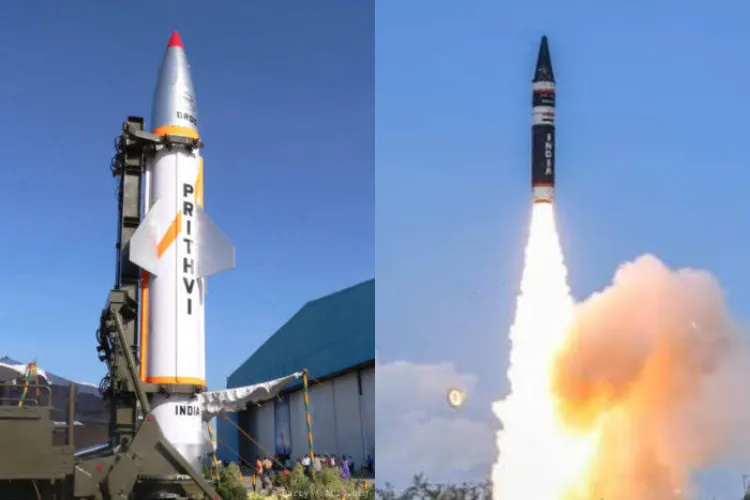
India Missile Test 2025: Prithvi-II and Agni-I ballistic missiles were successfully launched by Strategic Forces Command, enhancing India’s nuclear deterrence and defence preparedness.
India’s Dual Missile Test Strengthens Strategic Deterrence
Successful Night-Time Test of Prithvi‑II and Agni‑I
On July 17, 2025, India’s Strategic Forces Command (SFC) conducted simultaneous night-time user-training launches of two nuclear-capable short-range ballistic missiles (SRBMs)—Prithvi‑II and Agni‑I—from the Integrated Test Range, Chandipur, Odisha, and APJ Abdul Kalam Island. Both missiles met all mission objectives, validating their technical and operational readiness
Missile Capabilities and Specifications
- Prithvi‑II: A liquid-fuelled SRBM with a range of ~350 km and payload capacity of 500–1,000 kg; inducted in 2003 and regularly tested since
- Agni‑I: A solid-fuelled SRBM with a range of 700–1,200 km and payload capacity up to 1,000 kg; first launched in 2002 and designed to bridge the gap between Prithvi and medium-range missiles
Strategic Context and Symbolism
These dual tests took place shortly after Operation Sindoor (May 7–10, 2025), following cross-border hostilities, signaling India’s commitment to credible minimum deterrence and readiness to respond to regional threats, particularly from Pakistan
Indigenous Development and Technological Maturity
Developed by DRDO under the Integrated Guided Missile Development Programme, Prithvi and Agni missiles reflect India’s self‑reliance in strategic weapons. Standard user-training exercises, such as these tests, reinforce accuracy, guidance systems, and personnel proficiency
Regional Security Implications
In the backdrop of increasing strategic challenges along borders with Pakistan and China, India’s enhanced missile readiness reinforces deterrence across ranges—from low to intermediate, ensuring quick-strike capability and command control efficiency
Why This News Is Important
Heightened Strategic Posture
The dual test of Prithvi‑II (350 km) and Agni‑I (700–1,200 km) demonstrates India’s expanded capability to deliver quick, accurate nuclear or conventional strikes over tactical and operational distances. This achievement strengthens India’s nuclear triad by ensuring short-range missile systems remain fully operational as part of its credible minimum deterrent doctrine.
Message to Neighbors & Deterrence Signal
Timed after Operation Sindoor cross-border incidents, the tests are a clear diplomatic signal to Pakistan, reinforcing India’s readiness to deploy nuclear-capable missiles if necessary, and thereby enhancing strategic stability in South Asia.
Enhancing Exam-Relevant Themes
For aspirants of teaching, police, banking, railways, defence, and civil services, grasping government exam topics like missile range categories, defence doctrine, and India’s deterrence policy is crucial. This news enriches sections on defence preparedness, technology awareness, and current geopolitical scenarios.
Historical Context: From Prithvi to Agni
IGMDP Origins
The Integrated Guided Missile Development Programme (IGMDP), launched in 1983, aimed to develop indigenous missile systems. Prithvi was India’s first tactical SRBM, first tested in 1988, offering nuclear and conventional strike capability
Evolution and Induction
- Prithvi‑II entered service in 1996–2003 and underwent multiple tests, including night trials, culminating in the July 2025 training launch
- Agni‑I, conceptualized after the Kargil War to fill range gaps, began testing in 2002, and consistently demonstrated maturity through successive trials
Strategic Forces Command and Routine Drills
SFC, responsible for India’s nuclear missile arsenal, routinely conducts user trials to validate missile reliability. The July 17 dual-night test continues this long-standing practice of maintaining missile readiness.
Key Takeaways from India’s Dual Missile Test
| # | Key Takeaway |
|---|---|
| 1 | Dates & Launch Details: Prithvi‑II and Agni‑I were successfully test-fired on July 17, 2025, under SFC from Chandipur and Kalam Island |
| 2 | Missile Profiles: Prithvi‑II – ~350 km range, liquid-fuelled; Agni‑I – 700–1,200 km range, solid-fuelled, nuclear-capable |
| 3 | Strategic Deterrence: The launch strengthens India’s minimum deterrence and sends a calibrated message following Operation Sindoor |
| 4 | Indigenous Development: Both missiles were developed by DRDO under IGMDP, exemplifying India’s self-reliant defence capabilities |
| 5 | Operational Readiness: Night-time user trials are part of routine drills to ensure SFC teams and systems are mission-ready at all times |
FAQs: Frequently Asked Questions
Q1. What is the range of the Prithvi-II missile?
A: The Prithvi-II has a range of approximately 350 kilometers.
Q2. Is the Agni-I missile nuclear-capable?
A: Yes, Agni-I is a nuclear-capable short-range ballistic missile (SRBM).
Q3. Which organisation is responsible for the development of Prithvi and Agni missiles?
A: Both missiles were developed by the Defence Research and Development Organisation (DRDO) under the Integrated Guided Missile Development Programme (IGMDP).
Q4. What is the fuel type used in Agni-I?
A: Agni-I uses solid fuel propulsion.
Q5. Why were the recent missile tests conducted?
A: The tests were part of routine user-training exercises to validate operational readiness and demonstrate credible minimum deterrence.
Q6. When were the tests of Prithvi-II and Agni-I conducted?
A: The tests were conducted on 17 July 2025.
Q7. Which command oversaw the missile launches?
A: The Strategic Forces Command (SFC), which manages India’s nuclear arsenal.
Q8. What is the payload capacity of Prithvi-II?
A: It ranges between 500 to 1,000 kilograms.
Q9. What was the significance of conducting night-time trials?
A: Night-time trials help evaluate missile performance under limited visibility and simulate real-time combat conditions.
Q10. What is the role of SFC in India’s nuclear policy?
A: SFC is tasked with the operational command and control of India’s strategic nuclear forces to maintain deterrence and rapid response capability.
Some Important Current Affairs Links