








India Global Solar Initiatives 2025: At the 8th ISA Assembly in New Delhi, India launched major programmes like SUNRISE for solar recycling and OSOWOG for global grid connectivity, advancing its leadership in renewable energy and sustainable development.
India’s Major Push for Global Solar Leadership at ISA 2025
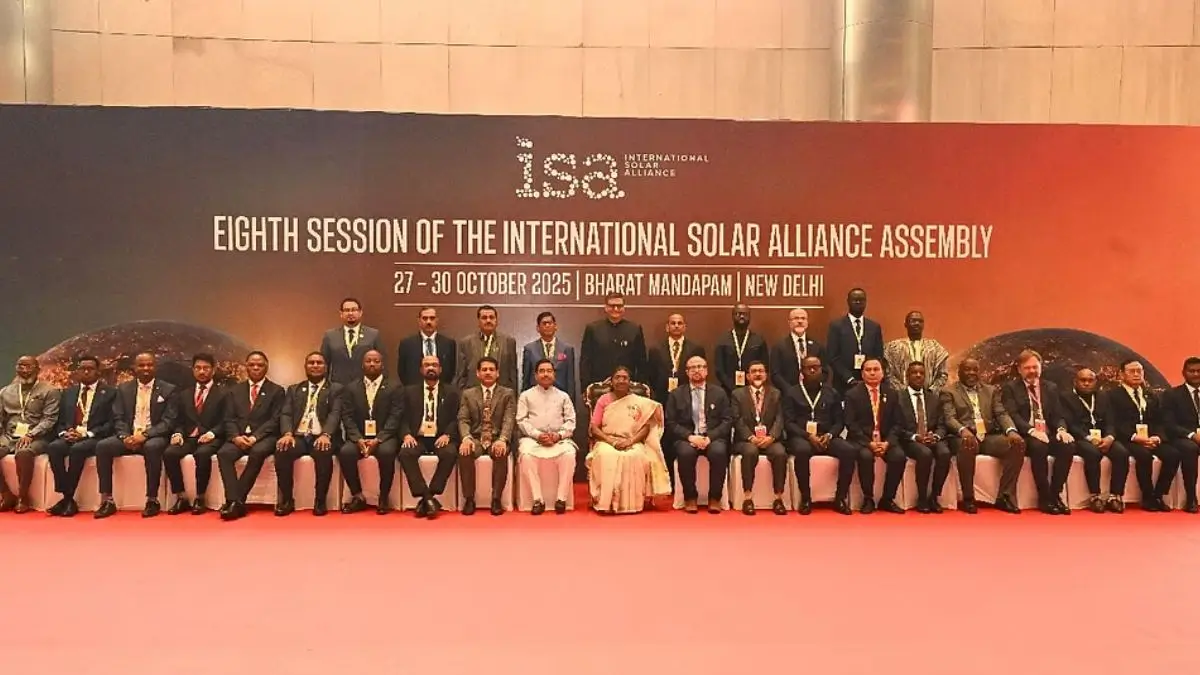
At the 8th assembly of the International Solar Alliance held on 28 October 2025 in New Delhi, India made a bold stride in the global clean-energy domain by unveiling a suite of initiatives aimed at accelerating solar access, innovation and sustainability worldwide. The Indian government described these programmes as central to a “people-first, inclusive solar revolution” and called on partner nations to join in a transition driven by circular economy practices, technological innovation and equitable access.
The flagship initiative “SUNRISE” (Solar Up-cycling Network for Recycling, Innovation & Stakeholder Engagement) addresses one of the emerging challenges for the solar industry: the management of end-of-life solar panels and associated electronic waste. Under this programme, India will promote recycling and up-cycling of decommissioned solar modules, create green manufacturing jobs and stimulate a circular economy around solar assets.
Another major launch is the expansion of the “OSOWOG” (One Sun One World One Grid) vision. This initiative envisages interconnected solar power grids spanning Asia, Middle East, Europe and Africa, enabling the trade of solar power across time zones, promoting round-the-clock renewable electricity and lowering carbon dependency through regional-scale cooperation.
Complementing these is the establishment of a Global Capability Centre (GCC) for solar research and innovation, together with the “ISA Academy” – an AI-powered learning platform designed to build global solar capacity, train professionals and foster startups in solar technologies.
In recognition of the specific energy-vulnerability of island nations, India also launched a procurement platform specially targeting Small Island Developing States (SIDS). With 16 SIDS signing an in-principle MoU, the platform pools their demand for solar systems, enabling low-cost resilient access to clean energy solutions tailored for islands in the Caribbean, Pacific and Indian Ocean regions.
Collectively, these initiatives mark India’s elevation from national solar actor to global solar orchestrator — seeking not just to deploy solar panels, but to shape the architecture of a global solar economy, emphasising inclusion, technology, innovation and sustainability.

Why This News Is Important
For Government Exam Aspirants
This announcement is highly relevant for students preparing for government exams (teaching, banking, railways, defence, civil services) because it characterises India’s strategic direction in energy, climate change, technology and international diplomacy. Understanding such developments equips candidates to answer questions about India’s global renewable-energy initiatives, multilateral cooperation, and climate-resilience strategies.
Strategic and Diplomatic Significance
By launching these initiatives at ISA 2025, India underscores its role as a global leader in clean energy and climate action. This matters not just for technology and economics, but also for foreign policy — connecting energy access, sustainable development and international cooperation. Exam questions often test the linkage between India’s domestic policy and its global commitments.
Relevance Across Sectors
The aspects of recycling/up-cycling (SUNRISE), grid connectivity (OSOWOG), capacity building (GCC/ISA Academy) and special focus on vulnerable regions (SIDS) highlight the cross-cutting themes of environment, innovation, infrastructure and inclusion. These are frequently featured in the syllabus of general studies, environment, science & technology, and even current-affairs sections across banking, railways, defence and civil-services exams.
Long-Term Impact
Understanding these initiatives helps anticipate future exam content — e.g., grid interconnectivity projects, solar recycling technologies, training programmes, island-states energy access. The news therefore offers both immediate relevance and long-term value in conceptual understanding.
Historical Context: Solar Diplomacy & India’s Renewable Journey
India has actively positioned itself in the renewable-energy domain for over a decade. The International Solar Alliance (ISA) was launched in 2015 by India and France, aiming to promote solar deployment across member nations in the sun-belt (particularly tropical countries). This organisation has grown significantly in membership and ambition.
Domestically, India has committed to ambitious targets for solar capacity under its National Solar Mission, part of the National Action Plan on Climate Change. Over recent years, solar tariffs have fallen dramatically and India has become a major manufacturer and installer of solar panels.
On the multilateral front, India has promoted the One Sun One World One Grid (OSOWOG) concept previously, reflecting its vision of interconnected clean-energy systems. The global context of climate change, the Paris Agreement commitments, decarbonisation pathways and the push for circular economy have all framed the backdrop to ISA 2025’s announcements.
Similarly, the need for recycling end-of-life solar panels has emerged as a critical issue as earlier phases of solar deployment age — especially with India’s large and growing fleet of solar installations. The new SUNRISE initiative signals India’s pre-emptive move into this next stage.
Small Island Developing States (SIDS) have long been identified as vulnerable to climate change and energy-security challenges. Traditionally reliant on fossil-fuel imports, these nations increasingly look for resilient renewable solutions. India’s platform aligns with global efforts to support SIDS through clean-energy financing and technology transfer.
Overall, ISA 2025 builds on these historical trends and signals a new era of solar diplomacy where India not only deploys solar energy domestically, but exports frameworks, capacity-building and system architecture globally.
Key Takeaways from India’s Global Solar Initiatives at ISA 2025
| S. No. | Key Takeaway |
|---|---|
| 1 | The 8th ISA Assembly held on 28 October 2025 in New Delhi. |
| 2 | India launched the SUNRISE initiative focusing on solar-panel recycling, up-cycling and circular innovation. |
| 3 | The OSOWOG (One Sun One World One Grid) initiative aims to interconnect solar grids across Asia, Middle East, Europe and Africa. |
| 4 | A Global Capability Centre for solar innovation and the ISA Academy for AI-powered solar training were announced to build worldwide solar capacity. |
| 5 | A procurement platform for Small Island Developing States (SIDS) was launched, with 16 SIDS signing in-principle MoUs, to enable low-cost resilient solar systems for islands. |
FAQs – Frequently Asked Questions
Q1. What is the International Solar Alliance (ISA)?
The International Solar Alliance is an intergovernmental organization launched jointly by India and France in 2015 to promote the use of solar energy among countries located between the Tropic of Cancer and the Tropic of Capricorn.
Q2. When and where was the 8th ISA Assembly held?
The 8th ISA Assembly was held on 28 October 2025 in New Delhi, India.
Q3. What is the SUNRISE initiative announced by India?
The SUNRISE (Solar Up-cycling Network for Recycling, Innovation & Stakeholder Engagement) initiative focuses on recycling and up-cycling used solar panels to promote a circular economy and create green employment opportunities.
Q4. What does the OSOWOG project aim to achieve?
The “One Sun One World One Grid” project envisions interlinking solar power grids across multiple regions—Asia, Africa, the Middle East and Europe—to facilitate global renewable-energy trade and ensure round-the-clock solar power.
Q5. How does India’s new platform support Small Island Developing States (SIDS)?
The platform helps SIDS procure affordable solar systems through bulk-demand aggregation and shared financing, enhancing energy resilience for island nations vulnerable to climate change.
Q6. What is the Global Capability Centre (GCC) in the ISA 2025 context?
The GCC is a research and innovation hub established to develop solar technologies, foster startups and enhance collaboration between nations and industry partners.
Q7. What is the significance of the ISA Academy?
ISA Academy is an AI-enabled training and capacity-building platform for professionals in solar-energy technologies worldwide.
Q8. How many Small Island Developing States signed the MoU at ISA 2025?
A total of 16 SIDS signed the in-principle Memorandum of Understanding for the solar procurement platform.
Q9. How is ISA 2025 relevant for government-exam aspirants?
It links to key syllabus themes—environmental governance, renewable energy policy, international relations, and India’s role in sustainable development—often covered in General Studies and current-affairs sections.
Q10. What role does India play in global solar diplomacy?
India serves as a leading advocate for global solar cooperation, promoting affordable, accessible and sustainable energy through multilateral platforms like ISA and initiatives like OSOWOG.
Some Important Current Affairs Links