


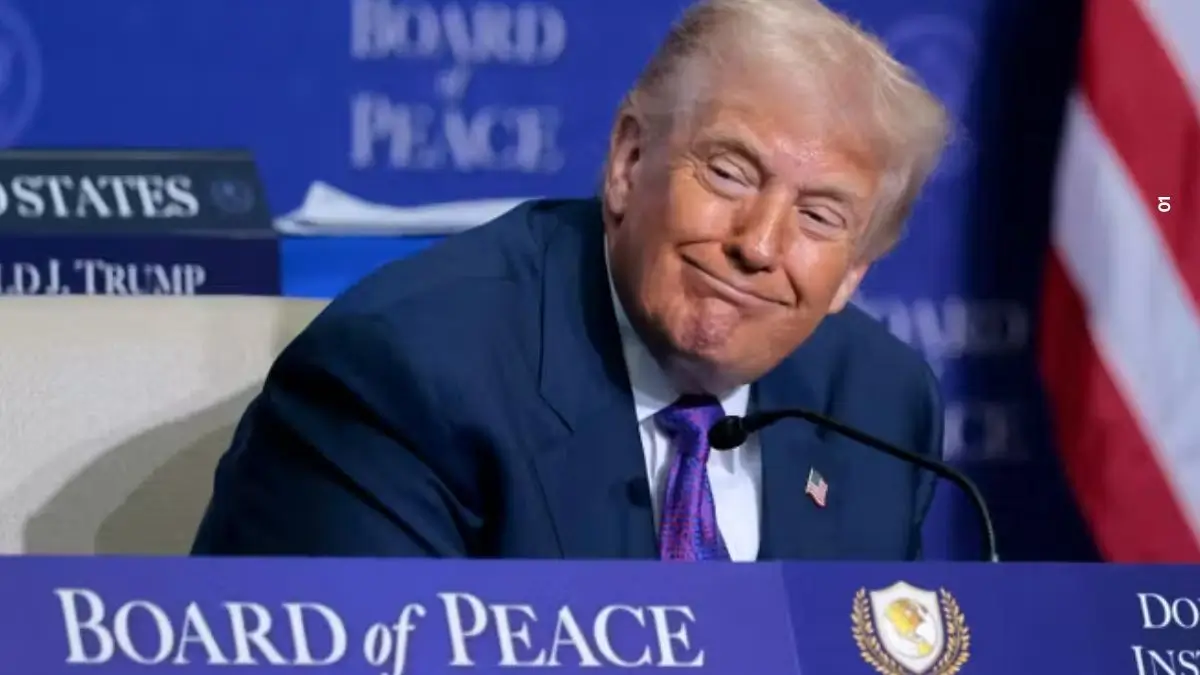
India Gaza peace observer: India attended Donald Trump’s Board of Peace meeting as an observer, highlighting its strategic diplomacy, balanced foreign policy, and role in international peace initiatives.
India Attends Donald Trump’s Gaza Peace Board Meeting as Observer: A Strategic Diplomatic Move
In a significant development in global diplomacy, India attended the inaugural meeting of the Gaza Peace Board hosted by Donald Trump in Washington, D.C., as an observer nation. This meeting, convened on February 19, 2026, was a high‑level international gathering focused on advancing peace, reconstruction, and stability in the Gaza Strip following the conflict between Israel and Hamas.
Unlike many countries that joined as full members, India chose observer status, participating in discussions without formally becoming part of the Board’s decision‑making body. India’s representation was led by Namgya C. Khampa, a veteran officer of the Indian Foreign Service (IFS) serving as Charge d’Affaires at the Indian Embassy in Washington, highlighting the diplomatic importance India places on this engagement.
Board of Peace Initiative and Its Global Context
The Board of Peace was proposed by former U.S. President Donald Trump as a diplomatic platform to address the ongoing humanitarian and political issues in Gaza and other conflict zones. Its primary aim is to support ceasefire implementation, coordinate reconstruction efforts, and enhance regional stability through multilateral cooperation. Over 40 countries and international entities attended the first meeting either as members or observers, reflecting broad international interest.
At the Washington meeting, significant financial commitments were announced. Trump pledged USD 10 billion in support of peace and reconstruction efforts, while several participating nations collectively pledged billions more for humanitarian aid and security support as part of the broader Gaza peace plan. The initiative also discussed strategies for deploying multinational stabilization forces and rebuilding civil infrastructure in the war‑torn region.
Why India Opted for Observer Status
India’s calculated decision to participate as an observer rather than a full member underscores its balanced foreign policy approach. India supports peace in West Asia and has historically advocated for a two‑state solution between Israel and Palestine. Attending as an observer allows India to engage in discussions with global powers while maintaining strategic autonomy and avoiding alignment with any single bloc or framework.
Furthermore, India’s approach reflects its longstanding commitment to multilateralism and a UN‑centric peace process. Rather than being part of an ad‑hoc body, India seeks to strengthen established international institutions and norms. This careful diplomacy preserves India’s diplomatic flexibility across the Middle East and global forums.
Implications for India’s Global Diplomacy
India’s presence at the Board of Peace meeting comes at a time when geopolitical tensions in the Middle East remain volatile. By engaging as an observer, India has reaffirmed its role as a responsible global stakeholder willing to contribute to peace initiatives without compromising its core diplomatic principles. The move also strengthens India’s strategic engagement with the United States and other influential nations while upholding its independent foreign policy.
This participation has implications not only for India’s foreign policy but also for aspirants preparing for UPSC, CDS, SSC, banking, railways, and other government exams, as it highlights India’s evolving diplomatic strategies in complex global conflict environments.

Why This News Is Important for Government Exam Aspirants
The story of India participating as an observer at Donald Trump’s Board of Peace meeting is crucial current affairs knowledge for competitive exams like UPSC Civil Services, SSC CGL, banking and railways, CDS, IBPS PO, and state PSCs due to several reasons:
Understanding India’s Foreign Policy Strategy
India’s choice to attend as an observer, rather than a full member, highlights its strategic autonomy in international relations. This reflects India’s traditional diplomatic stance — engaging constructively with global powers while preserving its national interests and avoiding entanglement in potentially polarising alliances. Such nuances are often tested in the International Relations section of exams.
Gaza Conflict and Global Diplomacy
The ongoing conflict in Gaza and efforts for reconstruction and peace are major global issues covered under international affairs. Recognising India’s role — albeit as an observer — helps aspirants frame nuanced answers in GS Paper II (International Relations) and essay questions related to peace initiatives, multilateral diplomacy, and conflict resolution.
Multilateral Institutions and Ad‑Hoc Mechanisms
India’s preference for UN‑centric mechanisms over ad‑hoc bodies provides insight into its diplomatic priorities. Understanding this helps aspirants answer questions concerning India’s approach to organisations like the United Nations and other global platforms.
Broader Geopolitical Implications
This news demonstrates how India balances relations with global powers such as the United States, while maintaining its principles. It is relevant for topics on foreign policy, strategic diplomacy, and global governance, which frequently appear in UPSC and PCS exam syllabi.
Historical Context: India and Peace Initiatives in West Asia
India’s engagement in West Asian peace processes has historical roots and strategic importance. Since the mid‑20th century, India has maintained diplomatic relations with both Israel and Arab nations. It supported Palestinian self‑determination while strengthening bilateral ties with Israel post‑1992. India’s balanced approach aimed to secure energy interests, diaspora safety, and regional stability.
The Gaza conflict, which intensified following the 2023 hostilities between Israel and Hamas, prompted global diplomatic efforts for a ceasefire and reconstruction. In October 2025, a peace framework was agreed upon, aiming to end hostilities and lay down steps for rebuilding Gaza. In line with this, Trump’s Board of Peace was proposed as a new platform to guide reconstruction and ensure sustained peace. India’s participation, therefore, fits into its broader foreign policy trajectory of advocating peace through dialogue while supporting established international norms.
Key Takeaways from India Attends Trump’s Gaza Peace Board Meeting as Observer
| S. No. | Key Takeaway |
|---|---|
| 1. | India attended the inaugural Board of Peace meeting hosted by Donald Trump as an observer nation in Washington, D.C. |
| 2. | The meeting focused on peace and reconstruction efforts for the Gaza Strip and involved over 40 countries and entities. |
| 3. | India participated through Namgya C. Khampa, indicating strong diplomatic representation. |
| 4. | India’s observer status reflects its balanced diplomacy and strategic autonomy, avoiding full membership. |
| 5. | The initiative forms part of broader efforts to address global conflicts but remains distinct from UN‑led peace mechanisms. |
FAQs: Frequently Asked Questions
1. What is the Board of Peace initiated by Donald Trump?
The Board of Peace is a diplomatic initiative proposed by former U.S. President Donald Trump to facilitate peace, reconstruction, and stability in the Gaza Strip, involving multiple countries and international organizations. Its main aim is to coordinate humanitarian aid, ceasefire implementation, and post-conflict reconstruction.
2. Why did India attend the Board of Peace meeting as an observer?
India chose observer status to maintain its strategic autonomy, engage in global diplomatic discussions, and support peace initiatives without aligning fully with any single bloc or ad-hoc mechanism. This aligns with India’s balanced foreign policy approach in West Asia.
3. Who represented India at the Board of Peace meeting?
India was represented by Namgya C. Khampa, a senior Indian Foreign Service (IFS) officer, serving as Charge d’Affaires at the Indian Embassy in Washington, D.C.
4. How many countries participated in the inaugural Board of Peace meeting?
Over 40 countries and international organizations attended the first meeting, either as full members or observers, reflecting global interest in the Gaza peace process.
5. How does this news relate to India’s foreign policy?
India’s participation highlights its commitment to multilateral diplomacy, a UN-centric peace process, and strategic engagement with global powers while maintaining independent decision-making in conflict resolution and humanitarian initiatives.
6. What are the potential implications of this meeting for India?
It strengthens India’s diplomatic engagement with the U.S. and other influential nations, enhances its role as a responsible global stakeholder, and reflects India’s nuanced approach to global conflict resolution.
7. What financial commitments were made during the meeting?
Donald Trump pledged USD 10 billion for Gaza’s reconstruction and peace efforts, while other participating countries also pledged additional support for humanitarian and security initiatives.
Some Important Current Affairs Links




