




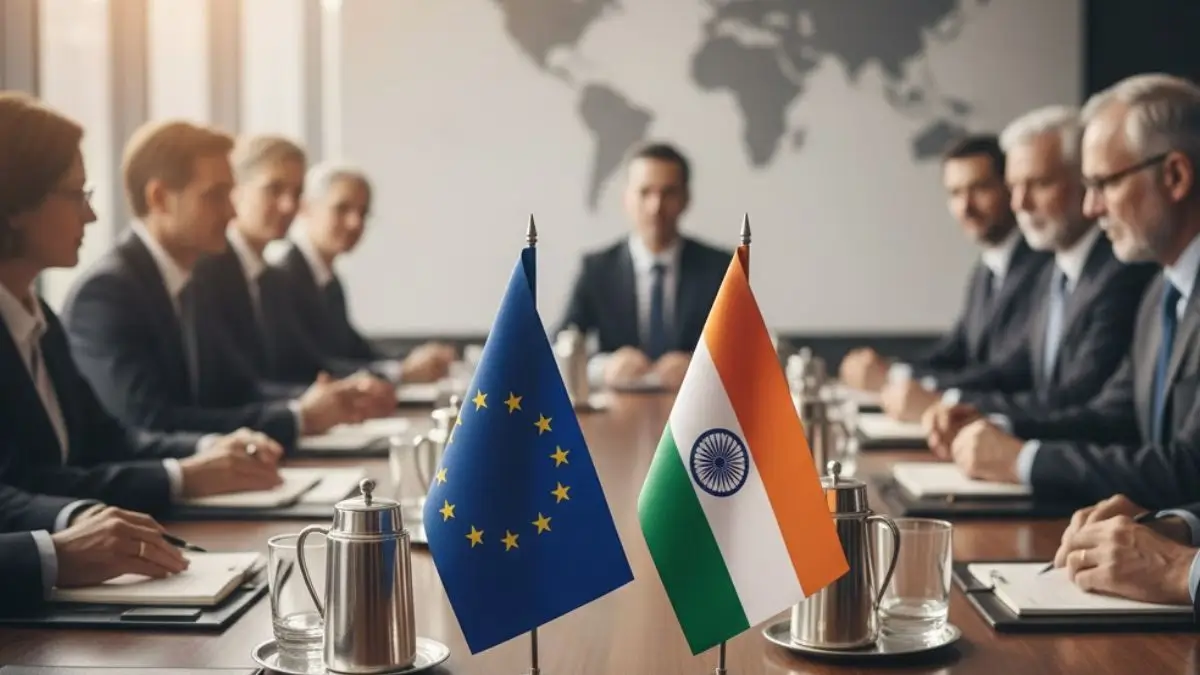
India EU Trade Summit 2026 highlights key updates on the Free Trade Agreement, defence cooperation, and mobility framework. Important for government exams and current affairs preparation.
India-EU Summit 2026: A Strategic Turning Point in Trade, Defence & Mobility Cooperation
The 16th India-European Union (EU) Summit 2026 held in New Delhi on January 27, 2026 has entered a decisive phase, marking a potential milestone in diplomatic and economic relations between India and the EU. Hosted immediately after India’s 77th Republic Day celebrations, this summit is poised to conclude long-pending negotiations on a landmark Free Trade Agreement (FTA) while broadening cooperation in defence, security and people-to-people mobility.
High-Profile Diplomacy and Globe-wide Attention
The summit’s significance has been underlined by the presence of top EU leadership, including European Commission President Ursula von der Leyen and European Council President António Costa at the Republic Day festivities and summit meetings. This is the first time EU leaders attended as chief guests, reflecting the deepening political trust and strategic alignment between India and the EU—an alliance representing over two billion people and one-quarter of global GDP.
Expected Conclusion of India-EU Free Trade Agreement
The India-EU Free Trade Agreement has been under negotiation since 2007, suspended for nearly a decade, and revived in 2022. The summit is expected to officially conclude these talks and set the stage for legal vetting and ratification processes. The FTA aims to reduce tariffs, enhance market access, and boost bilateral trade and investment. Trade sectors likely to benefit include automobiles, wines and spirits, pharmaceuticals, and steel—though some climate-linked mechanisms like the Carbon Border Adjustment Mechanism (CBAM) still remain contentious.
Enhanced Security and Defence Cooperation
Another key focus of the summit is the establishment of a Security and Defence Partnership (SDP) between India and the EU. This cooperation is expected to enhance joint military coordination, interoperability and information sharing, while creating opportunities for Indian defence manufacturers in Europe’s advanced defence ecosystem. Discussions also include a potential Security of Information Agreement (SOIA) to support secure classified data exchange.
Mobility Framework for Skilled Workers and Students
India and the EU are also expected to launch a Mobility Framework aimed at facilitating legal migration pathways for skilled workers, researchers and students. This is critical for addressing labour market needs in Europe while providing opportunities for Indian youth in education and employment sectors, encouraging stronger people-to-people ties.
Strategic Importance & Global Trade Context
The summit comes at a time of shifting global trade dynamics, with countries diversifying supply chains amid geopolitical tensions. Completing the FTA would not only restore lost tariff concessions on Indian exports but also position India as a more resilient partner in the global economy.

Why This News Is Important for Government Exam Aspirants
Global Diplomatic Landscape & India’s Strategic Role
The India-EU Summit 2026 underscores India’s evolving global stature as a key strategic partner of the European Union. Successfully concluding the Free Trade Agreement and enhancing defence and mobility cooperation elevates India’s geopolitical influence, an important topic for exams like UPSC, PCS and other competitive exams where international relations and diplomacy are tested.
Economic Implications and Policy Knowledge
For aspirants of Banking, SSC, Railways and Civil Services, understanding the economic impact of such a summit is crucial. The FTA is expected to reduce trade barriers, potentially increase exports, attract foreign investment, and reshape market access for Indian industries. These developments often influence banking policies, foreign exchange trends, and industry regulations—topics frequently covered in economics and GS papers.
Security & Defence Cooperation
The expanding security and defence cooperation with the EU is significant for aspirants of Defence services, CAPF and related government jobs. India’s engagement with global partners in maritime security, cyber defence and coordination mechanisms highlights modern defence diplomacy—an important dimension of current affairs in exam syllabi.
People-to-People Mobility and Human Resource Policies
With talks on mobility frameworks promoting skilled migration and education access, this summit affects youth employment and international student prospects—relevant to aspirants preparing for policy interpretation questions and societal development issues in competitive exams.
Contextual Relevance Across Sectors
This summit intertwines international relations, trade economics, strategic studies, migration policies, and diplomatic history, offering rich material for essay writing, descriptive answers and MCQ sections across various exams.
Historical Context: India-EU Relations & the Long Road to 2026
Origins of India-EU Strategic Partnership
India and the European Union officially began strategic dialogue decades ago, aiming to enhance cooperation in political, economic and cultural spheres. The relationship matured through shared commitments to democratic values, trade cooperation, and multilateralism.
The Free Trade Agreement Journey
Negotiations for an India-EU Free Trade Agreement (FTA) started in 2007, but were suspended in 2013 due to disagreements over tariffs, non-tariff barriers, and regulatory issues. Talks resumed in 2022, reflecting renewed urgency to strengthen economic integration amid global trade shifts.
Evolving Security & Defence Cooperation
Over the years, defence and security cooperation deepened through joint exercises, collaborative dialogues on maritime security, cyber threats and counterterrorism. This has laid the groundwork for the current Security and Defence Partnership expected to be formalised in 2026.
People-to-People Exchanges & Mobility Talks
India’s growing youth demographic and skilled workforce have been central to discussions on mobility and migration with the EU, especially in sectors facing labour shortages in Europe. These talks now form a key element of the summit agenda.
Key Takeaways from India-EU Summit 2026: Trade, Defence & Mobility Talks
| S. No. | Key Takeaway |
|---|---|
| 1 | The 16th India-EU Summit was held in New Delhi on January 27, 2026, following India’s Republic Day celebrations. |
| 2 | A long-pending India-EU Free Trade Agreement is expected to be concluded and later ratified. |
| 3 | Security and Defence Cooperation is set to expand through a new partnership and information sharing agreements. |
| 4 | Discussions include a mobility framework benefiting skilled workers, students, and researchers. |
| 5 | The summit strengthens India’s geopolitical influence, impacting trade policy, international relations and economic strategy. |
FAQs: Frequently Asked Questions
1. What is the India‑EU Summit 2026?
The India‑EU Summit 2026 is the 16th high-level meeting between India and the European Union, held on January 27, 2026, in New Delhi. It focuses on trade, defence, and mobility cooperation.
2. Who were the key participants in the summit?
Key participants included European Commission President Ursula von der Leyen, European Council President António Costa, and top Indian leaders including the Prime Minister of India.
3. What is the significance of the India‑EU Free Trade Agreement?
The FTA aims to reduce tariffs, improve market access, and boost bilateral trade in sectors such as automobiles, pharmaceuticals, steel, and wines & spirits, strengthening economic relations.
4. What are the defence and security initiatives discussed at the summit?
The summit proposed a Security and Defence Partnership, including joint military coordination, information sharing, and potential agreements for secure classified data exchange.
5. What is the Mobility Framework between India and EU?
The Mobility Framework facilitates legal migration pathways for skilled workers, researchers, and students, enhancing employment, education opportunities, and people-to-people ties.
6. How does this summit impact India’s global position?
It strengthens India’s geopolitical influence, positioning the country as a strategic partner of the EU, and enhances trade, defence, and technological cooperation.
7. When did India and the EU start negotiating the Free Trade Agreement?
FTA negotiations began in 2007, paused in 2013 due to disagreements, and resumed in 2022, aiming to finalize during the 2026 summit.
8. Which sectors in India are expected to benefit most from the FTA?
Sectors like automobiles, pharmaceuticals, steel, wine and spirits are expected to benefit significantly from tariff reductions and market access.
9. Why is the summit important for students and aspirants of government exams?
It covers topics on international relations, trade, security policies, mobility frameworks, and economic diplomacy, which are frequently tested in UPSC, SSC, Banking, Railways, and Defence exams.
10. What is the historical context of India‑EU relations?
India and the EU have had a strategic partnership for decades, focusing on political, economic, and cultural cooperation, with growing trade and security engagements leading up to the 2026 summit.
Some Important Current Affairs Links