






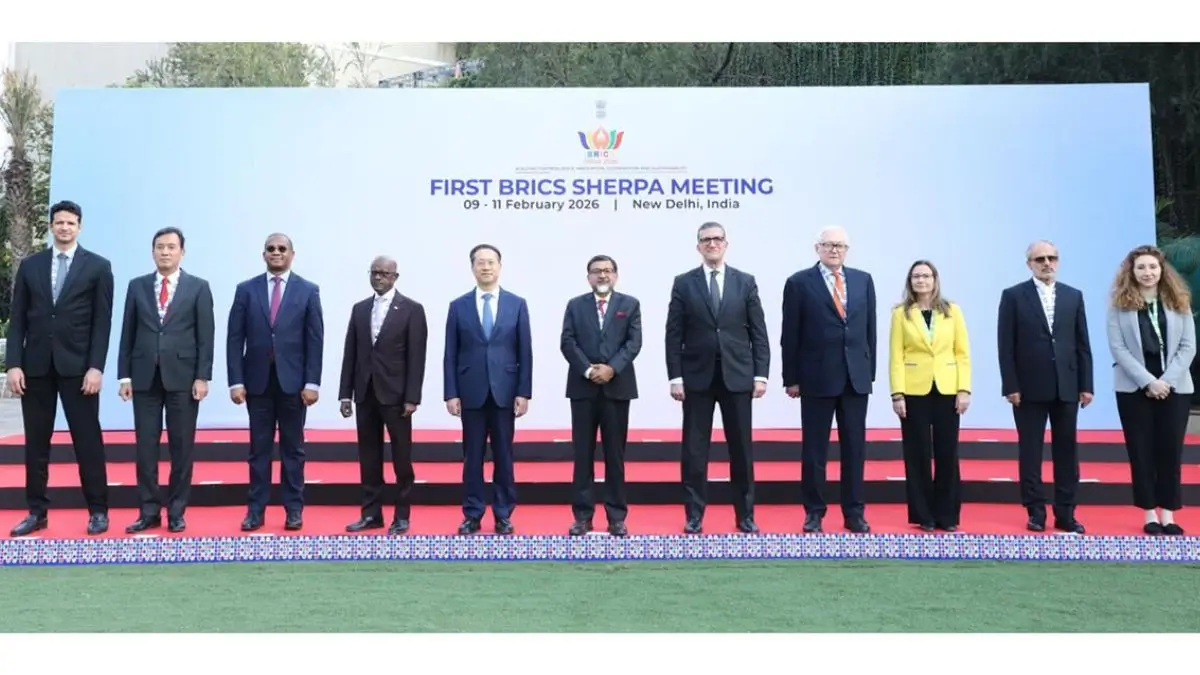
India BRICS Sherpas Meeting 2026 highlights India’s chairship priorities, global cooperation agenda, and key facts important for UPSC, SSC, banking, and state PSC exams.
India Hosts First BRICS Sherpas Meeting 2026: Strategic Priorities Under Its Chairship
India Initiates BRICS 2026 Chairship With Sherpas & Sous-Sherpas Meeting
India has formally kicked off its BRICS (Brazil, Russia, India, China, South Africa) Chairship for the year 2026 by hosting the first BRICS Sherpas and Sous-Sherpas Meeting in New Delhi from 9–10 February 2026.
The meeting, chaired by Sudhakar Dalela, India’s BRICS Sherpa and Secretary (Economic Relations), brought together high-level representatives from all member countries including Brazil, China, Egypt, Ethiopia, Indonesia, Iran, Russia, Saudi Arabia, South Africa, and the United Arab Emirates (UAE).
Participants also included senior officials from partner nations and Indian policy-making circles, underscoring New Delhi’s commitment to robust and cooperative international dialogue.
Theme and Strategic Priorities of India’s Chairship
Under its chairship, India unveiled the central theme for the 2026 BRICS cycle:
📌 “Building for Resilience, Innovation, Cooperation and Sustainability.”
This theme aims to reinforce BRICS as an inclusive forum tackling global challenges such as climate change, economic disruption, technological gaps, and geopolitical instability. India’s “people-centric” approach integrates the welfare of citizens into diplomatic and economic agendas, expanding beyond purely geopolitical interests.
Multidimensional Focus Areas Discussed
During the Sherpas meeting, detailed discussions were held on sectoral priorities that are expected to shape policy exchanges throughout India’s chairship:
- Health Cooperation & Pandemic Preparedness
- Agriculture & Food Security
- Environment & Climate Change Initiatives
- Innovation and ICT Expansion
- Economic and Financial Synergies
- Security & Counter-terrorism Collaboration
- Labour, Employment & Disaster Risk Management
All these areas will guide successive working group sessions and high-level discussions through 2026.
People-Centric Initiatives and Cultural Engagements
Unlike traditional geopolitical forums, India’s chairship prioritises “people-oriented” engagement, evident through proposals for cooperative activities like:
- BRICS Youth Forums & Cultural Exchanges
- Sports and Academic Linkages
- Civil Society and Business Alliance Platforms
This strategy aims to strengthen interpersonal ties among member nations, fostering collaboration beyond government corridors into societal and professional spaces.
Significance of the Meeting Ahead of the BRICS Summit
The Sherpas meeting sets the groundwork for India’s broader role ahead of the main BRICS Summit later in 2026. By coordinating across thematic tracks and outlining a comprehensive agenda early, India has positioned itself to influence global affairs through the BRICS platform—especially as the group celebrates two decades of cooperation.

Why This News Is Important for Competitive Exams
Geopolitical Significance
India’s role as the BRICS Chair in 2026 is a critical development in international geopolitics and global governance. BRICS represents a coalition of influential emerging economies—collectively accounting for a large share of the world’s population, GDP and trade. India’s leadership in this forum places it at the forefront of discussions around global economic coordination, sustainable development, and multilateral diplomacy—topics highly relevant for administrative, diplomatic, and strategic segments of civil services, defence, and foreign policy studies.
Global Economic & Strategic Priorities
The priorities outlined during the Sherpas meeting—especially resilience, innovation, cooperation and sustainability—reflect major themes in global exams such as UPSC, SSC, and state PCS syllabi. Questions related to BRICS often examine international cooperation frameworks, geopolitical influence, and India’s foreign policy objectives. India’s strategic agenda, including engagement on health, climate change, technology, and economic integration, provides direct content for such questions.
Domestic and International Policy Integration
Understanding India’s Chairship priorities helps students answer analytical questions on how international positions align with domestic policy frameworks like innovation ecosystems, disaster risk strategies, and multilateral diplomacy. It also demonstrates how multilateral forums can expand beyond economic cooperation to include social and cultural dimensions—a key insight for long-form answers in exams like UPSC mains.
Historical Context: BRICS and India’s Growing Leadership
Formation and Evolution of BRICS
The BRICS grouping began in 2006 as “BRIC” (Brazil, Russia, India, China), aimed at creating a platform for emerging economies to consolidate influence in global economic governance. South Africa joined in 2011, transforming it into BRICS. Over the years, BRICS has evolved into a forum not just for economic cooperation, but also for political and strategic dialogue.
Expansion and Institutional Growth
In 2024–25, BRICS expanded its membership to include Egypt, Ethiopia, Iran, UAE, and Indonesia, significantly broadening its geopolitical footprint. With this expansion, BRICS now represents diverse regions across Asia, Africa, and the Middle East, signaling a shift towards more inclusive global governance.
India’s Previous Role and Chairship Legacy
India has held the BRICS presidency previously, notably in 2016 and 2021. Each tenure allowed New Delhi to shape the agenda on global economic cooperation and policy harmonisation. The 2026 chairship comes at a time when the world is navigating complex challenges—from post-pandemic recovery to digital transformations—providing India an opportunity to push for a people-centric multilateral order.
Key Takeaways from “India Hosts First BRICS Sherpas Meeting 2026”
| S. No. | Key Takeaway |
|---|---|
| 1. | India hosted the first BRICS Sherpas and Sous-Sherpas Meeting in New Delhi as part of its 2026 chairship. |
| 2. | The meeting focused on the theme “Building for Resilience, Innovation, Cooperation and Sustainability.” |
| 3. | Participants included senior representatives from BRICS member and partner countries. |
| 4. | Key discussion areas were health, agriculture, environment, security, ICT, and economic cooperation. |
| 5. | India emphasised a people-centric and humanity-first approach in its BRICS agenda for 2026. |
FAQs: India Hosts First BRICS Sherpas Meeting 2026
1. What is the purpose of the BRICS Sherpas Meeting?
The BRICS Sherpas Meeting is a preparatory diplomatic forum where representatives (Sherpas) of member countries coordinate agendas, negotiate priorities, and set the groundwork for ministerial meetings and the BRICS Summit.
2. Which country is chairing BRICS in 2026?
India is chairing BRICS in 2026 and hosted the first Sherpas and Sous-Sherpas Meeting in New Delhi as part of its leadership responsibilities.
3. What are the key priorities of India’s BRICS 2026 chairship?
India’s chairship focuses on resilience, innovation, cooperation, sustainability, health collaboration, climate action, economic cooperation, and people-centric initiatives.
4. Why is BRICS important for India’s foreign policy?
BRICS strengthens India’s role in global governance, promotes South-South cooperation, and supports economic and diplomatic collaboration among emerging economies.
5. Who are the members of the BRICS grouping?
The core members include Brazil, Russia, India, China, and South Africa, with recent expansion adding countries from Africa and the Middle East.
6. How is this news relevant for competitive exams?
It is important for sections on international relations, India’s foreign policy, global organizations, and current affairs in exams like UPSC, SSC, Banking, Defence, and State PSCs.
7. What does the term “Sherpa” mean in diplomacy?
A Sherpa is a high-level official appointed by a country to represent it in international negotiations and preparatory meetings.
8. What theme guides India’s BRICS 2026 chairship?
The theme emphasizes resilience, innovation, cooperation, and sustainability to address global challenges.
Some Important Current Affairs Links




