








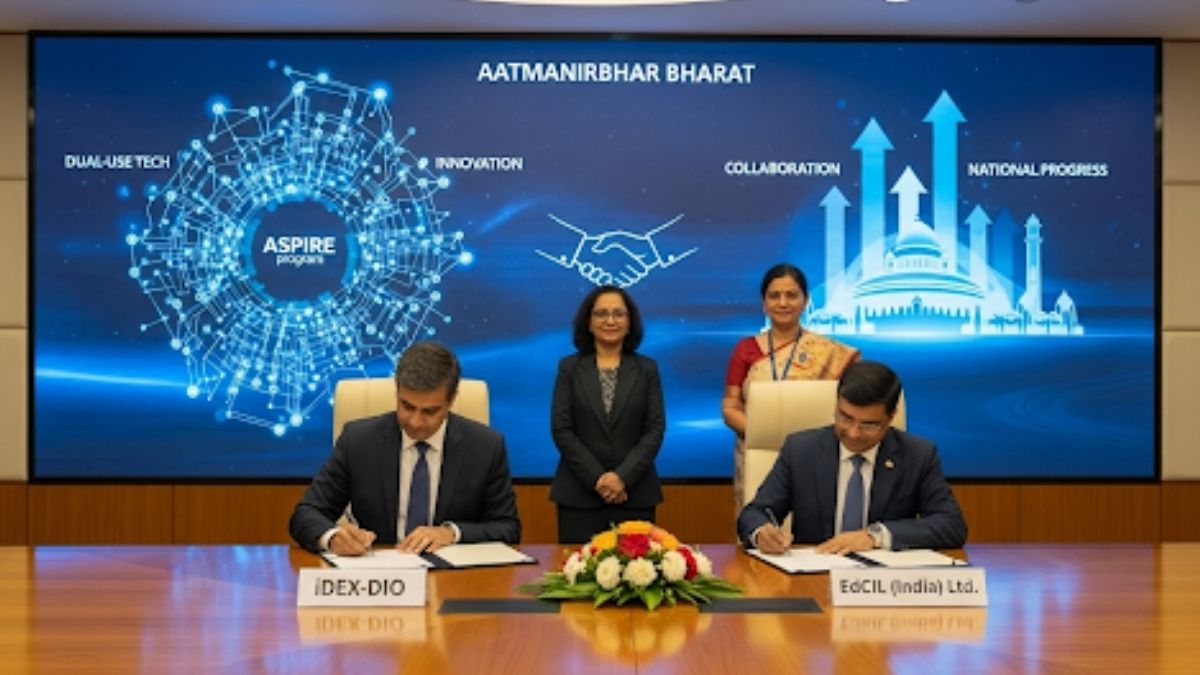
ASPIRE program: iDEX-DIO and EdCIL sign MoU to promote dual-use technologies in India, fostering innovation, education, and defence collaborations for startups and indigenous solutions.
iDEX-DIO and EdCIL Join Hands Under ASPIRE to Promote Dual-Use Tech Innovations
Partnership for Innovation and Dual-Use Technologies
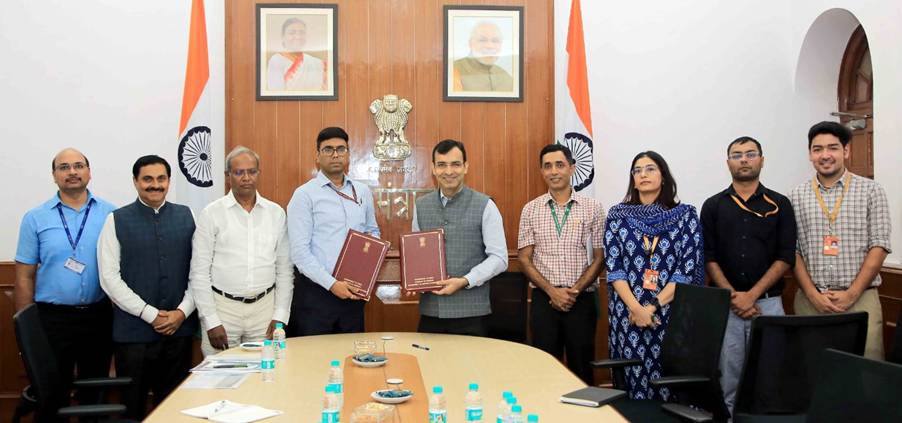
On 9 September 2025, the Government of India witnessed the signing of a Memorandum of Understanding (MoU) between Innovations for Defence Excellence – Defence Innovation Organisation (iDEX-DIO) and EdCIL (India) Limited. The agreement aims to launch the ASPIRE program, which stands for Accelerating Strategic Progress in Research and Education. Through this collaboration, the two organisations will push the frontiers of dual-use technologies — that is, technologies which have both civilian and defence applications.
Who Are the Stakeholders
- iDEX-DIO is a flagship initiative under the Ministry of Defence, focusing on fostering innovation, especially from startups and other tech-driven entities in defence.
- EdCIL (India) Limited, a Mini Ratna Category-I Central Public Sector Enterprise under the Ministry of Education, has strong expertise in educational technology (ed-tech), project management, and consultancy services in education. It serves both domestic and international clients.
Objectives of the ASPIRE Program
The ASPIRE program under this MoU has several goals:
- Extend the iDEX innovation model beyond purely defence sectors into the civilian/educational domain.
- Leverage EdCIL’s strengths in ed-tech solutions, education project implementation, and consultancies to support innovations with higher social impact.
- Tap into India’s startup ecosystem to encourage scalable, impactful innovations that can be used both in defence and civilian sectors.
Signatories and Ceremony Details
The MoU was signed in New Delhi. The key persons involved were:
- Shri Amit Satija, Joint Secretary (DIP) & Additional CEO, DIO.
- Shri Govind Jaiswal, Joint Secretary (TEL), Ministry of Education & CMD, EdCIL.
EdCIL’s Growth & Relevance
EdCIL has shown considerable growth over the past decade, marking a compounded annual growth rate (CAGR) of approximately 24% from FY 2014-15 to FY 2023-24, with its revenue increasing from about ₹74 crore to ₹655 crore. This scaling underscores its capacity to partner in large, cross-sectoral innovation programmes.
Why This News Is Important
Bridging Civil and Defence Sectors
This MoU under ASPIRE is significant because it blurs the traditional line between civilian innovation and defence innovation. In government exams, questions often test knowledge of how India is enhancing its defence readiness not just through military procurement but by cultivating home-grown technology in synergy with education, startups, and private sector. This move exemplifies that policy direction.
Encouraging Start-ups & Innovation Ecosystem
The partnership boosts the role of India’s startup and innovation ecosystem in defence-relevant technologies. For students preparing for exams, knowing government priorities (like supporting dual-use tech, localization, “Make in India”) is critical, since it aligns with many recent policies and is likely to appear in current affairs / essay / interview-round questions.
Strengthening Self-Reliance & Indigenous Capability
With India emphasising self-reliance (Aatmanirbhar Bharat), this kind of collaboration helps reduce foreign dependency. Understanding initiatives like ASPIRE will help exam-takers connect dots between policy statements and concrete actions taken by ministries.
Relevance to Education Sector & Tech Policy
Since EdCIL is from the education sector and $iDEX-DIO$ from defence, the ASPIRE program is situated at the intersection of these two critical arms of government policy: education & security. Students in teaching positions, civil service (especially educational administration), defence services, banking (as they often need to evaluate risk and tech trends) will find this news useful.
Historical Context
Rise of Dual-Use Technology in India’s Policy
Over the last decade, India has increasingly emphasised dual-use technologies — i.e. innovations that serve both civilian and defence purposes. This is seen in policies such as Defence Acquisition Procedure (DAP), Defence Production Policy, and the establishment of the iDEX scheme itself to promote indigenous defense tech.
EdTech’s Growing Role
Meanwhile, EdTech has expanded rapidly in India, especially since the COVID-19 pandemic. Government entities like EdCIL have increasingly become central in implementing education technology initiatives, remote learning, digital classrooms, etc. The synergy of ed-tech and defence innovation is a newer trend, but built on years of growth in both sectors.
Previous MoUs & Initiatives
India has already seen MoUs between defence bodies and civilian technology/academic bodies. For example, earlier collaborations between DRDO, academic institutes, startup schemes under DST (Department of Science & Technology), etc. The ASPIRE program is part of this continuum, reinforcing policy direction of innovation “ecosystems” that cut across sectors.
Policy Frame: “Make in India”, Self-Reliance, Innovation Missions
Initiatives like Make in India, Startup India, Atma-Nirbhar Bharat, National Education Policy (NEP) 2020 have collectively created an enabling environment for cross-sector innovation. These policies encourage domestic R&D, startup participation, indigenisation of defence tech, and enhancement of educational infrastructure. ASPIRE is hence a logical outcome of several earlier policies.
Key Takeaways from This News: ASPIRE MoU
| S.No. | Key Takeaway |
|---|---|
| 1 | Partnership: iDEX-DIO (Defence innovation arm) and EdCIL (Education sector PSU) have signed an MoU under the ASPIRE program. |
| 2 | Dual-Use Technology Focus: The collaboration aims to develop technologies that have both civilian and defence applications. |
| 3 | Strengthening Innovation Ecosystem: It seeks to leverage startups and ed-tech to create scalable, impactful innovations. |
| 4 | Leadership and Signatories: Shri Amit Satija (iDEX-DIO) and Shri Govind Jaiswal (EdCIL) are the key officials who signed the MoU. |
| 5 | Strategic Importance & Growth of EdCIL: EdCIL has grown significantly over the past decade (CAGR ~24%, revenue from ~₹74 crore → ~₹655 crore), showing its capacity. ASPIRE matches well with national priorities like self-reliance and ‘Make in India’. |
FAQs: Frequently Asked Questions
Q1. What does ASPIRE stand for?
A: ASPIRE stands for Accelerating Strategic Progress in Research and Education. It is a collaborative program launched under the MoU between iDEX-DIO and EdCIL.
Q2. Who are the key stakeholders of the ASPIRE program?
A: The primary stakeholders are iDEX-DIO (Innovations for Defence Excellence – Defence Innovation Organisation) and EdCIL (India) Limited, a PSU under the Ministry of Education.
Q3. What is the main objective of the ASPIRE program?
A: To promote dual-use technologies that can serve both civilian and defence applications and to leverage India’s startup and educational ecosystem for innovation.
Q4. Who signed the MoU on behalf of iDEX-DIO and EdCIL?
A: Shri Amit Satija (Joint Secretary & Additional CEO, DIO) and Shri Govind Jaiswal (Joint Secretary TEL, Ministry of Education & CMD, EdCIL).
Q5. Why is ASPIRE important for India’s self-reliance initiatives?
A: It strengthens indigenous innovation, supports startups, and reduces dependence on foreign technologies, aligning with Make in India and Atmanirbhar Bharat objectives.
Q6. How has EdCIL grown in recent years?
A: EdCIL’s revenue grew from approximately ₹74 crore in FY 2014–15 to ₹655 crore in FY 2023–24, with a CAGR of ~24%.
Q7. What sectors does ASPIRE bridge?
A: It bridges the education sector, startup ecosystem, and defence technology, focusing on dual-use applications.
Some Important Current Affairs Links