










Human Wildlife Conflict Solution now has a centralised approach with the Govt launching a Centre of Excellence at WII–SACON, Dehradun. Learn how AI and research will prevent animal-human encounters.
Govt to Set Up Centre of Excellence to Tackle Human‑Wildlife Conflict 🚨
Introduction: A Strategic Leap for Wildlife Management
The Union Environment Minister, Bhupendra Yadav, announced on 21 June 2025 that the central government will establish a Centre of Excellence (CoE) for Human‑Wildlife Conflict Management at the Wildlife Institute of India – Salim Ali Centre for Ornithology and Natural History (WII–SACON). This groundbreaking initiative aims to prevent wildlife incidents using cutting-edge technology, policy interventions, and community engagement
Integrating Technology and AI for Prediction & Prevention
The CoE will leverage Artificial Intelligence, satellite mapping, and predictive analytics to identify potential human-wildlife conflict hotspots before incidents occur. It will develop AI‑driven early-warning systems and coordinate rapid response teams to address emergencies efficiently
Research, Training, and SOP Development
A key mandate is to conduct applied research and capacity building, equipping forest personnel with the latest skills. The CoE will work with States and Union Territories to standardize SOPs and deploy rapid‑response protocols including tranquilization teams and rescue units for conflict situations
Public Awareness & Community Outreach
Regular awareness campaigns will engage forest-dependent communities in rural and fringe areas—teaching safety protocols, wildlife behaviour, and mitigation techniques. The CoE’s strategy emphasizes grassroots sensitization alongside technology and policy
Complementary Conservation Moves
This initiative complements broader efforts, such as the Gharial conservation project in Katarniaghat that released hatchlings, promoting river ecosystem revival and ex-situ/in-situ conservation. Data-driven insights, including declining tiger attacks (111 in 2022 → 86 in 2023 → 74 in 2024) and rising elephant-human incidents (628 deaths in 2023–24), underscore the urgency
Why This News Is Important
Safeguarding Lives in High‑Risk Zones
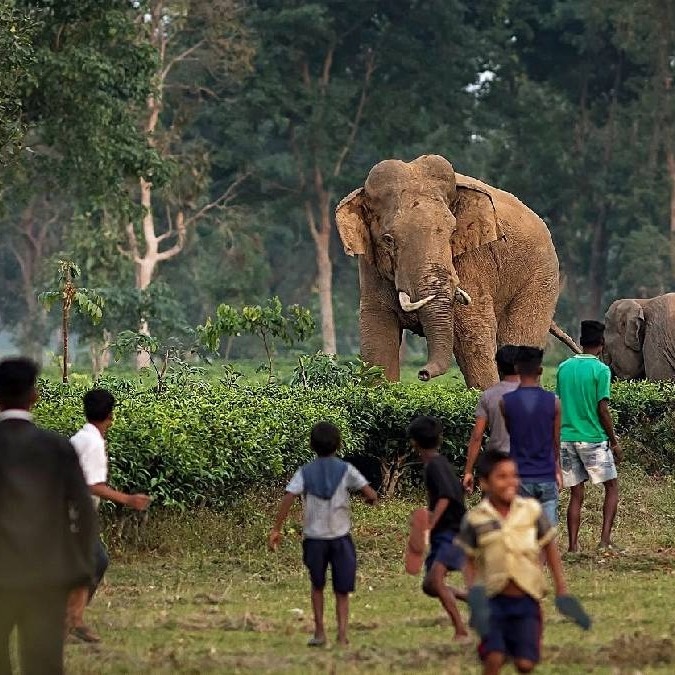
Conflict between humans and wildlife—especially involving tigers and elephants—has led to hundreds of fatalities in recent years. In 2024 alone, there were 74 tiger-related deaths and 628 elephant-related deaths, with states like Maharashtra, Odisha, and West Bengal most affected. The CoE aims to reduce these deaths significantly by integrating predictive and response systems with community engagement .
Evolution from Advisory to Implementation
Building on 2021 advisories and 2022 SOP guidelines, which highlighted coordinated efforts and hotspot identification, the CoE marks a shift from recommendations to institutionalized action, ensuring responsible management of wildlife emergencies
A Multi‑Pronged National Framework
Unlike state-level efforts, this CoE offers centralized coordination, harnessing AI, standardization, research, and outreach nationwide. Through uniform protocols and effective rapid response units, it enhances synergy between forest departments and local frontline teams.
Direct Relevance for Exam Aspirants
Students preparing for UPSC, state PSC, railway, bank, police, VYAPAM, and other sarkari exams should note this initiative’s significance in Environment & Ecology, Government Schemes, Disaster Management, and Current Affairs—topics frequently featured in prelims and mains.
Historical Context: Long-Term Conflict Management Efforts
2021: First Advisory
In February 2021, the Ministry issued a national advisory urging States to form inter‑departmental committees, map conflict zones, and set up Rapid Response Teams (RRTs) equipped for wildlife emergencies
2022: Standard Operating Procedures
June 2022 saw the rollout of detailed SOP guidelines, promoting community involvement, non-lethal deterrents, compensation protocols, and coordination through state/district-level panels
Rising Human‑Wildlife Conflict
Between 2022–24, tiger-related human fatalities decreased (111 → 86 → 74), while elephant-related deaths climbed to 628 in 2023–24—highlighting the urgent need for a systemic solution
Ground-Level Innovations
Organisations such as the Wildlife Trust of India, Wildlife SOS, and Aaranyak have piloted RRTs, radio-collaring elephants, and solar fencing—creating local, scalable models that the CoE plans to adopt nationwide
Key Takeaways from This News
| S.No. | Key Takeaway |
|---|---|
| 1. | A Centre of Excellence for human-wildlife conflict is being set up at WII–SACON in Dehradun to integrate AI, research, training, SOPs, and community awareness. |
| 2. | The CoE will use AI-based predictive tools and rapid-response teams to reduce incidents involving tigers and elephants. |
| 3. | It institutionalizes past directives from the 2021 advisory and 2022 SOPs, marking the transition from policy to implementation. |
| 4. | Rising fatalities (74 tiger deaths in 2024; 628 elephant deaths in 2023–24) emphasize the urgency of structured mitigation measures. |
| 5. | The initiative aligns with broader conservation efforts like gharials release, rescue centres, RRT models by NGOs, and enhanced legal frameworks. |
Frequently Asked Questions (FAQs)
1. What is the purpose of the new Centre of Excellence (CoE) for human-wildlife conflict?
The Centre of Excellence aims to proactively prevent human-wildlife conflicts through AI-based predictive analysis, research, training, and community engagement.
2. Where will the CoE be established?
The CoE will be established at the Wildlife Institute of India – Salim Ali Centre for Ornithology and Natural History (WII–SACON), located in Dehradun.
3. How will technology be used by the Centre?
The CoE will use Artificial Intelligence, satellite mapping, and predictive tools to identify potential conflict hotspots and deploy early warning and rapid response systems.
4. Which animals are most commonly involved in human-wildlife conflicts in India?
Elephants and tigers are the most commonly involved species, causing hundreds of deaths annually. In 2023–24 alone, 628 elephant-related and 74 tiger-related deaths were reported.
5. Why is this initiative important for exam aspirants?
This topic is relevant to UPSC, State PSCs, SSC, and other government exams under subjects like Environment & Ecology, Government Schemes, and Disaster Management. It could be asked in GS papers, essay writing, or interviews.
Some Important Current Affairs Links