








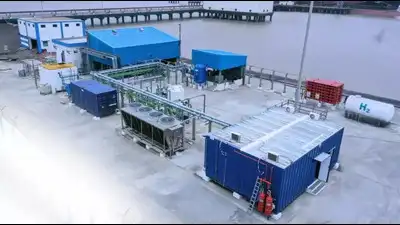
Make in India hydrogen plant commissioned at Kandla, Gujarat, marking India’s first indigenously developed 1 MW green hydrogen facility under the National Hydrogen Mission.
India’s First ‘Make in India’ Green Hydrogen Plant Commissioned at Deendayal Port, Kandla, Gujarat
Introduction
India has achieved a landmark milestone in its clean‑energy transition by commissioning the country’s first indigenously developed 1 MW green hydrogen plant under the “Make in India” initiative. Located at the Deendayal Port Authority (DPA) in Kandla, Gujarat, this facility marks a significant step toward maritime decarbonization and energy self‑reliance
Project Overview & Features
The green hydrogen plant has an initial capacity of 1 megawatt, with planned expansion to 5 MW by the end of the current fiscal year, and full operational capacity of 10 MW by mid‑2026Once at full scale, the plant will produce approximately 140 metric tonnes of green hydrogen annually, sufficient to power buses, street lighting, tugs, ships, and port industrial units
Indigenous Technology & Speed of Execution
Built entirely using Indian technology and engineered by local experts—with the electrolyzer manufactured domestically—the entire facility was commissioned in just four months The project’s speedy execution exemplifies India’s growing technical prowess and alignment with the Atmanirbhar Bharat vision
Leadership & Support
The plant was inaugurated by Union Minister Sarbananda Sonowal, signaling the government’s strategic backing for the initiative as a “new benchmark” in green hydrogen deployment. The foundation stone for this project was laid by Prime Minister Narendra Modi during his visit to Bhuj on 26 May 2025 Larsen & Toubro (L&T) was recognized for its engineering leadership in delivering the facility on time
Environmental & Strategic Significance
This port‑based green hydrogen plant is poised to reduce carbon emissions significantly from port operations and accelerate India’s journey toward net‑zero. It places the DPA at the forefront of sustainable maritime practices while enhancing India’s global leadership in the clean energy domain

Why This News Is Important
Strategic Push for Atmanirbhar Bharat and Clean Technology
This project showcases India’s ability to develop sophisticated green hydrogen infrastructure indigenously, boosting domestic technology manufacturing and reducing dependence on foreign suppliers. Such initiatives underpin national aspirations under the Make in India and Atmanirbhar Bharat missions.
Policy Momentum for Green Hydrogen
It aligns directly with India’s National Green Hydrogen Mission, launched in 2023, which targets 5 million tonnes of green hydrogen production by 2030 and supports the deployment of at least 125 GW of renewable energy capacity to power electrolysis technology
Decarbonisation of the Maritime Sector
By powering port services, vehicles, and lighting with clean hydrogen, DPA is pioneering maritime decarbonization, reducing carbon footprints and serving as a scalable model for other ports and industrial clusters across India.
Energy Security and Economic Benefits
Producing hydrogen domestically enhances energy security, lowers emissions, and helps meet climate targets cost-efficiently. Additionally, green hydrogen projects spur green jobs, industrial growth, and foster investment in related sectors like electrolyzers, storage, and fuel cell technologies.
Historical Context
Evolution of Green Hydrogen in India
India’s journey in hydrogen energy dates back to the National Hydrogen Energy Road Map (NHERM) launched in 2003–2006, aimed at diversifying energy sources and reducing fossil fuel dependence
National Mission and Policy Support
In 2023, the government launched the National Green Hydrogen Mission, setting ambitious targets such as 5 million tonnes of production by 2030, with policy frameworks and incentives to mobilize public and private investments
Precedent Projects
Prior to this, India saw pilot-scale green hydrogen initiatives—such as Oil India’s 99.99% pure pilot plant, and Adani’s 5 MW off‑grid hydrogen plant in Kutch—laying the groundwork for scale‑up
Key Takeaways from India’s First ‘Make in India’ Green Hydrogen Plant
| # | Key Takeaway |
|---|---|
| 1 | India’s first indigenously built 1 MW green hydrogen plant is operational at Deendayal Port, Kandla, Gujarat, under the Make in India initiative. |
| 2 | Initial capacity is 1 MW, with phased expansion to 5 MW by end of fiscal year and 10 MW by mid‑2026, aiming to produce 140 tonnes/year of hydrogen. |
| 3 | Entire project executed in just four months, highlighting India’s engineering capabilities using domestic technology and electrolyzers. |
| 4 | Inaugurated by Union Minister Sarbananda Sonowal, and foundation stone laid by Prime Minister Narendra Modi on 26 May 2025. |
| 5 | Supports India’s climate goals under the National Green Hydrogen Mission, strengthens maritime decarbonisation, and enhances energy security and green industrial growth. |
FAQs: Frequently Asked Questions
1. What is the significance of the green hydrogen plant in Kandla?
The plant is India’s first indigenously developed green hydrogen facility and marks a milestone in India’s clean energy transition under the Make in India and Atmanirbhar Bharat initiatives.
2. Where is the first ‘Make in India’ green hydrogen plant located?
It is located at the Deendayal Port Authority (DPA), Kandla, in the state of Gujarat.
3. What is the total planned capacity of the hydrogen plant?
The facility will scale up to 10 MW by mid-2026, with 140 metric tonnes of hydrogen production annually.
4. Which Indian company was involved in the engineering and construction of the plant?
Larsen & Toubro (L&T) led the engineering and timely execution of the project.
5. Who inaugurated the hydrogen plant at Deendayal Port?
The plant was inaugurated by Union Minister Sarbananda Sonowal, with the foundation laid by Prime Minister Narendra Modi.
6. How long did it take to complete the commissioning of the plant?
The entire facility was commissioned in just four months.
7. Which national mission does this initiative align with?
It aligns with the National Green Hydrogen Mission, which aims to make India a global hub for green hydrogen production and export.
8. How will the hydrogen be used at the port?
It will power buses, street lights, port equipment, and vessels, contributing to maritime decarbonization.
Some Important Current Affairs Links