









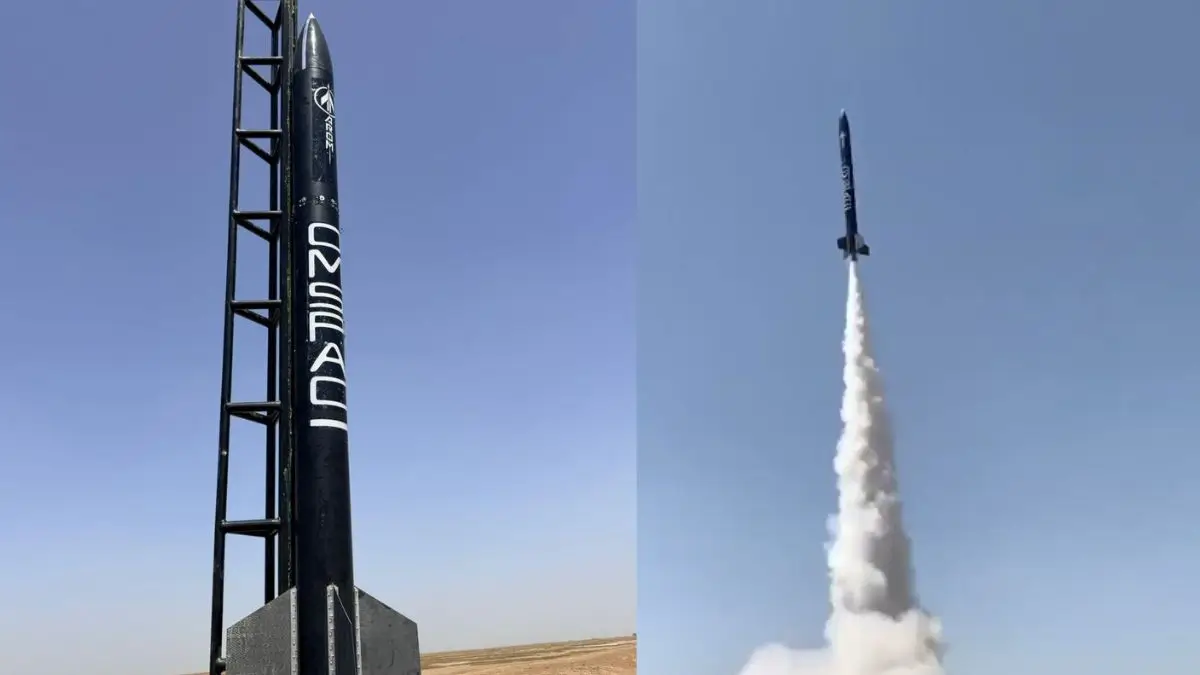
Gujarat sounding rocket launch marks the first successful private mission near Dholera by Omspace Rocket and Exploration Pvt Ltd, advancing India’s space technology and regional innovation.
Gujarat Successfully Tests Its First Sounding Rocket Near Dholera — A Major Boost to India’s Space Sector
On 15th March 2026, Gujarat etched its name in technological history as the state successfully launched its first sounding rocket from Bavaliyari village near Dholera. The rocket was developed and flown by Ahmedabad‑based startup Omspace Rocket and Exploration Pvt Ltd, highlighting India’s expanding space innovation ecosystem beyond traditional hubs like Bengaluru and Sriharikota.
At around 1:00 PM, the single‑stage sub‑orbital rocket took off from a temporary launch facility, reaching an altitude of approximately 3 kilometres. The mission aimed to validate advanced rocket technologies and systems such as propulsion, avionics, and autonomous recovery mechanisms, all of which performed successfully during the flight.
🌐 Mission Highlights and Scientific Payload
A notable aspect of this launch was the integration of a mini weather satellite payload onboard. This payload was designed to collect atmospheric data during ascent, demonstrating how sounding rockets can serve dual roles: testing rocket technologies and supporting scientific research.
The rocket’s design also showcased modern aerospace engineering capabilities. Using lightweight composite materials such as carbon fibre for the airframe, the mission reflected the growth of India’s private sector in manufacturing and technology development — further aligning with national initiatives like Make in India and Atmanirbhar Bharat (Self‑Reliant India).
🛠️ Regulatory Support and Collaboration
The launch was conducted with authorisation and technical coordination from key national agencies, including the Indian National Space Promotion and Authorization Centre (IN‑SPACe), Airports Authority of India (AAI), Directorate General of Civil Aviation and the Indian Coast Guard — underscoring how public and private sectors are collaborating to expand India’s presence in space technology.
Officials noted that this successful mission aligns with the Gujarat Spacetech Policy 2025‑2030, a strategic move by the state government to promote space innovation, attract startups, and build infrastructure that could one day support more advanced space missions.

📌 Why This News Matters to Government Exam Aspirants
Importance for UPSC, PSC & Competitive Exams
Understanding India’s space sector developments is crucial for general studies papers, especially in Science & Technology, Economic Development, and Government Policies. This launch illustrates the growing participation of private startups in strategic and high‑technology domains once dominated by government agencies like ISRO.
Private Sector Role in Strategic Innovation
The successful flight by a private entity marks a shift in India’s space ecosystem — from exclusive government control to collaborative public‑private innovation. This aligns with broader policy reforms such as the Space Sector Reforms and the establishment of IN‑SPACe, which enables private players to build and launch space systems.
Regional Technological Hubs
The event also signals Gujarat’s emergence as a technology and innovation hub, complementing existing industrial strengths. For exams, candidates should note how states are increasingly contributing to national development goals through targeted policies and innovation strategies.
📜 Historical Context: India’s Evolving Space Mission Landscape
India’s space journey began in the early 1960s with the establishment of the Indian Space Research Organisation (ISRO). Over decades, India has become a global space power, achieving milestones like launching communication satellites, lunar and Mars missions, and deploying advanced earth observation satellites.
In recent years, the private space sector has gained momentum. With policy reforms and institutions like IN‑SPACe, private firms such as Skyroot Aerospace, Agnikul Cosmos, and now Omspace Rocket and Exploration are contributing to sub‑orbital and low‑orbit missions. This local advancement is part of a global trend where private companies play a significant role in reducing launch costs and accelerating innovation.
Sounding rockets — smaller sub‑orbital rockets used mainly for scientific research — have long been part of space programmes worldwide. India too has historically used sounding rockets for atmospheric studies; however, Gujarat’s recent launch marks the first private sounding rocket test from the state and strengthens the ecosystem for future space projects at regional levels.
📊 Key Takeaways from “Gujarat’s First Sounding Rocket Launch”
| S. No. | Key Takeaway |
|---|---|
| 1. | Gujarat successfully launched its first sounding rocket near Dholera on 15 March 2026. |
| 2. | The rocket was developed by Ahmedabad‑based startup Omspace Rocket and Exploration Pvt Ltd. |
| 3. | It reached an altitude of about 3 km and tested key aerospace systems. |
| 4. | A mini weather payload onboard collected atmospheric data, showcasing research applications. |
| 5. | The launch reflects the growth of private space technology supported by policies like Gujarat Spacetech Policy 2025‑2030. |
FAQs: Frequently Asked Questions
1. What is a sounding rocket?
A sounding rocket is a sub-orbital rocket used primarily for scientific research, such as atmospheric studies, technology testing, and data collection, before satellites or full orbital launches.
2. When and where was Gujarat’s first sounding rocket launched?
Gujarat successfully launched its first sounding rocket on 15th March 2026 from Bavaliyari village near Dholera.
3. Which company developed Gujarat’s first sounding rocket?
The rocket was developed by Omspace Rocket and Exploration Pvt Ltd, an Ahmedabad-based private startup.
4. What was the altitude achieved by the rocket?
The single-stage sub-orbital rocket reached an altitude of approximately 3 kilometres.
5. What was the scientific payload onboard the rocket?
The rocket carried a mini weather satellite payload designed to collect atmospheric and meteorological data during its sub-orbital flight.
6. Which regulatory authorities supported the launch?
The launch was coordinated with IN-SPACe, Directorate General of Civil Aviation (DGCA), Airports Authority of India (AAI), and Indian Coast Guard.
7. How does this launch benefit India’s space ecosystem?
It strengthens the private space sector, promotes regional space innovation, and aligns with policies like Gujarat Spacetech Policy 2025-2030 to expand infrastructure and startup participation.
8. Why is this event significant for government exam aspirants?
This is relevant for Science & Technology, General Studies, and Current Affairs sections as it demonstrates India’s growing public-private collaboration in space technology.
Some Important Current Affairs Links