

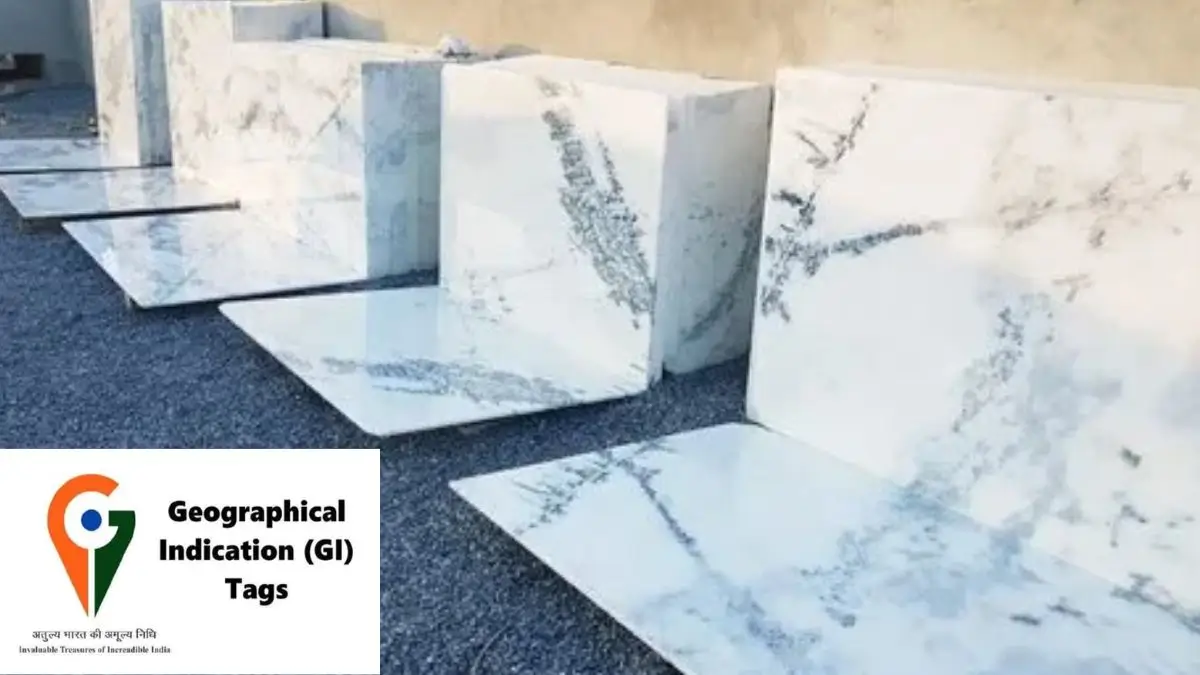
Ambaji Marble GI Tag news: Learn why Gujarat’s iconic Ambaji Marble received GI status, its features, history, and exam-relevant facts for UPSC, SSC, Banking, Railways, and Defence exams.
Ambaji Marble of Gujarat Gains GI-Tag Recognition
What Is the News?
The Indian government has officially granted a Geographical Indication (GI) tag to Ambaji Marble, a prized white marble sourced from the Ambaji region in Banaskantha district of Gujarat. This recognition was issued by the Department for Promotion of Industry and Internal Trade (DPIIT) under the Ministry of Commerce and Industry. The GI registration has been made under the Ambaji Marbles Quarry and Factory Association.
Unique Features of Ambaji Marble
Ambaji Marble is especially known for its milky white hue, strong durability, and natural polish, all of which contribute to its high commercial and architectural value. Chemically, it has a high calcium content, which helps with its robustness, and it can be polished to a smooth finish, making it ideal for temples and monuments. Its fine, closely packed grains give it a uniform texture that is highly desirable in stone architecture.
Historical and Spiritual Significance
The marble mines in Ambaji are ancient, with their origins estimated to be 1,200 to 1,500 years old, dating back to the era when the Dilwara Jain Temples at Mount Abu were built. Over the centuries, this marble has been used in religious architecture. According to reports, Ambaji Marble was used in the Ambaji Temple, and there is belief that it was also used in the Ram Temple in Ayodhya.Beyond India, the marble has found its way into spiritual and cultural buildings in cities like Miami, Los Angeles, Boston, and even in New Zealand and England.
How the GI-Tag Will Help
Granting the GI tag to Ambaji Marble brings several benefits:
- Authenticity protection: Only marble actually mined from the Ambaji region can be legally marketed as “Ambaji Marble.”
- Brand value: It helps build a unique brand identity on the global stage, making Ambaji Marble more desirable in international markets.
- Economic uplift for the region: The GI tag is expected to boost local mining and marble-processing industries, benefiting artisans, miners, and small businesses in the Banaskantha district.
- Export potential: With authenticity guaranteed, the export demand for Ambaji Marble may rise, increasing revenues.
- Protection from imitation: It helps prevent misuse of the name “Ambaji Marble,” protecting both reputation and quality.

Why This News Is Important
Strengthening India’s Cultural Heritage and Economy
The GI tag for Ambaji Marble is not just a matter of nomenclature — it is a formal recognition of the cultural and historical value of this natural resource. For students preparing for government exams, especially in civil services (IAS/PCS), banking, or defense, this is relevant in the context of economic geography, intellectual property rights, and heritage conservation.
Promoting Rural and Traditional Industries
By giving Ambaji Marble a GI status, the government is supporting local artisans, quarry owners, and traditional craftspeople. This directly aligns with policies of regional development and village-level economic empowerment, which are often topics in exam syllabus (e.g., general studies, polity, and economy).
Enhancing Global Trade Credentials
With GI recognition, Ambaji Marble has a stronger brand identity abroad, which can lead to higher exports. This supports India’s broader economic goals of boosting “made in India” products and increasing foreign demand for authentic traditional goods.
Historical Context
Ambaji Marble has a rich historical lineage. The marble mines in and around Ambaji (Banaskantha district) are believed to date back over a millennium.The marble was used in the construction of the Dilwara Jain Temples in Mount Abu, which themselves are centuries old and renowned for their exquisitely carved marble architecture.
Over time, the marble from this region has been exported and used globally — not just in India’s temples but also for spiritual buildings in the United States, England, and New Zealand. The recent GI-tag acknowledgment serves as a formalization of this legacy, reinforcing Ambaji Marble’s identity both as a cultural symbol and a commercial resource.
Key Takeaways from This News
| Serial No. | Key Takeaway |
|---|---|
| 1 | Ambaji Marble, mined in Banaskantha district (Gujarat), has received a GI tag, boosting its global identity. |
| 2 | GI Registration Authority: The GI tag has been issued by the DPIIT under the Ministry of Commerce & Industry. |
| 3 | Distinctive Features: Milky-white colour, high calcium content, durability, fine-grained texture. |
| 4 | Historical & Spiritual Use: Used in ancient temples like the Dilwara Jain Temples, the Ambaji Temple, and potentially in the Ram Temple at Ayodhya. |
| 5 | Economic and Legal Benefits: GI-tag will protect authenticity, support local artisans, encourage exports, and prevent misuse of the name. |
FAQs: Frequently Asked Questions
1. What is Ambaji Marble?
Ambaji Marble is a high-quality, milky-white natural stone mined from the Ambaji region in Banaskantha district of Gujarat. It is known for its purity, durability, and use in temples and monumental architecture.
2. Which authority grants GI tags in India?
The Geographical Indication (GI) tags in India are granted by the Geographical Indications Registry, operating under the Department for Promotion of Industry and Internal Trade (DPIIT), Ministry of Commerce & Industry.
3. Why was Ambaji Marble given a GI tag?
It was awarded the GI tag to legally protect its uniqueness, prevent counterfeit products, strengthen regional identity, support local artisans and miners, and promote export potential.
4. What makes Ambaji Marble unique?
It has a natural milky-white color, high calcium content, fine grain texture, strong durability, and exceptional polishing ability, making it ideal for temples and heritage architecture.
5. Where is Ambaji Marble primarily used?
It has been used in structures like the Dilwara Jain Temples, Ambaji Temple, and is believed to have been used in the Ram Temple at Ayodhya. It is also used in temples across the USA, UK, New Zealand, and other countries.
6. Which district of Gujarat produces Ambaji Marble?
Ambaji Marble is produced only in the Banaskantha district.
7. How does a GI tag benefit local industries?
A GI tag boosts brand recognition, increases market value, improves export prospects, protects traditional artisans, and prevents misuse of product names.
8. How is the GI tag relevant to government exams?
Questions on GI tags, intellectual property rights, Indian geography, cultural heritage, and regional industries are frequently asked in UPSC, State PCS, SSC, Railways, Banking, and Defence exams.
9. How old are the Ambaji Marble mines?
Historical estimates suggest the mines are 1,200–1,500 years old, making them one of the oldest marble-producing regions in India.
10. Who applied for the GI tag for Ambaji Marble?
The application was filed by the Ambaji Marbles Quarry and Factory Association.
Some Important Current Affairs Links