









Exercise Trishul 2025: India begins its major tri-service military exercise across Gujarat and Rajasthan, bringing together the Army, Navy and Air Force to enhance joint defence readiness and western border security.
India Launches Tri-Service Exercise ‘Ex Trishul’ Along Western Front
India has commenced the large-scale tri-service military exercise named Exercise Trishul (Ex Trishul) along its western border with Pakistan, bringing together the Indian Army, the Indian Navy and the Indian Air Force (IAF) to test joint operations, enhance interoperability, and strengthen India’s defence posture in a sensitive region.
Objective of the Exercise
The primary goal of Ex Trishul is to bolster coordination, communication and mission-readiness among the Army, Navy and Air Force. The exercise seeks to improve interoperability — the ability of diverse military forces to operate together effectively under unified command — thereby replicating real-world combat scenarios requiring cross-domain collaboration.
Venue & Timeline
The exercise is being held from 30 October to 10 November 2025 across the states of Gujarat and Rajasthan, both of which share a long and strategically important border with Pakistan. These terrain conditions offer an apt environment to simulate land, sea and air operations in a western frontier context.
Phases & Scope of the Exercise
Ex Trishul unfolds in three distinct phases:
- The Indian Navy leads the first phase, emphasising coastal defence and sea–air coordination.
- The Indian Army spearheads the second phase, focusing on land-based combat operations and armoured engagements.
- The Indian Air Force takes charge of the final phase, centring on air-superiority missions and long-range strikes.
Supporting assets such as the Border Security Force (BSF) and the Indian Coast Guard are also participating, reflecting a comprehensive approach to border defence and maritime security.
Scale and Assets Deployed
The exercise involves over 20,000 personnel supported by a wide array of sophisticated platforms:
- Tanks such as the T-90S and Arjun.
- Attack helicopters and missile systems.
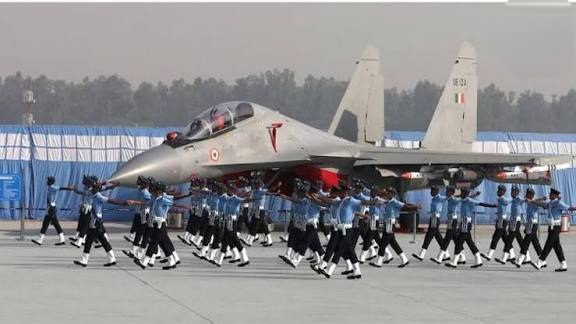
- Fighter jets including the Rafale and Sukhoi-30MKI.
- A flotilla of naval frigates and destroyers.
This indicates that India is testing its ability to conduct large-scale integrated operations across land, air and sea domains under realistic conditions.
Emphasis on Joint Command and Technological Integration
According to defence officials, Ex Trishul demonstrates India’s commitment to evolving joint command structures where the Army, Navy and Air Force operate under shared leadership frameworks. There is also an emphasis on technological cooperation and information-sharing among the services to ensure quicker, smarter responses to security challenges.
Regional Reactions and Implications
In what appears as a direct response to rising Indian military activity along the western front, Pakistan announced adjustments to certain flight routes over Karachi and Lahore just before the exercise began. Additionally, Defence Minister Rajnath Singh had earlier declared that any aggression in the Sir Creek region would be met with a “strong and historic response”, signaling India’s readiness to defend its borders and ensure regional stability through strength.
Why This News Is Important
Relevance for National Security and Defence Strategy
The launch of Ex Trishul underscores India’s strategic intent to maintain superiority in its western theatre by integrating its defence forces across branches. For aspirants preparing for various competitive exams like teacher recruitment (with general awareness components), banking, railways, defence and civil services (such as PCS to IAS), understanding this exercise is key to grasping India’s evolving defence architecture and policy priorities.
Impact on Geopolitical Dynamics
With the exercise taking place on the India-Pakistan border, it has significant implications for regional geopolitics. It demonstrates India’s capability and readiness to conduct joint operations and signals deterrence to adversaries. Questions related to India’s defence initiatives, border security, military collaborations and inter-service integration may arise in the General Studies sections of exams.
Link to Exam Syllabi
Many competitive exams include topics like “Defence and National Security”, “Current Affairs”, “Geopolitics” and “India and Neighbouring Countries”. The details of Ex Trishul — its multi-service nature, strategic objectives, geographic scope and assets involved — provide important factual information that can be used for short answers, multiple choice questions, and essay sections.
Historical Context
Joint military exercises involving multiple arms of the Indian Armed Forces have been a recurring feature of India’s defence preparedness strategy. Over the years, India has conducted exercises such as Exercise Ajeya Warrior (with the UK), Exercise Malabar (with the US and other partners), and domestic tri-service drills like Exercise Sudarshan Shakti.
The concept of tri-service synergy gained emphasis after the 2016 Defence White Paper, which called for enhanced jointness and modernisation of command structures. The establishment of the Chief of Defence Staff Office in 2019 also accelerated this process by enabling greater coordination among Army, Navy and Air Force. The western border region — particularly Gujarat and Rajasthan — has for decades been a strategic focus due to adversarial proximity with Pakistan and past conflicts such as the 1971 and 1999 Kargil War. Ex Trishul thus builds upon this legacy of evolving defence readiness and reactive posture.
Key Takeaways from This News: Exercise Trishul
| S.No | Key Takeaway |
|---|---|
| 1 | The tri-service exercise named Exercise Trishul is being held from 30 October to 10 November 2025 across Gujarat and Rajasthan. |
| 2 | The exercise involves the Indian Army, Navy and Air Force working jointly, emphasising interoperability, coordination and integrated command. |
| 3 | More than 20,000 troops are participating, along with major platforms such as T-90S/Arjun tanks, attack helicopters, missile systems, Rafale & Sukhoi-30MKI jets, and navy frigates/destroyers. |
| 4 | It is being conducted in three phases: navy-led coastal segment, army-led land segment, and air-force-led final segment, with support from BSF and Indian Coast Guard. |
| 5 | The drill underlines India’s strategic focus on western border security, joint operations capability and deterrence posture in the India-Pakistan frontier region. |
Frequently Asked Questions (FAQs)
FAQs on India’s Tri-Service Exercise ‘Ex Trishul’
1. What is Exercise Trishul?
Exercise Trishul is a large-scale tri-service military exercise conducted by the Indian Army, Navy, and Air Force to enhance joint operational capability and defence readiness along the western front.
2. Where is Exercise Trishul being conducted?
The exercise is taking place across the states of Gujarat and Rajasthan, both of which border Pakistan and have significant strategic importance.
3. When is Exercise Trishul 2025 scheduled?
The exercise is being conducted from 30 October 2025 to 10 November 2025.
4. What are the main objectives of Exercise Trishul?
The objectives include improving inter-service coordination, operational synergy, real-time communication, and joint command readiness across land, air, and sea operations.
5. Which branches of the Indian Armed Forces are involved in Exercise Trishul?
All three major branches — the Indian Army, Indian Navy, and Indian Air Force (IAF) — are participating, supported by the BSF and Indian Coast Guard.
6. How is the exercise structured?
Ex Trishul is divided into three phases: naval (coastal operations), army (land operations), and air force (air operations).
7. Why is this exercise strategically important?
It strengthens India’s military posture along its western border with Pakistan and showcases the country’s ability to coordinate tri-service missions effectively.
8. How many personnel are participating in the exercise?
Over 20,000 troops are taking part, making it one of the most extensive tri-service exercises held domestically.
9. What key assets are being used during the exercise?
Key assets include Rafale and Sukhoi-30MKI fighter jets, Arjun and T-90S tanks, attack helicopters, missile systems, and naval frigates/destroyers.
10. How can this topic be useful for competitive exams?
Questions about defence exercises, joint military operations, and India’s border security initiatives often appear in the General Awareness and Current Affairs sections of exams like UPSC, CDS, NDA, AFCAT, SSC, and banking exams.
Some Important Current Affairs Links