



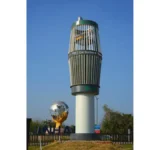


Microalgae Air Tower Delhi uses photosynthetic microalgae to absorb CO₂, PM, and NOx, providing India’s first highway-based eco-friendly pollution control solution.
Delhi Installs India’s First Microalgae Air Tower to Fight Highway Pollution — A Groundbreaking Environmental Innovation
In a significant step toward combating urban air pollution, New Delhi has deployed India’s first microalgae‑based air purification system — the PureAir Tower — along the high‑traffic Aerocity highway corridor. This modern biotechnology installation is being introduced as a pilot project to neutralize harmful vehicular emissions and improve air quality in one of the capital’s busiest regions.
The PureAir Tower differs fundamentally from traditional smog towers that use mechanical filters. Instead, it employs photosynthetic microalgae, tiny aquatic organisms capable of absorbing air pollutants such as carbon dioxide (CO₂), particulate matter (PM), and nitrogen oxides (NOx) directly from urban air. Through natural biological processes, these pollutants are converted into oxygen and algal biomass, reducing harmful emissions at street level without generating secondary waste.
This innovative system operates with minimal energy use and no filter disposal requirements, making it environmentally sustainable and potentially more cost‑effective than older technologies. By transforming ordinary road medians into active air purification units, the PureAir Tower represents a fusion of urban infrastructure and eco‑friendly biotechnology.
How the Microalgae Air Tower Functions
The microalgae inside the tower act as a biological sink for pollutants. Unlike traditional towers that rely on fans and filters, this system uses microalgae’s natural photosynthesis capability to absorb and convert air contaminants. As polluted air comes into contact with the microalgae culture, CO₂, PM and NOx are absorbed and transformed. The process emits oxygen back into the environment, similar to how trees release oxygen through respiration.
This system’s efficiency is enhanced because it doesn’t generate filter waste, a common issue with mechanical purifiers. As a result, maintenance and operational footprints are lower, and the system remains economically feasible for long‑term deployment.
Collaboration and Project Partners
The PureAir Tower has been developed through a partnership between C P Arora Private Limited and Carbelim Pvt Ltd — a climate technology startup incubated at the Indian Institute of Technology (IIT) Madras and supported by the IIM Lucknow Enterprise Incubation Centre. This collaboration showcases the role of India’s academic and entrepreneurial ecosystem in developing solutions to environmental challenges.
Urban Infrastructure Meets Environment
Each PureAir Tower installed along highway medians is designed to deliver air purification performance equivalent to more than 15 mature trees, continuously treating vehicular emissions from passing vehicles. With future plans to install BioDivider panels, these towers may eventually convert entire road dividers into green corridors that help maintain cleaner and healthier urban air.
The introduction of microalgae‑based air purification technology marks a milestone in India’s environmental innovation landscape and shows how science and engineering can be integrated into everyday infrastructure to reduce pollution and enhance public health.

Why This News is Important
Relevance to Environment and Governance
Air pollution remains one of India’s most pressing environmental and public health challenges, especially in urban areas like Delhi. High concentrations of toxic air pollutants contribute to respiratory diseases, cardiovascular problems, and reduced life expectancy. For aspirants of government exams like UPSC, SSC, Banking, Railways and Defence, this development is highly relevant as it demonstrates how policy, technology, and environmental science intersect to address critical national issues.
Innovation in Sustainable Solutions
The deployment of the microalgae air tower is not just an infrastructure upgrade — it represents a shift toward biotech‑based pollution control systems. Unlike traditional air purifiers that depend on mechanical filtration and energy‑intensive operation, this model uses biological processes to absorb and transform harmful emissions. Such innovations may redefine how governments conceptualize and implement eco‑friendly pollution mitigation strategies in the future.
Implications for Competitive Exams
For students preparing for competitive exams, this news highlights key topics from the environment, biotechnology, public policy and sustainable urban development. Questions could be framed around air pollution control technologies, urban challenges, and innovative solutions under sections like General Studies, Environment & Ecology, or Science & Technology. Understanding such initiatives gives aspirants an edge in answering analytical and application‑based questions in exams like UPSC, SSC CGL, Bank PO, Railway Group D, and more.
Policy and Future Potential
This pilot project sets a precedent for expanding biotech solutions across other polluted corridors in major cities. If successful, it could influence national initiatives — such as the National Clean Air Programme (NCAP) — and shape future environmental policy decisions. Aspirants should comprehend not only the technology but also how such initiatives align with broader government frameworks aimed at sustainable development.
Historical Context
Air Pollution Challenges in Delhi
For over a decade, Delhi has been one of the world’s most polluted cities, frequently registering Hazardous‑level Air Quality Index (AQI) readings. Major pollution triggers include vehicular emissions, industrial output, construction dust, and crop burning in neighbouring states. The city’s air pollution crisis reached alarming front‑page coverage in national media and triggered policy responses across governments.
Previous Pollution Control Measures
In the past, authorities have experimented with smog towers and anti‑pollution installations that relied on mechanical filtration — such as the smog towers built under flyovers or park spaces. Though these did moderate local AQI levels in limited areas, their cost‑effectiveness and large‑scale feasibility were debated among experts and policymakers.
National Clean Air Programme (NCAP)
In 2019, the Government of India launched the National Clean Air Programme (NCAP) with targets to reduce particulate pollution (PM₂.₅ and PM₁₀) by at least 20–30% by 2024 across hundreds of identified non‑attainment cities. This involved monitoring stations, real‑time data analysis, pollution action plans, and community interventions. Academic and industrial research institutions also began piloting innovative technologies to align with these goals.
Emergence of Biotech Solutions
The introduction of the microalgae air tower reflects a newer phase in pollution control strategies — one rooted in biotechnology rather than mechanical intervention. This approach highlights the evolving landscape of solutions that are sustainable, low‑waste, and integrative with urban infrastructure — representing a hopeful direction in long‑term environmental governance.
Key Takeaways from Delhi’s Microalgae Air Tower Initiative
| S.No | Key Takeaway |
|---|---|
| 1 | India’s first microalgae‑based air purification tower, PureAir Tower, has been installed along Delhi’s Aerocity highway corridor. |
| 2 | This system uses photosynthetic microalgae to absorb pollutants like CO₂, PM and NOx, converting them into oxygen and biomass. |
| 3 | Unlike traditional smog towers, it operates with minimal energy and produces no secondary filter waste. |
| 4 | The project was developed through collaboration between C P Arora Pvt Ltd and Carbelim Pvt Ltd (IIT‑Madras incubated startup). |
| 5 | Each tower’s purification capacity is comparable to over 15 mature trees and may lead to greener road infrastructure via BioDivider panels. |
FAQs: Frequently Asked Questions
1. What is the Microalgae Air Tower installed in Delhi?
The Microalgae Air Tower, also called the PureAir Tower, is India’s first biotechnology-based air purification system. It uses photosynthetic microalgae to absorb air pollutants like CO₂, particulate matter (PM), and nitrogen oxides (NOx), converting them into oxygen and biomass.
2. Where has the first Microalgae Air Tower been installed in India?
It has been installed along the Aerocity highway corridor in New Delhi, a high-traffic area that often experiences severe air pollution.
3. How does the Microalgae Air Tower work?
Polluted air passes through chambers containing microalgae. The algae absorb CO₂, PM, and NOx via photosynthesis, releasing oxygen and producing biomass, which can later be harvested for bio-products.
4. Who developed this Microalgae Air Tower?
The project was developed by C P Arora Pvt Ltd in collaboration with Carbelim Pvt Ltd, a startup incubated at IIT Madras and supported by IIM Lucknow Enterprise Incubation Centre.
5. What are the advantages of Microalgae Air Towers over traditional smog towers?
Unlike mechanical smog towers, microalgae towers are energy-efficient, eco-friendly, produce no filter waste, and can continuously purify air while integrating with urban infrastructure.
6. How much pollution can one Microalgae Air Tower absorb?
Each tower has an air purification capacity equivalent to more than 15 mature trees, making it highly effective for localized pollution reduction.
7. Can this technology be replicated in other cities?
Yes, if successful, microalgae air towers can be installed in other pollution-prone urban areas to create cleaner air corridors and sustainable urban infrastructure.
8. Why is this innovation important for government exam aspirants?
It links environmental science, biotechnology, and public policy, which are frequent topics in exams like UPSC, SSC, Banking, Railways, and Defence. Understanding such initiatives helps in analytical and application-based questions.
Some Important Current Affairs Links