









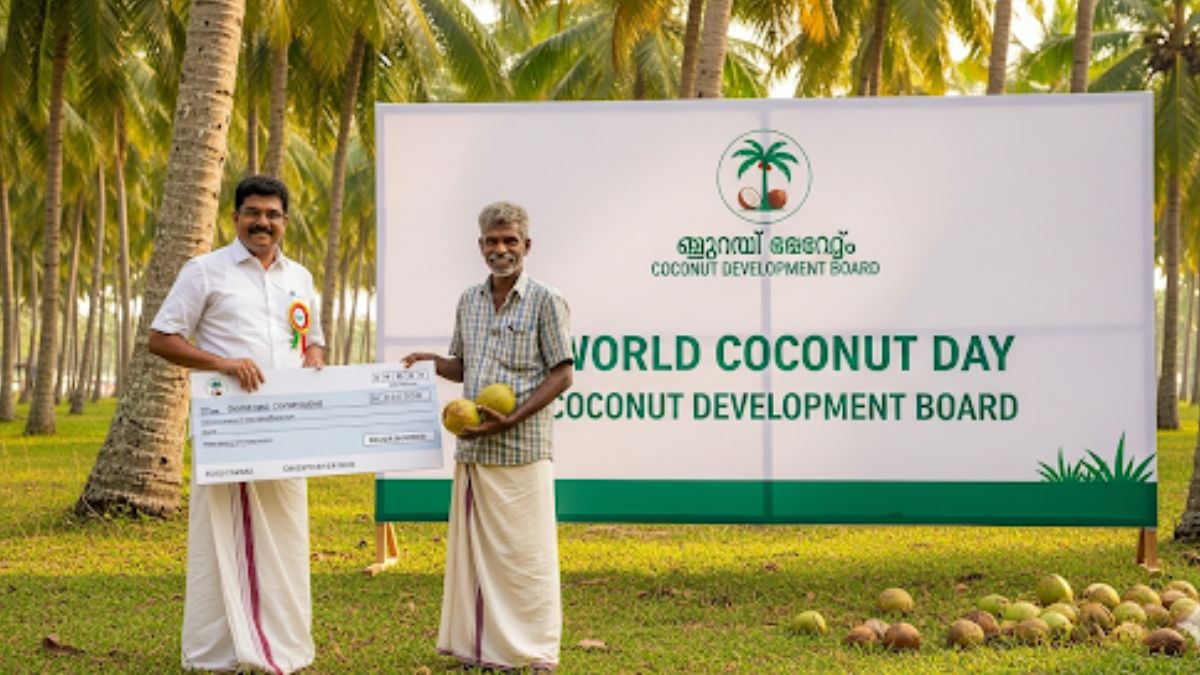
Coconut Development Board schemes 2025 provide enhanced subsidies, skill development, and global market opportunities for coconut farmers, promoting sustainable farming and higher income.
Coconut Development Board Launches Revised Schemes to Empower Coconut Farmers
Introduction: Celebrating World Coconut Day with Strategic Initiatives
On September 3, 2025, the Coconut Development Board (CDB) commemorated World Coconut Day by unveiling a series of enhanced schemes aimed at revitalizing the coconut sector in India. The event, held at the Adlux Convention Centre in Angamaly, Kerala, was graced by dignitaries including M.K. Raghavan, Member of Parliament, and Dr. Prabhat Kumar, CEO of CDB.
Enhanced Financial Assistance for Farmers
A significant highlight of the revised schemes is the substantial increase in financial subsidies for coconut farmers. The subsidy for the Area Expansion Programme has been raised from ₹6,500 to ₹56,000 per hectare, while the subsidy for seedling production has been enhanced from ₹8 to ₹45 per seedling. These measures are designed to encourage farmers to expand their cultivation areas and improve the quality of seedlings, thereby boosting overall productivity.
Focus on Value Addition and Export Promotion
Recognizing the importance of value-added products in enhancing the economic viability of coconut farming, the CDB has introduced schemes to support the development of products such as coir, coconut oil, virgin coconut oil, and coconut sugar. Additionally, the Board is facilitating participation in international trade fairs and establishing buyer-seller meets to promote coconut products in global markets.
Skill Development and Sustainable Practices
The revised schemes also emphasize skill development and the adoption of sustainable farming practices. Training programs are being organized to equip farmers with modern agricultural techniques, pest management strategies, and knowledge about organic farming. These initiatives aim to enhance the long-term sustainability and profitability of coconut cultivation.
Integration with National Agricultural Policies
The CDB’s efforts align with the government’s broader agricultural policies, which focus on increasing farmers’ incomes and promoting sustainable agricultural practices. By integrating these revised schemes with national initiatives, the CDB aims to create a more resilient and prosperous coconut farming community.
Conclusion: A Step Towards a Thriving Coconut Economy
The launch of these revised schemes marks a pivotal moment in the development of India’s coconut sector. By providing enhanced financial assistance, promoting value addition, and focusing on skill development, the CDB is laying the groundwork for a more sustainable and profitable coconut farming industry. These initiatives are expected to not only boost the livelihoods of coconut farmers but also contribute significantly to the nation’s agricultural economy.
Why This News is Important
Empowerment of Farmers
The increased financial assistance empowers farmers by providing them with the resources needed to expand their cultivation areas and improve the quality of their produce. This support is crucial for enhancing productivity and ensuring a steady income for farmers.
Promotion of Value-Added Products
By focusing on value addition, the CDB is helping farmers diversify their income sources. Products like virgin coconut oil and coir have higher market value, which can significantly improve the economic returns for farmers.
Skill Development Initiatives
The emphasis on skill development ensures that farmers are equipped with the latest knowledge and techniques in coconut cultivation. This not only improves productivity but also promotes sustainable farming practices.
Alignment with National Policies
The CDB’s initiatives are in line with the government’s broader agricultural policies aimed at increasing farmers’ incomes and promoting sustainable agriculture. This alignment ensures that the efforts are part of a cohesive national strategy.
Global Market Expansion
Facilitating participation in international trade fairs and establishing buyer-seller meets open up global markets for Indian coconut products. This expansion is vital for increasing exports and enhancing the global competitiveness of Indian coconut products
Historical Context
The Coconut Development Board was established in 1981 under the Ministry of Agriculture and Farmers’ Welfare, Government of India, to promote the integrated development of coconut cultivation and industry. Over the years, the Board has introduced various schemes to support farmers, including subsidies for seedling production, area expansion, and insurance schemes. The recent revisions to these schemes reflect the government’s ongoing commitment to enhancing the coconut sector’s productivity and sustainability.
Key Takeaways from ‘Coconut Development Board Launches Revised Schemes’
| No. | Key Takeaway |
|---|---|
| 1. | Subsidy for Area Expansion Programme increased from ₹6,500 to ₹56,000 per hectare. |
| 2. | Seedling production subsidy enhanced from ₹8 to ₹45 per seedling. |
| 3. | Introduction of schemes for value-added products like coir and coconut oil. |
| 4. | Emphasis on skill development and sustainable farming practices. |
| 5. | Initiatives aligned with national agricultural policies to boost farmers’ incomes. |
FAQs: Frequently Asked Questions
1. What is the Coconut Development Board (CDB)?
The Coconut Development Board is an autonomous organization under the Ministry of Agriculture and Farmers’ Welfare, Government of India, established in 1981 to promote integrated development of coconut cultivation and industry in India.
2. When were the revised schemes for coconut farmers launched?
The revised schemes were launched on September 3, 2025, coinciding with World Coconut Day, at the Adlux Convention Centre in Angamaly, Kerala.
3. What are the financial subsidies provided under the revised schemes?
The subsidy for the Area Expansion Programme has increased from ₹6,500 to ₹56,000 per hectare, and the subsidy for seedling production has increased from ₹8 to ₹45 per seedling.
4. What are the key objectives of the new schemes?
The key objectives include enhancing coconut productivity, promoting value-added products like coir and coconut oil, skill development for farmers, sustainable farming practices, and expanding exports of coconut products.
5. How do the schemes benefit coconut farmers in India?
The schemes provide financial support, training, and opportunities for global market exposure, thereby increasing farmers’ income, improving productivity, and promoting sustainable coconut cultivation.
6. Are the CDB schemes aligned with government policies?
Yes, the revised schemes align with national agricultural policies focused on increasing farmers’ income and promoting sustainable agriculture.
7. What skill development programs are included in the new initiatives?
Programs include training in modern agricultural techniques, pest management, organic farming practices, and knowledge of value-added product development.
8. How do these schemes promote exports?
The CDB facilitates participation in international trade fairs, buyer-seller meets, and support for value-added products, helping Indian coconut products reach global markets.
Some Important Current Affairs Links