










Chandrayaan-2 lunar exosphere discovery reveals how solar storms increase molecule density on the Moon. Explore ISRO’s CHACE-2 findings and their significance for space missions.
Chandrayaan-2 Detects Solar Impact on Moon’s Exosphere
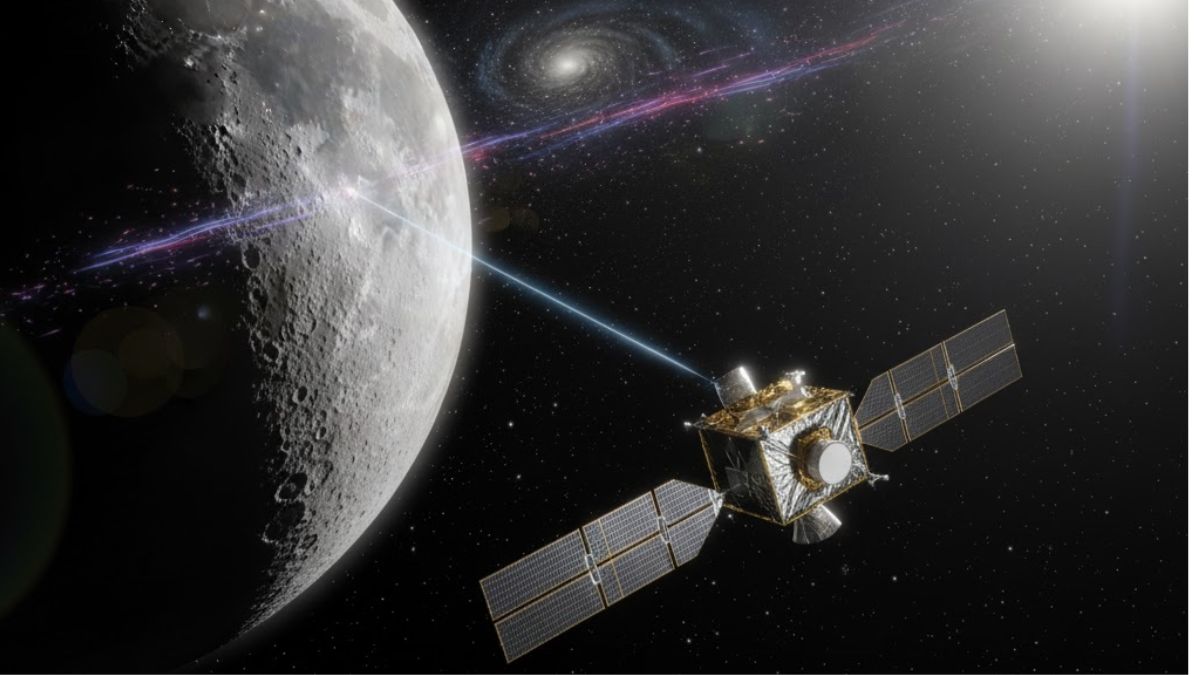
In a groundbreaking achievement, India’s Chandrayaan-2 mission has observed the first-ever impact of a solar Coronal Mass Ejection (CME) on the Moon’s exosphere. This significant discovery was made using the CHACE-2 (Chandrayaan-2 Atmospheric Compositional Explorer-2) instrument onboard the orbiter. The findings were published in the journal Geophysical Research Letters.
Understanding the Lunar Exosphere
The Moon’s exosphere is an extremely thin and tenuous layer of gases that surrounds the lunar surface. Unlike Earth’s atmosphere, the exosphere lacks a magnetic field and is composed of low-density particles such as hydrogen, helium, and sodium. These particles are primarily released from the lunar surface due to solar radiation, micrometeorite impacts, and other space weather phenomena.
The Role of CHACE-2 Instrument
The CHACE-2 instrument aboard Chandrayaan-2 is designed to study the composition and density of the Moon’s exosphere. During the solar event in May 2024, CHACE-2 recorded a significant increase in the total pressure of the lunar exosphere. This surge in pressure was directly correlated with the arrival of the CME at the Moon’s surface. The data indicated that the number density of neutral atoms and molecules in the exosphere increased by more than ten times, providing direct evidence of the Moon’s response to solar activity.
Implications for Lunar Exploration
This observation marks a significant milestone in lunar science, as it provides the first experimental evidence of how solar storms can influence the Moon’s exosphere. Understanding these interactions is crucial for future lunar exploration missions, as the exosphere plays a vital role in surface weathering and the potential for resource utilization on the Moon.
Why This News Is Important
Relevance to Government Exam Aspirants
This discovery is pertinent for students preparing for various government exams, including those for positions in the Indian Administrative Service (IAS), Indian Police Service (IPS), Indian Foreign Service (IFS), and other civil services. The understanding of space weather phenomena and their effects on celestial bodies is an emerging area of study in the General Studies papers, particularly in topics related to science and technology.
Contribution to Scientific Knowledge
The findings enhance India’s position in global space research and underscore the capabilities of ISRO in conducting advanced scientific investigations. This achievement not only contributes to the field of planetary science but also demonstrates the practical applications of space missions in understanding complex environmental interactions.
Historical Context
The study of the Moon’s exosphere has been a subject of scientific interest since the early space exploration missions. Previous lunar missions, including those by NASA and the Soviet Union, have provided limited data on the Moon’s tenuous atmosphere. However, it was not until India’s Chandrayaan-2 mission that comprehensive observations were made, leading to the current breakthrough. The detection of solar storm impacts on the Moon’s exosphere aligns with theoretical models proposed in the 1970s, which suggested that solar activity could influence the lunar environment. This discovery validates those models and opens new avenues for research in space weather and planetary atmospheres.
Key Takeaways from “Chandrayaan-2 Detects Solar Impact on Moon’s Exosphere”
| No. | Key Takeaway |
|---|---|
| 1 | First direct observation of a solar Coronal Mass Ejection (CME) affecting the Moon’s exosphere. |
| 2 | CHACE-2 instrument aboard Chandrayaan-2 recorded a significant increase in the lunar exosphere’s pressure during the solar event. |
| 3 | The number density of neutral atoms and molecules in the exosphere increased by more than ten times, indicating a direct response to solar activity. |
| 4 | The findings provide experimental evidence supporting theoretical models of solar influence on lunar environments. |
| 5 | The discovery has implications for future lunar exploration, aiding in the understanding of space weather effects on celestial bodies. |
FAQs: Frequently Asked Questions
1. What is the main discovery of Chandrayaan-2 related to the Moon?
Chandrayaan-2 detected the first-ever impact of a solar Coronal Mass Ejection (CME) on the Moon’s exosphere, showing that solar storms can significantly increase the density of molecules in the lunar atmosphere.
2. What instrument on Chandrayaan-2 made this discovery?
The CHACE-2 (Chandrayaan-2 Atmospheric Compositional Explorer-2) instrument onboard the orbiter detected the changes in the lunar exosphere.
3. What is the Moon’s exosphere?
The Moon’s exosphere is a very thin layer of gases surrounding its surface, composed mainly of hydrogen, helium, sodium, and other trace gases, with extremely low density.
4. How did the solar storm affect the Moon’s exosphere?
During the solar Coronal Mass Ejection, the number density of neutral atoms and molecules in the Moon’s exosphere increased more than tenfold, indicating a strong impact of solar activity.
5. Why is this discovery important for future lunar missions?
It helps scientists understand how solar activity affects the Moon’s environment, which is crucial for lunar surface operations, habitat planning, and resource utilization.
6. Which journal published the findings of this discovery?
The findings were published in the Geophysical Research Letters journal.
7. How does this discovery benefit India’s space research?
It highlights ISRO’s advanced capabilities in space science and strengthens India’s position in global lunar research.
8. Are there historical precedents for studying the Moon’s exosphere?
Yes, earlier missions by NASA and the Soviet Union provided limited data, but Chandrayaan-2 provided the first detailed observation of solar impact on the exosphere.
Some Important Current Affairs Links