




CE20 cryogenic engine ground test by ISRO achieves 22-tonne thrust, enhancing India’s LVM3 capabilities and space exploration potential. Key facts for competitive exams.
ISRO Successfully Conducts Ground Test of CE20 Cryogenic Engine
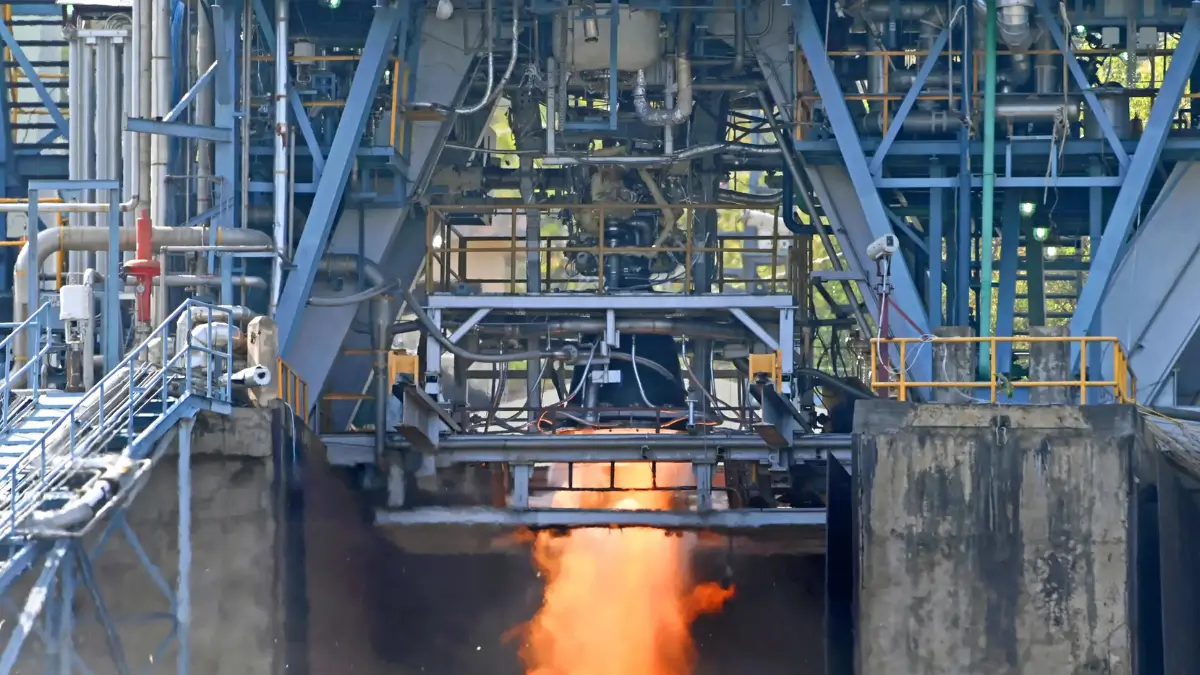
The Indian Space Research Organisation (ISRO) has achieved a significant scientific milestone by successfully carrying out a ground test of its CE20 cryogenic engine at a thrust level of 22 tonnes. This test was conducted at the ISRO Propulsion Complex in Mahendragiri, Tamil Nadu, marking a major advancement in India’s space propulsion technology.
Engineers at ISRO operated the CE20 engine continuously for about 165 seconds, demonstrating sustained performance and stability at high thrust. The CE20 cryogenic engine plays a crucial role in powering the upper stage of India’s Launch Vehicle Mark‑3 (LVM3) — one of the nation’s most powerful rockets used for heavy payload missions.
The 22‑tonne thrust level achieved in this ground test signifies a performance upgrade over past tests, which were previously conducted at lower thrust. This increase in power is critical for enhancing the payload capacity of the LVM3 launch vehicle, allowing it to carry heavier satellites and spacecraft modules into higher orbits.
Importance of the Ground Test
This sea‑level hot test not only validates the engine’s readiness for operational use in future missions but also strengthens India’s self‑reliance in advanced cryogenic propulsion technology. Such tests help engineers fine‑tune engine components like the nozzle protection system and multi‑element igniter under real‑world conditions.
With global space exploration becoming more competitive, this breakthrough places India among the select few nations with advanced cryogenic technology for heavy‑lift rockets. It also paves the way for ambitious missions including potential space station modules, deep space probes, and future human spaceflight programs.

Why This News is Important for Government Exam Aspirants
Enhances Understanding of India’s Space Capabilities
This development reflects India’s progress in high‑tech aerospace engineering — a topic frequently asked in science and technology current affairs sections of UPSC, SSC, banking, railways and defence exams. It showcases the country’s indigenous advancements in rocket propulsion, essential for questions on national achievements and technological competitiveness.
Relevant for Multiple Exam Themes
The test highlights key areas such as ISRO’s role, space exploration strategies, cryogenic engine applications, and the importance of India’s heavy‑lift launch vehicles — all essential facts for general studies papers. Since many exams now include questions on space missions, technological innovation, and research infrastructure, this news strengthens aspirants’ contextual knowledge.
Understanding such milestones helps aspirants connect India’s scientific achievements with broader goals like enhanced satellite deployment, global space partnerships, and future exploratory missions, making their answers more comprehensive and exam‑ready.
Historical Context: India’s CE20 Cryogenic Engine Journey
The CE20 cryogenic engine was developed by the Liquid Propulsion Systems Centre (LPSC), a key laboratory under ISRO. It is designed to power the cryogenic upper stage of the Launch Vehicle Mark‑3 (LVM3), often used to deploy heavy satellites and spacecraft.
Cryogenic engines use liquid hydrogen (LH₂) as fuel and liquid oxygen (LOX) as oxidiser, providing higher efficiency and thrust compared to conventional engines. Historically, mastering cryogenic propulsion has been a challenging technological target for many spacefaring nations.
Over the years, the CE20 underwent several qualification tests, including multiple hot fire tests at different thrust levels, vacuum ignition trials, and sea‑level demonstrations to ensure reliability under real flight conditions. Earlier iterations qualified the engine at thrust levels near 19‑20 tonnes, but the recent successful test at 22 tonnes represents a new benchmark for performance.
This engine is central not just to satellite launches but also to projects like Gaganyaan (India’s human spaceflight programme) and future missions that demand robust upper‑stage propulsion. Its success strengthens India’s capacity to undertake complex space exploration goals independently.
Key Takeaways from ISRO’s CE20 Cryogenic Engine Test
Title: ISRO’s CE20 Cryogenic Engine Ground Test Success
| S.No | Key Takeaway |
|---|---|
| 1 | ISRO successfully conducted a ground test of the CE20 cryogenic engine at 22 tonnes thrust level. |
| 2 | The test was performed at the ISRO Propulsion Complex, Mahendragiri, Tamil Nadu. |
| 3 | The engine ran continuously for approximately 165 seconds during the sea‑level hot test. |
| 4 | Higher thrust capability implies increased payload potential for the LVM3 heavy‑lift launcher. |
| 5 | The CE20 engine is critical for future missions including deep space missions and potential human spaceflight goals. |
FAQs: Frequently Asked Questions
1. What is the CE20 cryogenic engine?
The CE20 is an indigenously developed cryogenic engine by ISRO that uses liquid hydrogen as fuel and liquid oxygen as oxidiser. It powers the upper stage of the LVM3 (Launch Vehicle Mark‑3) for heavy payload missions.
2. Where was the CE20 engine ground test conducted?
The successful ground test was carried out at the ISRO Propulsion Complex, Mahendragiri, Tamil Nadu.
3. What was the thrust level achieved in the recent test?
The CE20 engine achieved a thrust of 22 tonnes during the sea-level hot test, a significant improvement over previous tests.
4. Why is cryogenic technology important for space missions?
Cryogenic engines offer higher efficiency and more thrust, allowing rockets to carry heavier satellites to higher orbits. Mastering cryogenic propulsion is crucial for advanced space missions, including human spaceflight.
5. How does this development benefit India’s space program?
This milestone enhances India’s self-reliance in advanced propulsion technology, improves payload capacity of LVM3, and supports future missions like Gaganyaan and deep-space exploration.
6. How long did the CE20 engine run during the test?
The engine operated for approximately 165 seconds, demonstrating sustained stability and performance.
7. Which ISRO mission primarily uses the CE20 engine?
The Launch Vehicle Mark‑3 (LVM3) uses the CE20 cryogenic engine in its upper stage for launching heavy satellites and spacecraft.
8. What is the significance of sea-level testing?
Sea-level testing validates engine performance under real-world atmospheric conditions, including thermal and structural stability of critical components like the nozzle and igniter.
Some Important Current Affairs Links