








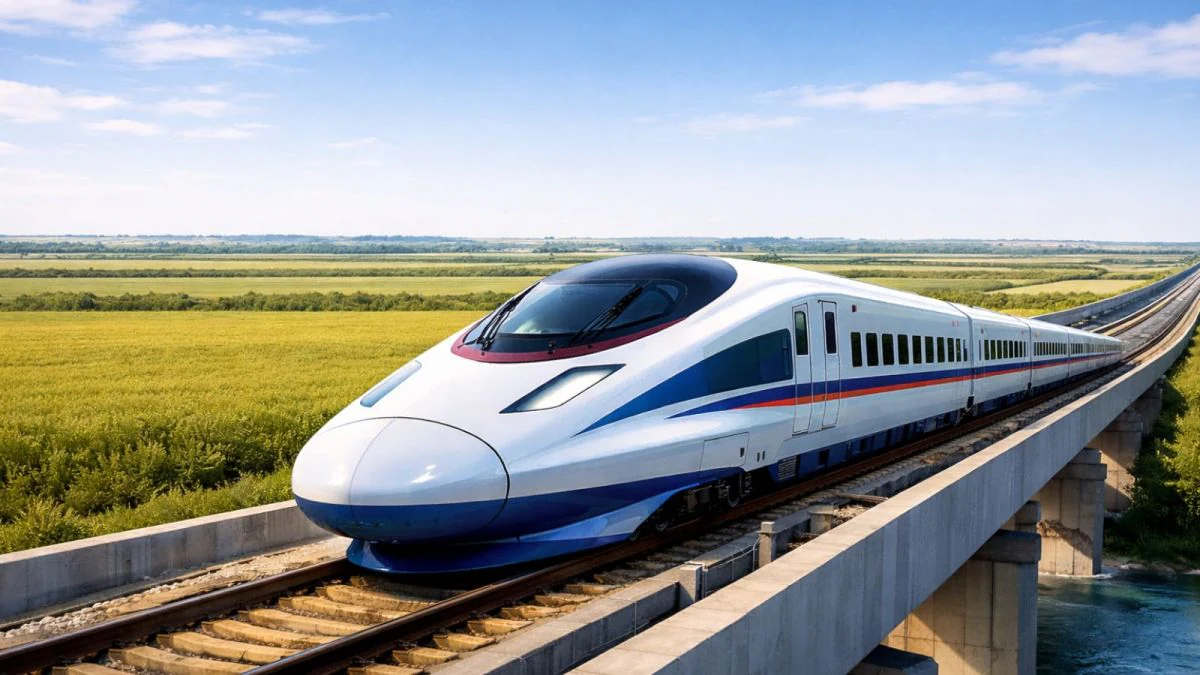
Bullet Train Corridors in India: Indian Railways begins viability assessment of 7 new high-speed rail routes, connecting major cities, boosting regional development, and reducing travel time.
Indian Railways Begins Viability Assessment for 7 New Bullet Train Corridors
Strategic Expansion of High‑Speed Rail Network
Indian Railways has initiated the viability assessment of seven new high‑speed rail corridors across the country, aiming to transform passenger travel, reduce journey times, and accelerate economic growth. This major development follows announcements in the Union Budget 2026‑27, where the government proposed expanding India’s bullet train infrastructure beyond the existing Mumbai‑Ahmedabad corridor.
Routes Identified for New Bullet Train Corridors
The seven proposed corridors span nearly 4,000 kilometres and are expected to cost around ₹16 trillion. These corridors include:
- Mumbai–Pune
- Pune–Hyderabad
- Hyderabad–Bengaluru
- Hyderabad–Chennai
- Chennai–Bengaluru
- Delhi–Varanasi
- Varanasi–Siliguri
These corridors are intended to connect major economic, educational, and industrial hubs, significantly improving connectivity between states in the north, south, east, and central India.
Role of NHSRCL and DPR Updates
The National High Speed Rail Corporation Limited (NHSRCL) has been directed to update the Detailed Project Reports (DPRs) for these routes. This includes revising cost estimates and evaluating financial feasibility before any decision on construction begins.
Railway Board officials have emphasized that standardisation of high‑speed systems, pre‑construction readiness, and dedicated planning teams are essential to ensure timely execution.
Benefits of Expanding Bullet Train Network
If implemented, these high‑speed corridors will:
- Reduce travel times significantly — for example Chennai to Bengaluru is expected in just over 1 hour.
- Promote regional development and economic integration by linking cities and industrial clusters.
- Boost employment through construction and allied services.
- Enhance technological capabilities in rail infrastructure.
Connecting Southern and Eastern Growth Engines
Rather than focusing only on the west ‑ where the first Mumbai‑Ahmedabad bullet train is under construction ‑ the new proposals focus on connecting the south and east of India, strengthening ties between cities like Hyderabad, Bengaluru, Chennai, and Varanasi.

Why This News Is Important for Exam Aspirants
Boost to Infrastructure and National Connectivity
The decision to assess seven new bullet train corridors signals a transformational shift in India’s transport infrastructure. High‑speed rail is not just about faster trains — it’s about building robust connectivity that supports industrial growth, urbanisation, and mobility. Such developments are often asked in government exams under Current Affairs — Economy & Infrastructure, highlighting India’s long‑term strategic planning and investment priorities.
Alignment with Union Budget Goals
This news is directly linked to the Union Budget 2026‑27, where the finance minister proposed these corridors as “growth connectors” to drive sustainable transport and regional integration. Understanding this linkage helps aspirants answer questions on budgetary allocations, national priorities, and policy decisions.
Relevance to Multiple Exam Sections
- Economy & Budget: Budgetary focus on infrastructure and capital investments.
- Science & Technology: High‑speed rail technology and engineering standards.
- Geography: Mapping new corridors across regions.
- General Awareness: Government initiatives impacting social and economic development.
Long‑Term Vision and Global Competitiveness
With India aiming to scale up high‑speed rail infrastructure, it reflects a long‑term vision of modernising transport networks, competing globally, and joining countries with advanced HSR systems. This can be a valuable point for essay writing and interviews.
Historical Context: Evolution of Bullet Train Initiatives in India
Origin with Mumbai‑Ahmedabad High‑Speed Rail
India’s bullet train journey began with the Mumbai‑Ahmedabad high‑speed rail project, undertaken with Japanese collaboration and Shinkansen technology. This flagship project is expected to dramatically reduce travel time between the two major cities and serve as a template for future corridors.
From Single Project to Multicorridor Vision
Earlier, India focused on just one high‑speed corridor. But the Union Budget 2026‑27 marked a significant shift by announcing seven new corridors — underlining the government’s ambition to build an extensive high‑speed rail network.
Policy Shift and Investment Trends
Over recent years, Indian Railways has emphasised:
- Indigenisation of rail tech, especially in signaling and construction.
- Infrastructure funding increases through successive budgets.
- Integration of high‑speed rail with national growth plans — recognising its impact on the economy and mobility.
This evolution highlights a broader movement from incremental rail upgrades to a future‑ready, modern transport ecosystem.
Key Takeaways from Railways Begins Viability Assessment for 7 New Bullet Train Corridors
| S. No. | Key Takeaway |
|---|---|
| 1 | Seven new bullet train/high‑speed rail corridors are being assessed across India. |
| 2 | The total network will span nearly 4,000 km with an estimated cost of ₹16 trillion. |
| 3 | NHSRCL has been tasked to update Detailed Project Reports (DPRs) for feasibility and cost revision. |
| 4 | Major cities like Mumbai, Pune, Hyderabad, Bengaluru, Chennai, Delhi, Varanasi, and Siliguri will be connected. |
| 5 | The proposal was announced in the Union Budget 2026‑27 to strengthen connectivity and economic integration. |
FAQs: Frequently Asked Questions
1. What is the latest development in India’s bullet train network?
Indian Railways has begun the viability assessment of seven new high-speed rail corridors across India to expand the bullet train network beyond the Mumbai–Ahmedabad route.
2. Which are the seven new proposed bullet train corridors?
The corridors include Mumbai–Pune, Pune–Hyderabad, Hyderabad–Bengaluru, Hyderabad–Chennai, Chennai–Bengaluru, Delhi–Varanasi, and Varanasi–Siliguri.
3. Which organization is responsible for preparing Detailed Project Reports (DPRs) for the new corridors?
The National High-Speed Rail Corporation Limited (NHSRCL) is responsible for updating DPRs and assessing financial feasibility.
4. How will these new bullet train corridors benefit India?
The corridors are expected to reduce travel time, promote regional development, boost employment, enhance connectivity between major cities, and strengthen technological capabilities in rail infrastructure.
5. What is the estimated cost and length of the new high-speed rail network?
The proposed seven corridors are expected to span nearly 4,000 km and cost approximately ₹16 trillion.
6. How is this news relevant to government exam preparation?
This news covers current affairs related to infrastructure, economy, Union Budget allocations, technology, and regional development, making it highly relevant for UPSC, PCS, SSC, Railways, Banking, and Defence exams.
7. What was India’s first bullet train project?
India’s first bullet train project is the Mumbai–Ahmedabad high-speed rail corridor, implemented with Japanese Shinkansen technology.
Some Important Current Affairs Links