









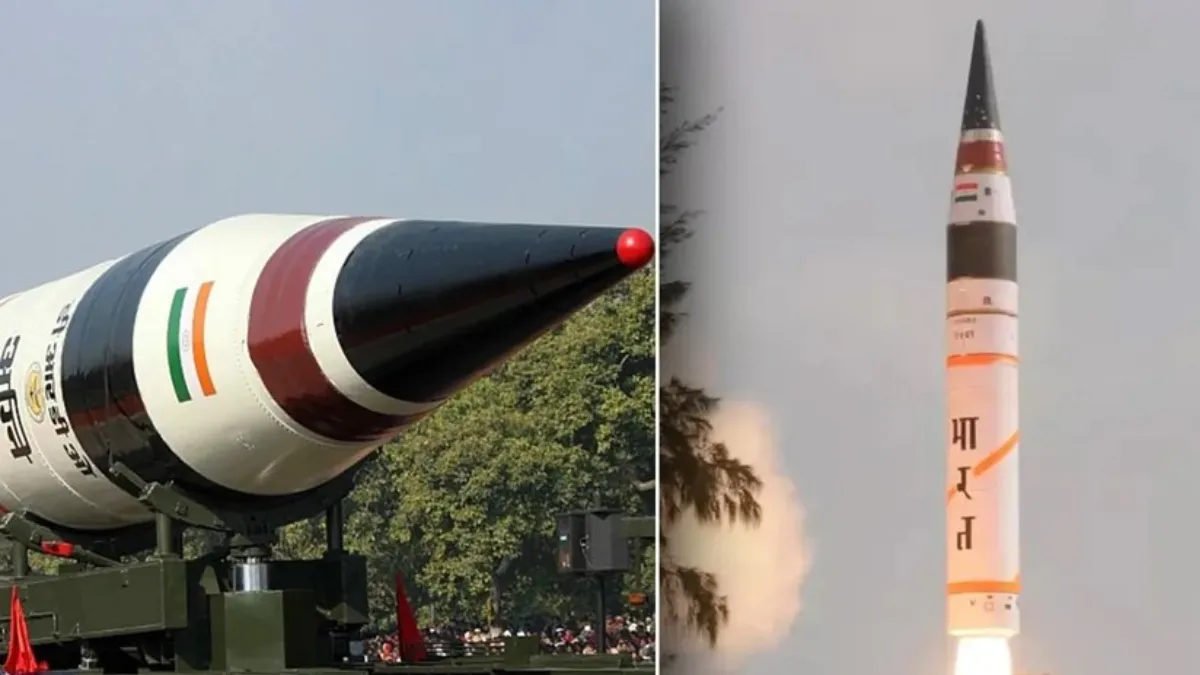
Agni 5 missile test 2025 successfully conducted by India from Chandipur, Odisha. Learn about Agni V missile range, features, strategic significance, and exam-relevant details for UPSC, Defence, Banking, and SSC aspirants.
India Successfully Test-Fires Agni-5 Intermediate-Range Ballistic Missile
India Achieves Major Milestone with Agni-5 Test
On August 20, 2025, India successfully test-fired its advanced Agni-5 Intermediate-Range Ballistic Missile (IRBM) from the Integrated Test Range (ITR) in Chandipur, Odisha. The launch, overseen by the Strategic Forces Command, validated all operational and technical parameters, marking a significant stride in India’s strategic warfare capabilities.
Enhancing Long-Range Strike and Deterrence
The Agni-5 missile, capable of carrying nuclear warheads, boasts a formidable range of up to 5,000 km, empowering India to strike deep into Asia and parts of Europe, including strategic regions like Turkey and China. This launch significantly strengthens India’s deterrence and long-range strike capabilities.
Strengthening National Security Architecture
This successful test underscores India’s progress in self-reliant defense technologies. It enhances the country’s nuclear deterrence posture, reinforcing its stance under the “No First Use” doctrine while advancing the credible minimum deterrent policy.
Regional and Global Strategic Implications
The launch has drawn regional attention, most notably from Pakistan, which views the development with concern due to the shifting strategic balance. It also sends a clear strategic signal to China, reaffirming India’s capabilities amid evolving geopolitical dynamics in South Asia.

Why This News Is Important
Strategic Deterrence and Security Posture
This test is a major boost for India’s strategic deterrence. With the Agni-5, India now possesses the ability to project power across a broader geography, injecting increased credibility into its second-strike capability––a cornerstone of nuclear deterrence. This development resonates across domains such as national security and defense policy, directly influencing exam topics in Defence, Civil Services, and PSCS.
Geopolitical Significance
The successful launch bears high geopolitical significance, especially in a region marked by complex India–China–Pakistan dynamics. It enhances India’s negotiating strength, strategic autonomy, and geostrategic posture—critical for students preparing for exams focusing on International Relations and Strategic Affairs.
Historical Context
Evolution of the Agni Missile Programme
India’s Agni missile programme began under the Integrated Guided Missile Development Programme (IGMDP) in the 1980s, spearheaded by Dr. A. P. J. Abdul Kalam. The series evolved from short-range variants like Agni-I (700–1,200 km) to Agni-IV (up to 4,000 km) and eventually to Agni-V, India’s first intercontinental ballistic missile (ICBM).
Agni-5: A Strategic Leap
Agni-5, a three-stage, solid-fuel, canisterized ICBM with MIRV potential (Multiple Independently Targetable Re-entry Vehicle), represents India’s entry into the elite club of nations with advanced intercontinental strike capabilities like the US, Russia, China, etc.
Policy Alignment
The Agni-5 test aligns with India’s No First Use nuclear policy and its commitment to a credible minimum deterrence—a strategic doctrine focused on ensuring survivable second-strike potential rather than offensive preemptive capabilities.
Key Takeaways from This News
| S. No. | Key Takeaway |
|---|---|
| 1 | Successful Test Date & Location: Agni-5 was test-fired on August 20, 2025, from Chandipur, Odisha under the aegis of Strategic Forces Command. |
| 2 | Extended Range Capability: The missile has a range of up to 5,000 km, enabling India to target deep into Asia and Europe. |
| 3 | Strategic Deterrence Boost: The launch strengthens India’s nuclear deterrence and second-strike capabilities under its No First Use doctrine. |
| 4 | MIRV and Technological Edge: Agni-5 is MIRV-capable, enhancing target flexibility and survivability against missile defenses. |
| 5 | Regional Geopolitical Impact: The success draws global attention, raising concerns in Pakistan and China, and reasserting India’s defense readiness. |
FAQs – Frequently Asked Questions
1. What is the Agni-5 missile?
Agni-5 is an Intermediate-Range Ballistic Missile (IRBM) developed by India’s DRDO. It has a range of up to 5,000 km and is capable of carrying nuclear warheads.
2. When and where was the Agni-5 missile last successfully tested?
The Agni-5 missile was successfully test-fired on 20th August 2025 from the Integrated Test Range (ITR), Chandipur, Odisha.
3. Who conducted the test launch of Agni-5?
The test was conducted under the supervision of the Strategic Forces Command (SFC) with support from the Defence Research and Development Organisation (DRDO).
4. Why is the Agni-5 test significant for India’s defense strategy?
It significantly strengthens India’s nuclear deterrence and second-strike capability, giving the country the ability to reach strategic targets across Asia and parts of Europe.
5. What is India’s nuclear policy related to missile deployment?
India follows a No First Use (NFU) policy and maintains a doctrine of credible minimum deterrence.
6. What technology does Agni-5 use?
Agni-5 is a three-stage, solid-fueled, canisterized missile and is capable of MIRV (Multiple Independently Targetable Re-entry Vehicle) deployment.
7. Which countries fall within the range of Agni-5?
Agni-5 can cover almost all of Asia (including China and Pakistan) and extend into parts of Europe (Turkey, Eastern Europe).
8. What is the historical importance of the Agni missile program?
The Agni program began under the Integrated Guided Missile Development Programme (IGMDP) in the 1980s led by Dr. A.P.J. Abdul Kalam, evolving from short-range to intercontinental capabilities.
9. How does the Agni-5 test affect India’s geopolitical standing?
It boosts India’s strategic credibility and sends a strong signal to rivals, particularly China and Pakistan, regarding India’s deterrence capabilities.
10. Which exams are likely to ask questions about the Agni-5 missile?
This topic is relevant for UPSC (Prelims & Mains), State PCS, Defence exams (NDA, CDS, CAPF), Banking awareness, SSC, Railways, and Police recruitment tests.
Some Important Current Affairs Links