










20% ethanol blending India milestone achieved ahead of 2030: learn how E20 boosts farmer income, cuts CO₂ by 698 lakh tonnes, and saves ₹1.36 lakh crore in forex.
India Achieves 20% Ethanol Blending in Petrol – An Ahead-of-Schedule Milestone
Introduction
India’s ambitious 20% ethanol blending (E20) target in petrol has been successfully achieved in early 2025, a full five years before the original 2030 deadline, marking a significant victory in the nation’s renewable energy journey
Originally set in the National Policy on Biofuels (2018) and amended in 2022, this target reflects India’s commitment to cleaner energy and reduced fossil fuel dependence
Growth in Ethanol Blending Rates
Back in 2014, ethanol constituted only 1.5% of petrol blending. As of June 2025, that figure soared to 20%, supported by a rise in ethanol production from 38 crore litres to 661 crores
By March 2025, Oil Marketing Companies had already achieved an 18.4% blending level, showing strong momentum even before hitting E20
Economic & Farmer Income Benefits
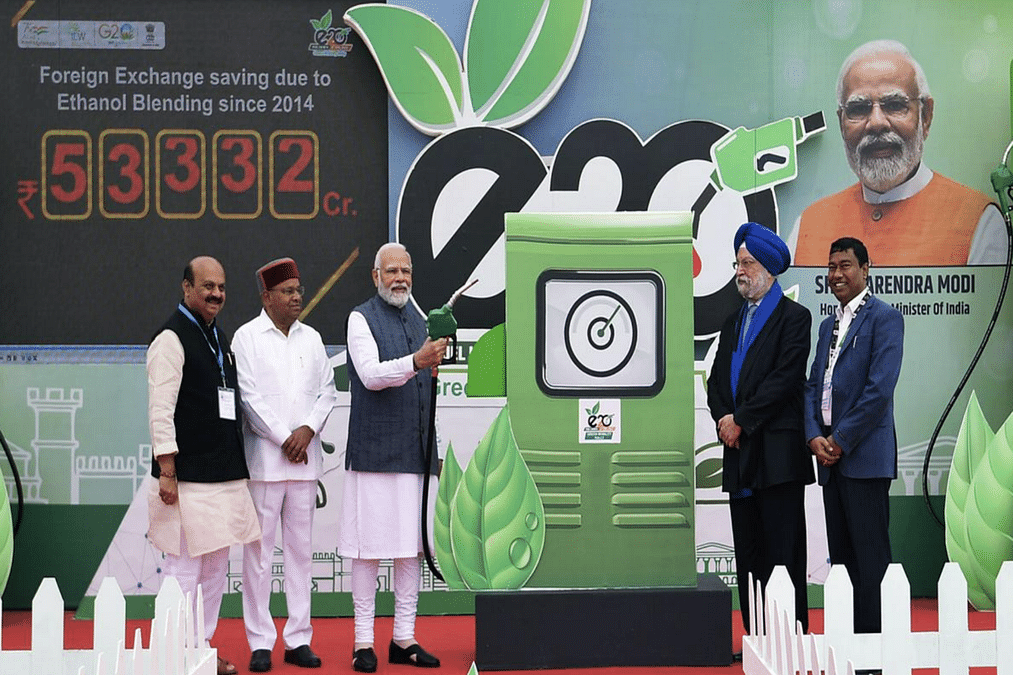
The ethanol blending initiative has boosted rural income and agricultural revenue. Farmers received ₹1.18 lakh crore, and distilleries earned ₹1.96 lakh crore. Additionally, India saved approximately ₹1.36 lakh crore in foreign exchange by cutting fuel imports
Environmental Impact
Ethanol blending helped reduce carbon dioxide emissions by about 698 lakh tonnes, contributing to India’s climate mitigation goals
Role of Sectors and Policy
Sugar mills, particularly through sugarcane juice, B-heavy molasses, and crop residue, have been the backbone of ethanol supply. The energy and sugar industries, guided by a series of policy interventions post‑2014, were instrumental in enabling this leap
B) Why This News Is Important for Exam Aspirants
Energy Security and Consumer Benefits
Achieving E20 blending ahead of schedule reduces India’s reliance on crude oil imports and strengthens energy security. The savings in foreign exchange (about ₹1.36 lakh crore) directly impact macroeconomic stability and consumer pricing
Green Growth and Policy Success
For exams like UPSC, State PSC, and Environment-related tests, this success is a strong example of policy-driven progress in renewable energy, aligning with India’s climate commitments and sustainable development goals.
Rural Uplift and Farmer Welfare
This initiative channels hundreds of crores of rupees to farmers and distilleries, demonstrating government policy’s social and economic impact on rural incomes and agro-industry growth.
Module on Sustainability in Government Exams
Topics covering sustainable fuel, clean energy transition, and biofuel policy are increasingly prominent in railway, defence, banking, and civil services exams. This achievement provides a real-world case study.
C) Historical Context: From 5% to 20% and Beyond
Early Ethanol Blending Efforts
Under PM Vajpayee, a 5% blending committee was formed, but implementation lagged during 2009–2014 due to policy hesitation tied to food security concerns
Policy Reboot from 2014 Onwards
The NDA government under PM Modi re‑energized biofuel policy. The 2018 National Policy on Biofuels (later amended in 2022) accelerated the blending roadmap—setting E20 for 2025–26 instead of 2030
Progressive Realization
By May 2022, the government hit the 10% blending milestone, months before the deadline. This rapid acceleration laid the groundwork for reaching 20% well ahead of schedule
D) Key Takeaways from this News
Key Takeaways from “India Achieves 20% Ethanol Blending in Petrol”
| S. No. | Key Takeaway |
|---|---|
| 1 | India achieved its 20% ethanol blending in petrol in early 2025, five years ahead of the 2030 target. |
| 2 | Ethanol blending grew from 1.5% in 2014 to 20% by mid‑2025, with production rising from 38 to 661 crore litres. |
| 3 | The initiative saved ₹1.36 lakh crore in foreign exchange and generated ₹1.18 lakh crore for farmers and ₹1.96 lakh crore for distilleries. |
| 4 | India reduced 698 lakh tonnes of CO₂ emissions through ethanol blending. |
| 5 | Policy shifts from 2014 onwards—especially the National Policy on Biofuels (2018, amended 2022)—were crucial in accelerating the ethanol blending agenda. |
FAQs (Exam-Focused)
What is the role of ISMA in ethanol blending?
Indian Sugar Mills Association (ISMA) helps coordinate supply, capacity building, and policy feedback.
What does E20 mean?
E20 refers to petrol blended with 20% ethanol and 80% fossil petrol.
When did India achieve 20% ethanol blending?
India achieved E20 in early 2025, well ahead of the originally stated 2030 timeline.
Which policy laid the roadmap for ethanol blending?
The National Policy on Biofuels, 2018 (amended in 2022) provided the structured roadmap.
What was India’s ethanol blending level in 2014?
About 1.5%.
Which sectors benefit economically from ethanol blending?
Farmers, distilleries, and Oil Marketing Companies (OMCs) benefit directly; the economy gains via FOREX savings.
How much CO₂ reduction is attributed to ethanol blending?
Approximately 698 lakh tonnes of CO₂ reduction has been reported.
How much foreign exchange has India saved through ethanol blending?
Around ₹1.36 lakh crore.
What major feedstocks are used for ethanol in India?
Sugarcane juice, B-heavy molasses, damaged food grains, surplus rice, and crop residues.
Which ministries are primarily involved?
Ministry of Petroleum & Natural Gas, Ministry of Consumer Affairs, Food & Public Distribution, and Ministry of Agriculture.
What was the target year for E20 before it was advanced?
Initially 2030, later advanced to 2025–26.
Has India considered increasing the blending target beyond 20%?
Yes, discussions around E27 (27% blending) have been reported.
What are the key benefits of ethanol blending for farmers?
Higher assured procurement prices, diversified revenue streams, and reduced cane arrears.
What are the challenges in sustaining E20?
Feedstock availability, water use in sugarcane, distillery capacity, and vehicle compatibility.
Is E20 compatible with all vehicles?
Newer E20-compliant vehicles are designed for it; older vehicles may face performance or warranty issues if not approved.
Some Important Current Affairs Links




