






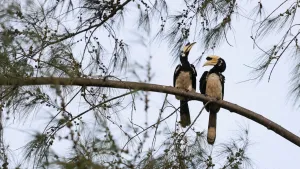
Hornbill Conservation Centre Anamalai Tiger Reserve to be India’s first centre of excellence for hornbill protection. ₹1 crore sanctioned by Tamil Nadu govt to conserve four native hornbill species and promote ecological research in the Western Ghats.
Tamil Nadu to Establish India’s First Centre of Excellence for Hornbill Conservation at Anamalai Tiger Reserve
Introduction
The Tamil Nadu government has approved ₹1 crore to establish India’s first Centre of Excellence for Hornbill Conservation at the Anamalai Tiger Reserve (ATR) in Coimbatore district Located in the ecologically rich Western Ghats, this initiative aims to deepen scientific understanding and protect hornbill species endemic to this biodiversity hotspot.
Objectives of the Conservation Centre
The centre will focus on comprehensive activities including research on movement ecology, breeding habits, genetic diversity, and climate impact studies of hornbills Habitat restoration will be central—through protecting nesting sites, raising native saplings in nurseries, and installing artificial nest boxes
Research & Training Infrastructure
Facilities will include laboratories, seminar halls, training rooms, and accommodations for researchers and trainees. The ATR’s foothills are being considered for land allocation Research collaborations are planned with leading institutions like the Nature Conservation Foundation (NCF), SACON, Wildlife Institute of India (WII), and the Advanced Institute for Wildlife Conservation
Species Coverage & Monitoring Strategy
The centre will focus on four hornbill species native to the Western Ghats: the Great Indian Hornbill, Malabar Grey Hornbill, Malabar Pied Hornbill, and Indian Grey Hornbill Monitoring will employ tools like distance sampling, GPS telemetry, and phenological mapping of food and nest trees
Community Engagement & Outreach
Local communities will be actively involved through nest adoption schemes, scholarship support for aspiring students of ecology, sustainable livelihoods via seed collection, and citizen science through apps linked to global platforms like GBIF and eBird Educational outreach including school visits and field trips is also planned
Geographic Expansion & Broader Vision
Beyond ATR, similar efforts will be rolled out in Kalakkad Mundanthurai Tiger Reserve (KMTR), Sathyamangalam Tiger Reserve (STR), and parts of Kanyakumari district to reinforce hornbill conservation across the Western Ghats

Why This News Is Important
Significance for Biodiversity & keystone species
Hornbills are often referred to as “farmers of the forest” because they disperses seeds of native trees, playing a crucial ecological role in forest rehabilitation. Protecting these keystone species is essential for maintaining forest ecosystems, especially in the ecologically sensitive Western Ghats
Policy & Government Focus on Environmental Sustainability
This move signifies proactive environmental governance under the Endangered Species Conservation Corpus Fund, marking a milestone in wildlife protection policy. It also sets a precedent for state-level conservation excellence centres focusing on threatened species.
Relevance for Exam Syllabi
For students preparing for UPSC, State PSCs, SSC, Banking, Railways, Defence, and Teaching Exams:
- This initiative aligns with GS Paper‑3 topics like Biodiversity Conservation, Environmental Governance, and Forest Policy.
- It is also a strong case study under environmental ecology and biodiversity sections for prelims and mains.
Enhancing Local Livelihood & Community-Based Conservation
The project integrates community participation, offering sustainable incomes through seed germination and nest-protection programs. This exemplifies modern conservation models that blend ecological science with social empowerment.
Historical Context & Background
Forest Conservation in Tamil Nadu
Tamil Nadu has a legacy of biodiversity projects such as the Dugong Conservation Reserve, Nilgiri Tahr project, and Slender Loris Conservation Centre. The state’s forest department has actively engaged in ecological restoration, eco‐development, and community empowerment under legal frameworks like the Wildlife Protection Act, 1972
Importance of Anamalai Tiger Reserve
Located in the Anaimalai Hills, ATR is known for its rich wildlife including tigers, elephants, lion‐tailed macaques, and over 250 bird species—including key hornbill species Its ecological diversity and established infrastructure made it the ideal site for India’s first hornbill conservation centre.
Growing Threats to Hornbills
Hornbill populations in the Western Ghats—particularly the Great Hornbill and Malabar Grey Hornbill—face increasing threats from habitat loss, fragmentation, and climate change. Most hornbill species fall under the highest protection category of India’s Wildlife Protection Act, 1972, yet remain vulnerable without focused and sustained conservation efforts
Key Takeaways from Hornbill Conservation Centre at Anamalai Tiger Reserve
| # | Key Takeaway |
|---|---|
| 1 | ₹1 crore allocated under Tamil Nadu’s Endangered Species Conservation Corpus Fund for the Centre of Excellence for Hornbill Conservation at ATR. |
| 2 | Focus on four Western Ghats hornbill species: Great Indian Hornbill, Malabar Grey, Malabar Pied, and Indian Grey Hornbills. |
| 3 | Research and habitat management efforts include population monitoring, nest mapping, GPS telemetry, sapling nursery, and artificial nest boxes. |
| 4 | Collaboration with institutions like NCF, SACON, WII, IUCN Hornbill Specialist Group to augment conservation and research. |
| 5 | Community involvement through nest adoption, scholarships, seed-based livelihoods, and citizen‑science outreach. |
FAQs: Frequently Asked Questions
1. What is the Hornbill Conservation Centre in Tamil Nadu?
It is India’s first Centre of Excellence for Hornbill Conservation, being set up at Anamalai Tiger Reserve in Tamil Nadu, to protect and research hornbill species native to the Western Ghats.
2. How much funding has the Tamil Nadu government approved for this initiative?
The state has sanctioned ₹1 crore under the Endangered Species Conservation Corpus Fund to establish the centre.
3. Which hornbill species will the centre focus on?
The centre will primarily work on four species:
- Great Indian Hornbill
- Malabar Grey Hornbill
- Malabar Pied Hornbill
- Indian Grey Hornbill
4. What is the ecological importance of hornbills?
Hornbills are keystone seed dispersers and are often called the “farmers of the forest,” playing a vital role in maintaining the health of forest ecosystems.
5. Where is the Anamalai Tiger Reserve located?
It is located in Coimbatore district, Tamil Nadu, in the Anaimalai Hills of the Western Ghats, a UNESCO World Heritage biodiversity hotspot.
6. What kind of research will be conducted at the centre?
Research will include movement ecology, nesting patterns, food tree mapping, genetic diversity studies, and climate resilience of hornbills.
7. Will the local community be involved?
Yes, community participation includes nest adoption schemes, eco-education, scholarships, and income through seed collection.
8. What institutions will collaborate with the conservation centre?
Collaborators include SACON, NCF, Wildlife Institute of India (WII), IUCN Hornbill Specialist Group, and others.
9. Is this project relevant to competitive exams?
Yes. It is relevant for UPSC, State PSCs, SSC, Banking, Railways, Defence, and Teaching exams under Biodiversity, Environmental Governance, and Current Affairs.
10. What future plans are included in this initiative?
Expansion to KMTR, Sathyamangalam Tiger Reserve, and Kanyakumari district to strengthen hornbill conservation across the Western Ghats.
Some Important Current Affairs Links