





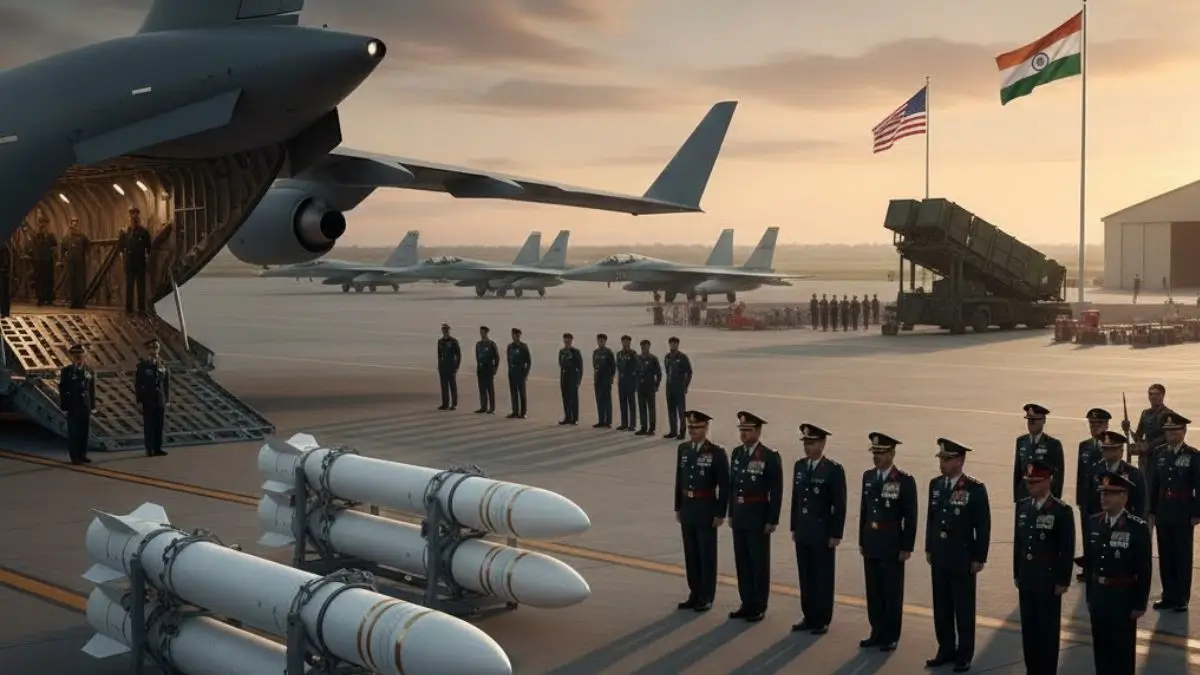
US approves strategic $93 million missile sale to India, including Excalibur artillery shells and Javelin anti-tank missiles. Strengthening India-U.S. defence partnership and regional security.
US approves strategic $93 million missile sale to India
In a notable development in India’s defence procurement and bilateral ties with the United States, the U.S. State Department has approved a defence sale package worth approximately US $93 million to India. The deal encompasses advanced precision‑guided artillery and anti‑tank missile systems, underscoring India’s growing focus on enhancing operational capability in border and high‑altitude terrain, and the U.S.’s strategic interest in bolstering a key Indo‑Pacific partner.
Approved systems and quantities
Key components of the sale include up to 216 units of M982A1 Excalibur precision‑guided artillery shells valued at around US $47.1 million, supplied by RTX Corporation (formerly Raytheon Technologies).
Additionally, the package includes 100 FGM‑148 Javelin anti‑tank missile systems plus 25 LwCLU (Lightweight Command Launch Units) valued at about US $45.7 million.
Other deliverables cover fire‑control systems, simulation/training gear, maintenance kits, technical assistance, and operator documentation—all enabling seamless integration into India’s forces.
Strategic significance for India’s defence posture
By acquiring these systems, India strengthens two critical domains: precision long‑range artillery and mobile anti‑armour capability. The Excalibur rounds allow for long‑range, high‑accuracy strikes with minimal collateral damage, while Javelin brings a “fire‑and‑forget” capability against armour in varied terrain—particularly relevant for high‑altitude border sectors.
The U.S. has clarified that deployment and maintenance of these systems will not require U.S. personnel oversight, ensuring India’s operational autonomy.
Impact on Indo‑US defence ties and regional dynamics
This deal forms part of the broader U.S. strategy of supporting India as a “Major Defence Partner,” a status that eases defence exports and fosters deeper cooperation.
The agreement is also positioned as contributing to regional stability and deterrence in the Indo‑Pacific, signalling both nations’ shared goal of countering emerging threats and enhancing interoperability. Although the official assertion is that the sale “will not change the military balance in South Asia,” the qualitative upgrade for India’s forces is significant.
Defence‑modernisation relevance for India
Under its long‑term strategic objective of achieving a modern, self‑reliant defence posture and enhancing interoperability with friendly nations, India’s decision to procure these advanced systems is timely.
The emphasis on precision‑strike capabilities and anti‑tank warfare reflects evolving threats in border regions and across the Indo‑Pacific theatre. For students preparing for government exams—especially in defence, civil services or related domains—this news highlights key themes: military diplomacy, procurement, strategic partnerships and defence capability building.

Why this News is Important
Relevance for aspirants across sectors
Whether you are preparing for positions in the police, railways, banking, teaching or the civil services (such as Union Public Service Commission exams), staying updated on significant defence‑related developments is crucial. Defence procurement is a recurring theme in General Studies papers under topics like India’s foreign policy, internal and external security, strategic partnerships and defence technology. The announced missile sale therefore is directly relevant for such examinations.
Strategic and geopolitical implications
The agreement underscores the deepening strategic partnership between India and the U.S., highlighting how defence diplomacy is leveraged as part of broader geopolitical objectives in the Indo‑Pacific. Recognising such linkages strengthens your understanding of India’s role in regional security—knowledge beneficial for interviews and essays.
Linkage with domestic defence modernisation
For aspirants aiming at civil or defence services, this sale illustrates how India is modernising its armed forces by integrating precision‑guided munitions and anti‑armour weapons. Understanding this helps with analysing defence budget allocations, indigenous production versus import decisions, and the implications for India’s security environment.
Implications for exam themes
Key exam themes this news touches upon include: India’s strategic partnerships, defence procurement processes, border and Indo‑Pacific security dynamics, and the role of advanced weapons in modern warfare. Awareness of such current affairs increases your preparedness for scenario‑based questions, short answer questions and descriptive essays.
Historical Context
India–U.S. defence ties over the years
India and the U.S. have been steadily deepening their defence relationship since the early 2000s—with key milestones such as the 2005 Defence Framework Agreement, the elevation of India to “Major Defence Partner” status in 2016, and successive defence‑technology transfers and co‑development agreements. The current missile‑sale approval builds upon this legacy.
Evolution of India’s defence procurement strategy
In the past, India relied heavily on large conventional imports. Over the decades there has been a shift towards precision, high‑technology weapons systems, increasing indigenous production (via Defence Research and Development Organisation and Indian private sector), and diversifying supply partners to include the U.S., Europe and Israel. The recent deal is symptomatic of that shift.
Regional security backdrop
India shares land borders with major adversaries, and high‑altitude, mountainous terrain has posed operational challenges. The demand for precision‑guided artillery and portable anti‑tank missiles increases in such contexts. Meanwhile, in the broader Indo‑Pacific domain, maritime and land security concerns—including China’s assertiveness—have pushed India to bolster its deterrence profile. The U.S., for its part, views India as a counter‑weight in the Indo‑Pacific security architecture.
Significance of the systems involved
The M982A1 Excalibur was developed as a GPS/inertial‑navigation guided artillery shell with extended range and high precision. The FGM‑148 Javelin, meanwhile, is a man‑portable, fire‑and‑forget anti‑tank missile with infrared guidance and proved performance in multiple theatres. This deal therefore aligns India’s arsenal more closely with modern standards for precision and mobility.
Key Takeaways from “US approves strategic $93 million missile sale to India”
| S No | Key Takeaway |
|---|---|
| 1 | The U.S. has approved a defence sale to India worth approximately US $93 million (~₹775 crore). |
| 2 | The sale includes up to 216 M982A1 Excalibur precision‑guided artillery shells, valued at about US $47.1 million. |
| 3 | Included are 100 FGM‑148 Javelin anti‑tank missile systems + 25 CLUs, valued at around US $45.7 million. |
| 4 | The systems will enhance India’s long‑range precision‑strike and mobile anti‑armour capabilities—particularly relevant for border and high‑altitude operations. |
| 5 | The deal is part of India’s defence‑modernisation push and strengthens the India‑U.S. strategic partnership, enabling deeper military cooperation in the Indo‑Pacific region. |
FAQs: Frequently Asked Questions
1. What is the value of the U.S. missile sale to India?
The U.S. approved a defence sale package worth approximately US $93 million.
2. Which missile systems are included in the deal?
The package includes 216 M982A1 Excalibur precision-guided artillery shells and 100 FGM‑148 Javelin anti-tank missile systems with 25 Lightweight Command Launch Units (LwCLUs).
3. Which companies are supplying the weapons to India?
Excalibur shells are supplied by RTX Corporation (Raytheon Technologies), while Javelin missiles are also from Raytheon/Lockheed Martin collaboration.
4. Why is this deal strategically important for India?
It strengthens India’s long-range precision-strike capability and mobile anti-armour capability, especially in high-altitude border regions.
5. How does this impact India–U.S. relations?
The sale reinforces India’s position as a Major Defence Partner and deepens bilateral defence cooperation in the Indo-Pacific.
6. Will U.S. personnel be involved in operating these systems in India?
No. India will operate and maintain the systems independently, ensuring full operational autonomy.
7. How does this deal contribute to India’s defence modernisation?
It aligns with India’s long-term goal of modernising its armed forces, integrating advanced precision and portable weapon systems.
8. How does this relate to regional security in the Indo-Pacific?
The sale signals strategic deterrence in the Indo-Pacific, enhancing India’s capabilities amid evolving border and regional security dynamics.
Some Important Current Affairs Links