






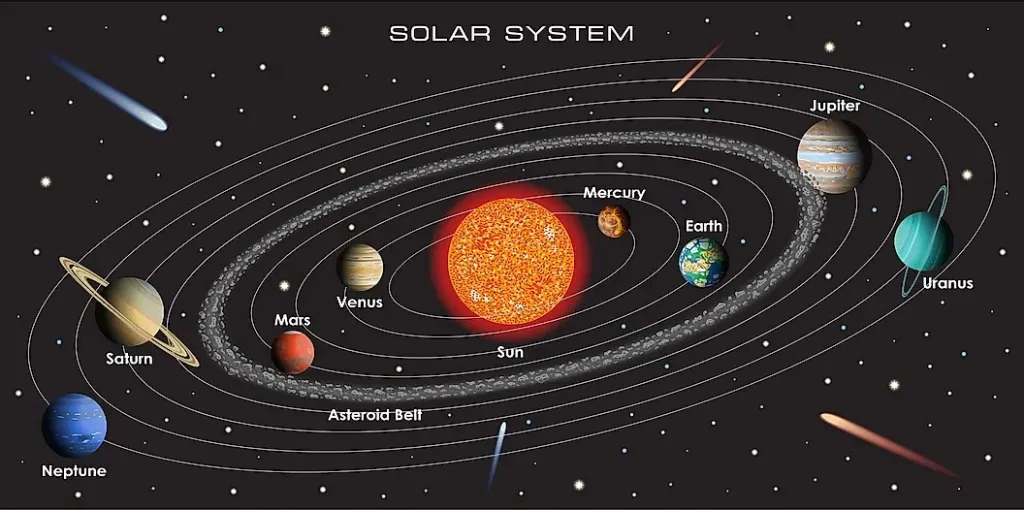
“Which is the Only Planet in Our Solar System That Has Life?”
Introduction: The Quest for Life Beyond Earth
In the vast expanse of the cosmos, Earth stands alone as the only planet known to harbor life. While scientists continue to search for signs of life on other planets and moons, Earth remains the singular example of a planet where conditions are just right for the emergence and sustenance of living organisms. This fact is fundamental to various scientific studies, especially for students preparing for government exams in fields like science, technology, and environment.
Why Earth is the Only Planet with Life
Earth’s unique position in the solar system and its specific characteristics contribute to its ability to support life. The presence of liquid water, an oxygen-rich atmosphere, a moderate climate, and a magnetic field that shields the planet from harmful solar radiation makes Earth uniquely habitable. These factors create a delicate balance that has allowed life to thrive, ranging from microscopic organisms to complex ecosystems.
The Search for Life on Other Planets
Despite extensive exploration of other planets, including Mars, Venus, and moons like Europa, no direct evidence of life has been found. However, scientists continue to explore the possibility of microbial life on planets or moons that have similar environmental conditions to Earth in the distant past or present. Advancements in technology, such as telescopes and rovers, are crucial in these ongoing efforts.
Future Exploration and Its Importance
The study of life beyond Earth holds great significance in understanding our planet and the universe. For students studying for competitive exams like UPSC, it is important to recognize the ongoing efforts in space exploration and the scientific methods used to study planets. This research not only helps in understanding extraterrestrial life but also provides insights into how life on Earth evolved and how we can preserve it.

Why This News is Important
Significance in Understanding Life
The fact that Earth is the only planet in the solar system known to support life is a cornerstone of modern science. This information is vital for students preparing for government exams, as it touches on key topics in fields like biology, environmental science, and astronomy. Understanding what makes Earth habitable can provide insights into the nature of life itself and the critical conditions that sustain it.
Space Exploration and Technological Advancements
The search for life on other planets is a critical aspect of space exploration. This subject is highly relevant for exams like the IAS, where questions on space missions, technology, and their impact on science and society are common. By studying the quest for extraterrestrial life, students gain an appreciation for the advancements in scientific tools and methods, such as rovers and space telescopes.
Historical Context: Background Information on Space Exploration
The idea of life beyond Earth has fascinated humans for centuries. In the early 20th century, scientists began developing theories about the possibility of life on other planets. With the launch of the first artificial satellite, Sputnik 1, in 1957, and the subsequent space missions by NASA and other space agencies, the possibility of discovering life on other planets became a prominent scientific pursuit. Key missions like the Mars rovers and the exploration of Europa, one of Jupiter’s moons, have expanded our understanding of the conditions that may support life.
Although no evidence of life has been discovered outside Earth yet, the exploration continues, with future missions aiming to investigate planets like Mars and exoplanets in habitable zones around distant stars.
Key Takeaways from “Which is the Only Planet in Our Solar System That Has Life?”
| S.No. | Key Takeaway |
|---|---|
| 1. | Earth is the only planet in our solar system known to support life. |
| 2. | Conditions like liquid water, an oxygen-rich atmosphere, and a protective magnetic field contribute to Earth’s habitability. |
| 3. | Despite exploration of other planets and moons, no direct evidence of life has been found yet. |
| 4. | Space missions continue to explore planets like Mars and moons like Europa for signs of past or present life. |
| 5. | The study of life beyond Earth is crucial for understanding biological evolution and the preservation of life on Earth. |
Important FAQs for Students from this News
What makes Earth the only planet with life in our solar system?
Earth is uniquely positioned in the habitable zone, with conditions like liquid water, a stable atmosphere, and a protective magnetic field, which makes it capable of supporting life.
Why are scientists so interested in finding life on other planets?
Scientists are interested in finding life on other planets to understand the conditions that support life, explore the possibility of life beyond Earth, and learn more about the origins of life.
What planets or moons are being explored for signs of life?
Scientists are exploring Mars, Europa (a moon of Jupiter), and Enceladus (a moon of Saturn) for possible signs of life, due to their conditions that might have supported microbial life in the past or present.
What space missions are focused on finding life beyond Earth?
Mars rovers, like Curiosity and Perseverance, and missions like NASA’s Europa Clipper are exploring these celestial bodies to search for past or present signs of life.
How do space explorations impact Earth science?
Space explorations help scientists understand Earth better, including how life evolved and how to preserve it. They also contribute to technological advancements that improve life on Earth.
Some Important Current Affairs Links