








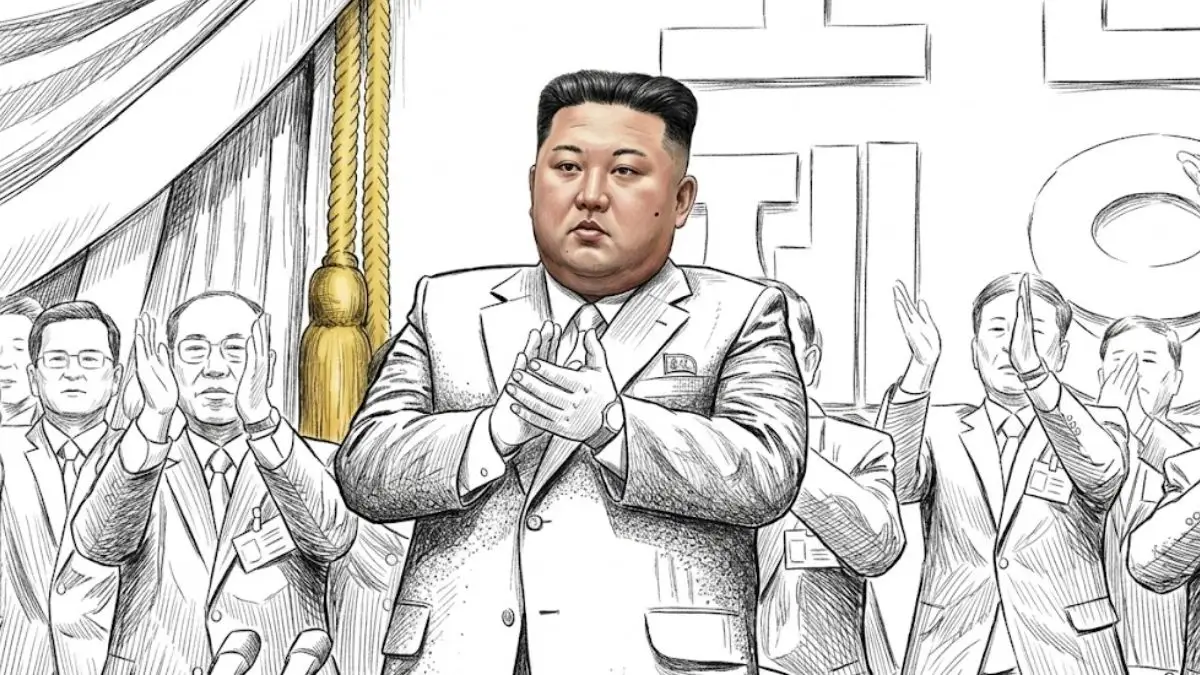
North Korea 2026 election analysis highlights Kim Jong Un’s continued dominance, electoral system, global impact, and key facts for competitive exams.
North Korea 2026 Election: How Kim Jong Un Strengthened His Grip on Power Again
Overview of North Korea’s 2026 Parliamentary Election
The 2026 parliamentary elections in North Korea once again highlighted the country’s unique political system, where leadership continuity is virtually guaranteed. Held on 15 March 2026, the elections were conducted to choose members of the Supreme People’s Assembly, the nation’s highest legislative body. Kim Jong Un emerged as the dominant figure, reinforcing his authority over the state.
According to official reports, nearly 99.99% voter turnout was recorded, with 99.93% votes cast in favor of government-approved candidates. This overwhelming support reflects the tightly controlled electoral system in North Korea, where dissent is minimal and political competition is absent.
One-Party System and Controlled Electoral Process
North Korea operates under a one-party system led by the Workers’ Party of Korea. In the 2026 elections, each constituency had only one candidate, pre-approved by the ruling party. This structure eliminates electoral competition and ensures predetermined outcomes.
Observers often describe these elections as symbolic rather than democratic, as citizens are expected to approve candidates rather than choose among alternatives. The process serves to demonstrate loyalty to the regime rather than reflect public opinion.
Election Results and Political Implications
All 687 seats in the Supreme People’s Assembly were filled by candidates aligned with the ruling establishment. The near-perfect victory further consolidates Kim Jong Un’s authority, reinforcing his leadership at both party and state levels.
Following the election, Kim was reappointed as the President of the State Affairs Commission, the highest executive position in the country. This reaffirmation of power indicates political stability within the regime but raises concerns internationally regarding lack of democratic governance.
Role of Technology and Symbolism in the Election
Interestingly, reports indicated the use of advanced technologies such as humanoid robots to guide voters in polling stations. While this reflects North Korea’s push towards modernization, it also serves as propaganda to showcase progress under Kim’s leadership.
Such symbolic initiatives aim to reinforce the image of a technologically advancing nation despite economic sanctions and isolation.
Global Reactions and Concerns
The international community has often criticized North Korea’s electoral system for lacking transparency and democratic principles. Analysts argue that the election results highlight the absence of political pluralism and meaningful opposition.
The elections also come amid heightened geopolitical tensions, with North Korea continuing its focus on military strength and nuclear capabilities. This combination of internal control and external assertiveness shapes the country’s global image.

Why This News is Important
Relevance for Global Politics
The 2026 election in North Korea is significant because it demonstrates the persistence of authoritarian governance in the modern world. While many nations practice democratic elections, North Korea’s model contrasts sharply, offering insights into alternative political systems.
Understanding such systems is crucial for students preparing for competitive exams, as questions related to global governance, political ideologies, and international relations are frequently asked.
Implications for International Relations
North Korea’s elections also influence global geopolitics. The reaffirmation of Kim Jong Un’s leadership signals continuity in policies related to nuclear weapons and regional security.
Countries like South Korea, the United States, and China closely monitor such developments, as they impact diplomatic relations, defense strategies, and peace negotiations in the Korean Peninsula.
Historical Context of North Korea’s Electoral System
Evolution of Elections in North Korea
North Korea has held parliamentary elections since its establishment in 1948. However, unlike democratic nations, these elections have always been conducted under a single-party framework dominated by the Workers’ Party of Korea.
Each election cycle typically results in near-unanimous support for government-backed candidates, reflecting the centralized political structure.
Previous Elections and Trends
The 2019 parliamentary elections also recorded similar turnout and approval rates, indicating a consistent pattern. Over the decades, elections have functioned as a mechanism to legitimize the leadership rather than provide a platform for political competition.
The 2026 election continues this trend, reinforcing the continuity of governance under Kim Jong Un.
Key Takeaways from This News
| S.No | Key Takeaway |
|---|---|
| 1 | North Korea held parliamentary elections on 15 March 2026 with 99.99% turnout. |
| 2 | All 687 seats in the Supreme People’s Assembly were won by government-backed candidates. |
| 3 | Kim Jong Un retained his leadership and was reappointed as the head of state. |
| 4 | The election featured a single-candidate system, highlighting lack of democracy. |
| 5 | The results reinforce North Korea’s authoritarian political structure and global geopolitical stance. |
FAQs: Frequently Asked Questions
1. When was the North Korea 2026 election held?
The North Korea 2026 parliamentary election was conducted on 15 March 2026 to elect members of the Supreme People’s Assembly.
2. What is the Supreme People’s Assembly?
It is the highest legislative body in North Korea, responsible for making laws and electing top state officials.
3. How many seats are there in the Supreme People’s Assembly?
There are 687 seats, all of which were filled by government-approved candidates in the 2026 election.
4. Why is North Korea’s election system considered non-democratic?
Because only one candidate is allowed per constituency, and all candidates are pre-approved by the ruling party, eliminating real competition.
5. Who is the current leader of North Korea after the 2026 election?
Kim Jong Un continues to lead North Korea and was reaffirmed in his position after the election.
6. What is the voter turnout in North Korea elections?
Official reports claim extremely high turnout, often above 99%, including the 2026 election.
7. What role does the Workers’ Party of Korea play in elections?
It controls the entire electoral process, including candidate selection and approval.
8. Why are such elections important for competitive exams?
They help in understanding global political systems, authoritarian regimes, and international relations—key topics in exams like UPSC, SSC, and Banking.
Some Important Current Affairs Links