





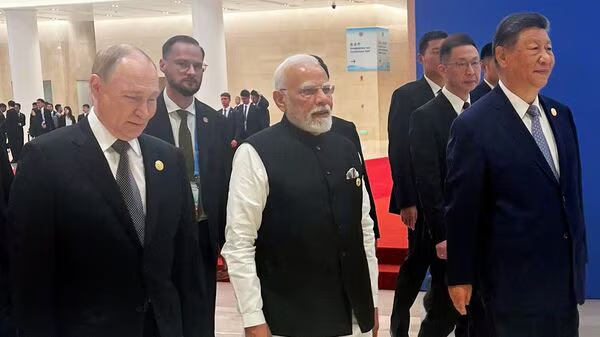
India China relations SCO Summit 2025 marks a diplomatic reset as PM Modi and Xi Jinping reconnect in Tianjin, agreeing to resume flights, border trade, and cultural exchanges while stressing strategic autonomy.
India-China Diplomatic Thaw at the SCO Summit in Tianjin Signals Renewed Partnership
Prime Ministers Reconnect Amid Diplomatic Reset
At the 2025 Shanghai Cooperation Organisation (SCO) Summit held in Tianjin, Prime Minister Narendra Modi and President Xi Jinping met face-to-face after nearly ten months—marking a significant thaw in bilateral relations since the 2020 Galwan Valley clashes. Their interaction on August 31, 2025, underscored a shared commitment to rebuild trust and strengthen cooperation across multiple sectors.
Restoring Connectivity: Flights, Trade, and Tourism
Among the key outcomes of this diplomatic reset was the agreement to resume direct flights between India and China—an essential confidence-building step following disruptions due to the pandemic. The leaders also discussed reviving the Kailash Mansarovar Yatra and reinstating tourist visa issuance, both suspended in previous years.
Strategic Autonomy and Partnership over Rivalry
Modi and Xi emphasized that India and China are “development partners, not rivals,” and stressed that bilateral differences should not spiral into disputes. Modi highlighted strategic autonomy and urged that bilateral ties should not be viewed through a “third country’s lens.”
A Broader Global and Economic Context
The renewed diplomacy comes against a backdrop of rising US tariffs and growing global instability. Both countries positioned their collaboration as vital for Global South solidarity. Analysts view this engagement as a pragmatic response to shifting trade and security dynamics, rather than a pivot away from established alliances.
Economic Prospects on the Horizon
The thaw opens possibilities for the Indian electric vehicle sector to benefit from Chinese investment and technology, while Chinese exporters may gain access to India’s vast consumer market. Additionally, China’s support on rare earth minerals could aid India’s industrial ambitions.
Reinvigorating Border Trade and Stability
Both leaders agreed to reopen border trade channels, which had been shut following 2020 tensions. They also praised ongoing disengagement at the Line of Actual Control as emblematic of restored peace and stability.

Why This News Matters
Diplomatic Balancing in a Polarised World
India’s outreach to China at the SCO Summit highlights its policy of strategic autonomy. As New Delhi navigates growing tensions with the US, especially related to tariffs, its engagement with Beijing signals a balanced approach to global alliances. This is crucial for civil services and foreign policy aspirants studying geopolitical strategy.
Implications for Economic Policy and Exam-Relevant Sectors
The agreement to resume direct flights, tourism, and cross-border trade has direct implications for sectors like civil aviation, tourism, and trade—areas frequently featured in government exams across banking, railways, and administrative services. Enhanced access to rare earth minerals and EV technology also opens new dimensions in industrial policy and economic planning.
Strategic Stability and Border Management
The emphasis on peaceful border management and disengagement at the LAC reinforces the significance of security policy and border protocol for aspirants preparing for civil and defence services. It also contributes to understanding India’s long-term peace-building frameworks.
Historical Context: From Galwan to Gradual Reengagement
Galwan Valley Clash (2020) and Tensions
The 2020 Galwan Valley skirmish marked a serious rupture in India-China relations, triggering a five-year standoff with heightened military deployments along the LAC.
Recent Pathways to De-escalation
- October 2024 (BRICS Summit, Kazan): Modi and Xi initiated a diplomatic thaw, leveraging mechanisms like Special Representatives to address border issues.
- January–April 2025: India and China resumed direct flights, re-launched the Kailash Mansarovar pilgrimage, and initiated disengagement protocols.
- June 2025 (Defence Ministers’ Meet, Qingdao): India’s Defence Minister Rajnath Singh called for structured border engagement and trust-building mechanisms.
- July 2025: India resumed issuing tourist visas to Chinese nationals, signaling renewed soft diplomacy.
These efforts laid the groundwork for the key SCO Summit rendezvous in Tianjin.
Key Takeaways from India-China Relations Thaw at SCO Summit
| S. No. | Key Takeaway |
|---|---|
| 1 | Modi and Xi met after 10 months at the SCO Summit, marking a diplomatic reset. |
| 2 | Agreement to resume direct flights and revitalize the Kailash Mansarovar Yatra. |
| 3 | Reinforcement of the doctrine: “India and China are development partners, not rivals.” |
| 4 | Focus on strategic autonomy amid global tariff tensions and shifting alliances. |
| 5 | Reopening of border trade and enhanced economic opportunities across sectors. |
Frequently Asked Questions (FAQs)
Q1. What was the key outcome of the Modi-Xi meeting at the SCO Summit 2025?
The main outcome was a diplomatic reset with agreements to resume direct flights, reopen border trade, and revive the Kailash Mansarovar Yatra.
Q2. Why is the SCO Summit 2025 important for India-China relations?
It provided a platform for both leaders to demonstrate commitment to strategic autonomy, rebuild trust, and position themselves as development partners.
Q3. How does this meeting impact students preparing for government exams?
The news connects to topics in international relations, diplomacy, economy, and border management, which are frequently asked in civil services, defence, and general awareness sections.
Q4. What is the relevance of the Kailash Mansarovar Yatra in bilateral ties?
The pilgrimage has both cultural and religious significance. Its resumption strengthens people-to-people ties, which are vital for soft diplomacy.
Q5. What is meant by “strategic autonomy” in this context?
Strategic autonomy means that India pursues independent policies without being influenced by external powers, maintaining balanced relations with both the US and China.
Q6. What historical event strained India-China ties in 2020?
The Galwan Valley clashes in June 2020 caused the most serious rupture in bilateral ties in decades.
Q7. How does the India-China engagement affect trade prospects?
It could boost bilateral trade in electronics, electric vehicles, and rare earth minerals, creating fresh opportunities for both economies.
Q8. What is the role of SCO in international diplomacy?
The Shanghai Cooperation Organisation (SCO) serves as a Eurasian political, economic, and security alliance where India and China engage with other regional powers.
Q9. Why is border disengagement at the LAC significant?
It reduces military tensions and builds confidence for broader cooperation in trade, tourism, and security.
Q10. How can exam aspirants prepare better with such current affairs?
Students should link current news with static topics like international organisations, India-China relations, border management, and economic policy for exam relevance.
Some Important Current Affairs Links