








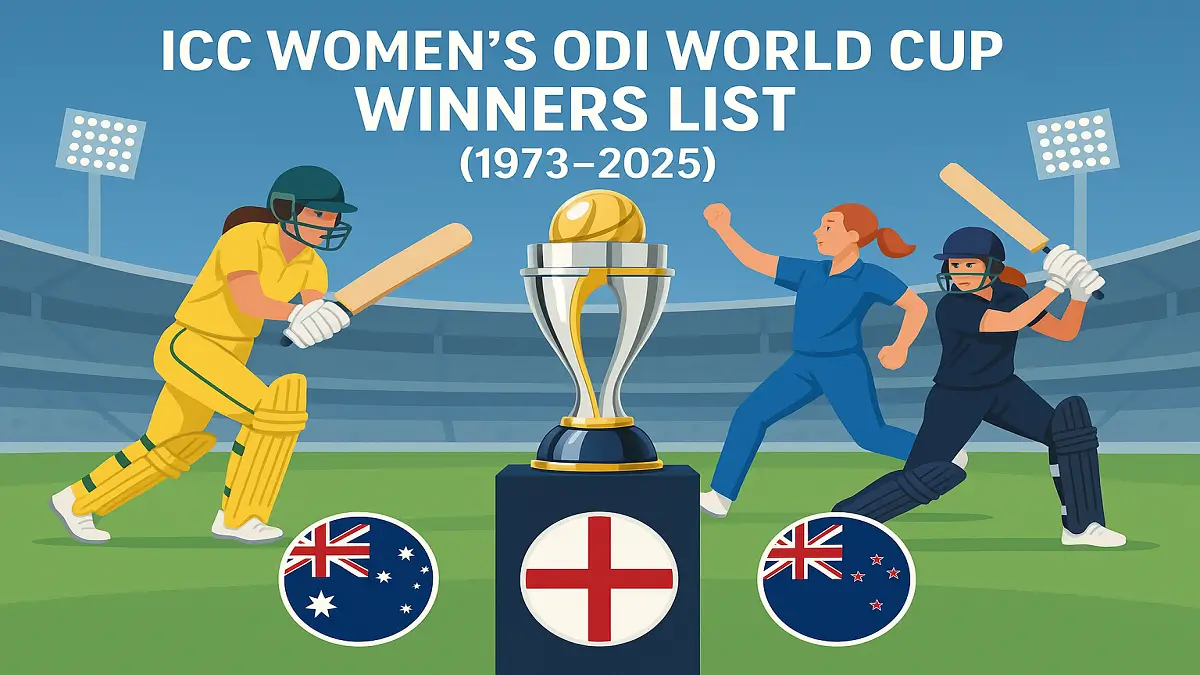
ICC Women’s Cricket World Cup winners list from 1973 to 2023 with history, key takeaways, and FAQs for exam preparation and general awareness.
Women’s Cricket World Cup: Champions and Trends from 1973 to 2023
The global women’s One Day International (ODI) tournament, the ICC Women’s Cricket World Cup, first held in 1973, has grown into one of the premier events in women’s sport. Over the 50 plus years since its inception, a select group of nations have risen to dominance, establishing patterns that are important for students of sports history and current‐affairs alike.
Early Beginnings and the Inaugural Edition
The first edition of the Women’s World Cup was held in England in 1973. Unlike later tournaments, it did not feature a traditional final. Instead teams played in a round‐robin league format, and the champion was decided on points. England emerged victorious over Australia by a margin of 92 runs via the league standings. icc+1 This set the stage for the tournament’s growth and international significance.
Rise of Australia’s Dominance
From the late 1970s and into the 1980s, the Australian Women’s team began to assert clear dominance. In 1978 Australia won their first title in India, beating England on a points basis. They followed that up in 1982 with another World Cup win in New Zealand by defeating England by three wickets. icc Along with an 8‐wicket win in the 1988 final (hosted in Australia) over England, the era cemented Australia as a powerhouse.
Competitive Shifts and Historic Upsets
While Australia held the upper hand for many editions, other teams made breakthrough performances. In 1993 England regained the trophy at home, defeating New Zealand by 67 runs. Then in 2000 New Zealand clinched the title on home soil, overcoming Australia by just four runs in a dramatic final.These results underscored that while Australia dominated often, the tournament remained open for other nations to challenge.
Recent Era and Australia’s Continued Supremacy
In more recent editions, Australia has extended its record number of titles. By 2022 the Australian Women’s team had secured their seventh title, defeating England by 71 runs. This continues to cement their status as the most successful side in the history of the Women’s World Cup. England remains a strong contender with four titles, while New Zealand and West Indies hold one each (as of 2023).
Growth and Exam Relevance
For students preparing for competitive exams — whether in teaching, banking, railways, defence or civil services — this topic is worth attention for several reasons. Firstly, it exemplifies how women’s sports have developed globally, linking to broader themes such as gender equality, international sporting governance, and cultural shifts in sport. Secondly, in general‐knowledge and sports‐current‐affairs sections, recognising the major winners, host nations and key milestones of the Women’s World Cup enhances one’s preparedness.
In short, the Women’s Cricket World Cup is far more than a sports listing: it reflects evolving global dynamics, national sporting ambitions, and the growing visibility of women in competitive sport.

Why This News is Important
Relevance to Current Affairs & Competitive Exams
Understanding the winners’ list of the Women’s World Cup offers valuable material for general‐awareness sections of many competitive exams (teacher recruitment, police constable, banking clerk, railways, defence/service cadre like PSCS to IAS). Questions may ask for “which country has won the most titles”, “first winner of the tournament”, “how many times England has won”, or “which team won in 2000”. Being conversant with these facts strengthens a candidate’s breadth of sports knowledge.
Reflects Broader Social and Global Trends
Beyond mere statistics, the dominance of a team like Australia signals strong domestic structures, investment in women’s sport, and global competition. This ties into themes such as gender equality, sports policy, international cooperation and cultural change. For government exam aspirants, linking such sports developments to policy or social change (for example, government initiatives for women in sport) adds depth to answers in descriptive sections or interviews.
Educational Value for All Streams
Even students not specialising in sports can benefit: teaching candidates can use the tournament progression story in lessons about women’s empowerment; police and defence aspirants can note how international tournaments foster global camaraderie; banking and railways aspirants can appreciate how sports events often stimulate infrastructure and economic activity (host venues, tourism, broadcasting). Thus the winners’ list is a springboard into multiple interdisciplinary discussion areas.
Historical Context
The Women’s Cricket World Cup predates the men’s equivalent by two years, highlighting an early recognition of women’s cricket at the international level. The inaugural event in 1973 featured a round-robin format rather than knockout finals, and included innovative teams like “Young England” and “International XI”. icc Over time, the format shifted to include more teams, global hosts, knockout stages, and greater media coverage. The dominance of teams like Australia reflects an evolution in professionalisation of women’s sport, coaching, and institutional support. Further, the list of winners (England, Australia, New Zealand, West Indies) shows how early adopters of women’s cricket gained advantage. Additionally, host venues across India, New Zealand, Australia and England illustrate how cricket’s global footprint expanded. By tracking this history, students gain insight into how sports structures adapt and globalise — an important concept for many competitive‐exam discussions on institutional evolution and international relations.
Key Takeaways from Women’s Cricket World Cup Winners List
| S. No | Key Takeaway |
|---|---|
| 1 | The inaugural Women’s Cricket World Cup was held in 1973 in England, and England won the title. |
| 2 | The most successful team in the Women’s World Cup history is Australia, with seven or more titles by 2022. |
| 3 | England has won the tournament four times, placing them second in success behind Australia. |
| 4 | New Zealand captured the title once (in 2000), illustrating that multiple nations have had World Cup success. |
| 5 | The tournament format and participation have evolved significantly — from round-robin in the early years to full knockout finals and multiple hosts internationally. |
Frequently Asked Questions (FAQs)
1. When was the first ICC Women’s Cricket World Cup held?
The inaugural ICC Women’s Cricket World Cup was held in 1973 in England, making it the first global cricket tournament for women, even preceding the men’s World Cup by two years.
2. Which team has won the most ICC Women’s Cricket World Cup titles?
Australia holds the record for the most ICC Women’s Cricket World Cup victories, having won seven titles as of 2023.
3. Who won the ICC Women’s Cricket World Cup 2022?
The Australian Women’s Cricket Team won the 2022 ICC Women’s Cricket World Cup by defeating England in the final by 71 runs.
4. How many times has England won the Women’s Cricket World Cup?
England has won the tournament four times — in 1973, 1993, 2009, and 2017.
5. Which country hosted the first Women’s World Cup outside England?
The 1978 edition was hosted by India, marking the first time the Women’s Cricket World Cup was played outside England.
6. Which country won the Women’s World Cup 2000?
New Zealand won the Women’s World Cup in 2000, defeating Australia by four runs in a thrilling final on home soil.
7. What is the governing body for the ICC Women’s Cricket World Cup?
The tournament is organized by the International Cricket Council (ICC), the global governing body of cricket.
8. Which team was the runner-up most often in Women’s World Cup history?
England has been the runner-up in multiple editions, including 1978, 1982, 1988, 1997, and 2022.
9. How does the Women’s Cricket World Cup differ from the Women’s T20 World Cup?
The Women’s Cricket World Cup is an ODI (50-over) tournament, while the T20 World Cup involves 20-over matches.
10. When will the next ICC Women’s Cricket World Cup be held?
The next ICC Women’s Cricket World Cup is scheduled for 2025, and it will be hosted by India.
Some Important Current Affairs Links