
Hayli Gubbi volcano erupts after 12,000 years in Ethiopia, volcanic ash drifts to India affecting air quality and flights. Learn impacts, hazards, and key facts for exams.
Ethiopia’s Dormant Hayli Gubbi Volcano Erupts After ~12,000 Years — Ash Plume Drifts Towards India
Sudden Eruption of a Dormant Volcano
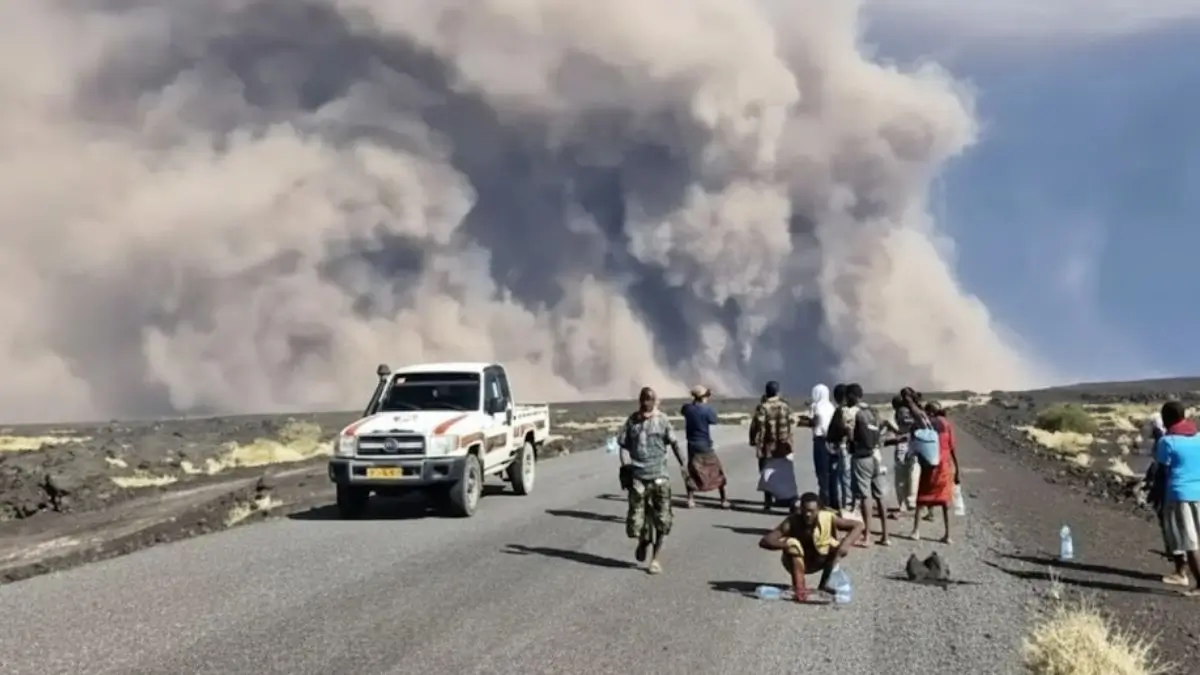
In a rare geological event, the Hayli Gubbi volcano in Ethiopia’s Afar region erupted on Sunday — the first time in an estimated 10,000–12,000 years. The explosive activity produced massive plumes of volcanic ash and gases, shooting a dense column up to approximately 14 kilometers into the sky.
The volcano lies in the geologically active Rift Valley — part of the Erta Ale Range — a region where tectonic plates meet, making it prone to seismic and volcanic activity.
Ash Cloud Travel: Across Seas and Skies
The plume of ash and volcanic gases didn’t remain confined to Ethiopia. Carried by strong upper-atmosphere winds, it traversed the Red Sea, passed over Yemen and Oman, and began drifting toward South Asia — including northern India and Pakistan.
Indian meteorological and aviation authorities tracked the ash cloud closely. According to reports, ash over western India — including Gujarat — was first spotted, before the plume progressed toward Rajasthan, Delhi-NCR, Punjab, Haryana, and northwest India.
Hazardous Implications: Air Travel and Public Safety
Volcanic ash clouds pose serious hazards — particularly for aviation. The plume from Hayli Gubbi rose to altitudes frequently used by commercial aircraft. Experts highlight that volcanic ash — containing fine particles of rock, glass, and volcanic gases (like sulphur dioxide) — can damage jet engines, reduce visibility, corrode aircraft components, and disrupt navigation instruments.
In response, the Directorate General of Civil Aviation (DGCA) and multiple airlines issued advisories to avoid affected altitudes and airspaces, and some flights were rerouted or delayed as a precaution.
Experts and meteorological agencies continue to closely monitor the dispersion of ash and volcanic gases to gauge potential impacts on air quality, public health, and further air travel disruptions.
Immediate Impact on Local Communities and Wildlife
While there have been no reported casualties or major livestock losses, the eruption blanketed nearby villages — including the settlement of Afdera — in volcanic ash. Pastures and grazing lands have been affected, raising concerns among local herders over fodder availability for their animals.
The remote and harsh terrain of the region — known for extreme heat and aridity — complicates on-ground relief and assessment efforts. Satellite imagery and remote monitoring remain the primary tools for now.

Why This News Matters
Global Connectivity and Vulnerability Highlighted
The eruption of the Hayli Gubbi volcano — dormant for millennia — shows how remote geological events can have far-reaching impacts. The ash plume travelling thousands of kilometres from East Africa across seas and continents underscores how interconnected our world is today. A volcanic eruption in one corner of the globe can disrupt air travel, trade, and even atmospheric chemistry across continents.
Relevance for Government Exam Aspirants (Geography, Environment, and Current Affairs)
For students preparing for exams like civil services, banking, railways, or defence, this event is a significant addition to the current affairs syllabus. Questions may arise under geography (Rift Valley tectonics), environment (volcanoes, atmospheric pollution), disaster management (international cooperation, aviation advisories) or global events. Understanding such events — their causes, implications, and global ripple effects — can help in both objective and descriptive-type questions.
Significance for Aviation, Disaster Preparedness and International Policies
Eruptions of dormant volcanoes like Hayli Gubbi challenge conventional risk models. Aviation agencies, meteorological departments, and environmental regulators must update contingency protocols. The incident could push for stronger international coordination to monitor volcanic activity and ensure air-space safety. For India and neighbouring countries, the event is a real-time test of preparedness for external environmental threats.
Historical Context
The Hayli Gubbi volcano is part of the Erta Ale volcanic range located in the Afar region — a segment of the broader Great Rift Valley that runs across East Africa. This region is defined by tectonic plate divergence, making it one of the most geologically active zones in the world.
According to the Global Volcanism Program, there has been no recorded eruption of Hayli Gubbi during the Holocene epoch (i.e., roughly the past 10,000–12,000 years), making this 2025 event the first known eruption in modern history.
Historically, such eruptions in the Rift Valley have led to significant geological transformations — altering landscapes, creating new landforms, or influencing climate and air travel (in the modern age). The eruption serves as a reminder that even long-dormant volcanoes can become active, which has implications for disaster preparedness, environmental monitoring, and global climate studies.
Key Takeaways from This News
| # | Key Takeaway |
|---|---|
| 1 | Hayli Gubbi volcano erupted on 23 November 2025 — first time in ~10,000–12,000 years. |
| 2 | The ash plume rose up to about 14 km and drifted thousands of kilometres, reaching the airspace over India and South Asia. |
| 3 | The ash cloud included fine ash, sulphur dioxide, rock and glass particles — hazardous to aircraft engines and aviation safety. |
| 4 | Aviation authorities (DGCA and airlines) issued advisories; some flights were rerouted or delayed as a precaution. |
| 5 | Although no casualties were reported, the eruption affected local communities — ash-covered villages, possible fodder shortage for livestock, economic hardship for herders. |
FAQs: Frequently Asked Questions
1. What is the Hayli Gubbi volcano?
Hayli Gubbi is a dormant volcano located in Ethiopia’s Afar region, part of the Erta Ale volcanic range within the East African Rift Valley. It erupted in November 2025 for the first time in approximately 12,000 years.
2. Why is the eruption significant for India?
The volcanic ash plume travelled thousands of kilometres and reached the northern parts of India, including Delhi, Rajasthan, and Punjab. It posed hazards for aviation and air quality in these regions.
3. What hazards are caused by volcanic ash?
Volcanic ash contains fine rock and glass particles, along with gases like sulphur dioxide, which can damage aircraft engines, reduce visibility, affect respiratory health, and pollute the environment.
4. How did authorities respond to the eruption?
Aviation authorities like DGCA issued flight advisories, rerouted or delayed some flights, and closely monitored the ash cloud. Meteorological agencies tracked its path to assess impacts on air quality and safety.
5. Has Hayli Gubbi erupted before?
No, there are no recorded eruptions in the Holocene epoch (~10,000–12,000 years). This 2025 eruption is the first in modern history.
6. Which regions were affected by the ash cloud?
The plume drifted from Ethiopia over Yemen, Oman, and across South Asia, affecting airspace in India (Delhi, Rajasthan, Punjab, Haryana) and Pakistan.
7. Why do eruptions occur in the Afar region?
The Afar region is geologically active due to divergent tectonic plates in the East African Rift Valley, which causes earthquakes and volcanic activity.
8. How does this news relate to competitive exams?
This event is relevant for geography, environment, disaster management, and current affairs sections in exams like UPSC, PSCs, banking, railways, and defence services.
Some Important Current Affairs Links