






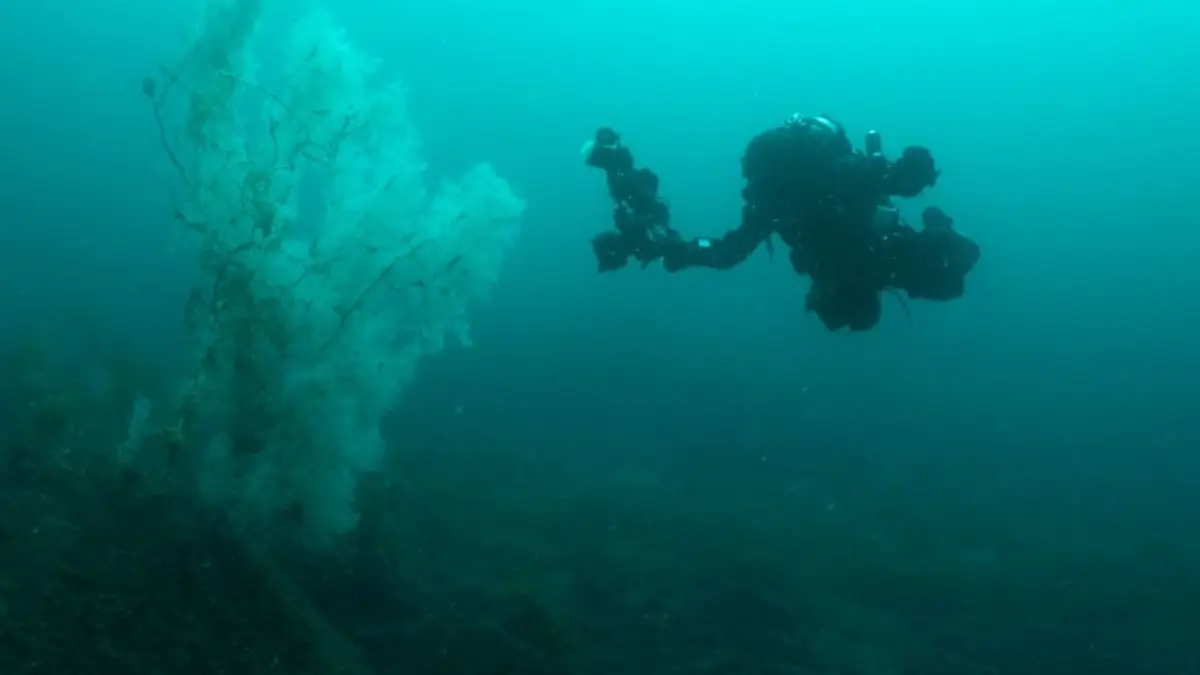
Giant black coral discovery in New Zealand reveals a 300-year-old marine species. Learn about ecological importance, conservation, and marine biodiversity insights.
Giant 300-Year-Old Black Coral Discovered in New Zealand’s Deep Sea
Introduction: Historic Discovery in World’s Oceans
Marine scientists have made a remarkable discovery in the deep waters off the Fiordland region of New Zealand — a giant black coral colony that is estimated to be around 300–400 years old and among the largest ever recorded in the country’s oceanic waters. This extraordinary find sheds new light on unexplored ecosystems deep beneath the ocean surface and underscores how much of the Earth’s oceans remain unknown to science.
What Makes the Black Coral Exceptional
The giant coral, believed to belong to the species Antipathella fiordensis, measures approximately 4 metres in height and 4.5 metres in width, far exceeding the typical size of black corals usually seen by researchers. Professor James Bell, a senior marine biologist with over 25 years of experience, described the discovery as “absolutely huge” — an exceptional specimen compared to the normally smaller black corals encountered during deep-sea dives.
Ecological Importance of Black Coral in Deep Waters
Black corals are slow-growing invertebrates that flourish in low-light environments of the deep sea. Despite being called black coral, the living tissue covering their skeleton often appears white in colour, with only the underlying structure retaining a dark hue. These corals provide essential habitats and breeding grounds for various deep-sea organisms, from juvenile fishes to other invertebrates, playing a critical role in maintaining marine biodiversity.
Scientific Efforts and Conservation Initiatives
Researchers from Te Herenga Waka—Victoria University of Wellington are collaborating with the New Zealand Department of Conservation and the Fiordland Marine Guardians to map the location and distribution of large coral colonies in the fiords. The goal is not only to study these long-lived organisms but also to develop strategies to protect them from physical damage such as boat anchoring, fishing gear, or habitat disruption. Marine experts are encouraging divers and boaters to report sightings of large corals to enhance scientific records.
Current and Future Research Implications
The discovery highlights how much remains unexplored in the deep ocean — one of the least studied parts of our planet. Scientists believe that studying such ancient marine organisms can provide insights into historical ocean conditions and environmental changes over centuries. With deep-sea ecosystems under threat from climate change, pollution, and other human activities, this find reiterates the urgency of advancing research and conservation measures for fragile ocean habitats worldwide.

Why This News Is Important
Significance for Ecology and Biodiversity Studies
The discovery of the giant black coral is important because it provides scientists with a rare opportunity to study an ancient organism that has survived for centuries in the deep ocean. Such findings help researchers understand patterns of marine biodiversity, species interactions, and how ecosystems adapt over extended periods. Since black corals develop very slowly, every large colony acts as a living record of oceanic conditions, offering insights into past environmental trends and biological resilience.
Relevance to Conservation and Policy
For students preparing for government exams — especially in environment, ecology, and marine conservation sections — this discovery underscores the importance of marine protection policies, such as those enforced by the New Zealand Wildlife Act. These protected marine species require legal safeguards because of their ecological roles and vulnerability. As exam questions increasingly incorporate contemporary environmental issues, this is an excellent case to understand policy implications, conservation strategies, and the rationale behind marine protected areas.
Implications for Scientific Research and Climate Studies
Long-lived organisms like this black coral can serve as bio-archives, helping scientists reconstruct historical oceanic conditions, including temperature, nutrient levels, and other factors. This type of information is critical for climate change assessments and forecasting future environmental shifts. For aspirants of civil services and science-focused competitive exams, understanding such interdisciplinary research is valuable for sections involving science & technology, environment, geography, and current affairs.
Historical Context: Deep-Sea Discoveries and Marine Biodiversity
Deep-Sea Exploration: A Frontier of Science
Historically, the deep sea has been one of the least accessible and least explored natural environments on Earth. Until the 20th century, scientists knew little about ecosystems below a few hundred metres depth due to technological limitations. With advances in deep-sea diving technologies, remotely operated vehicles (ROVs), and sonar mapping, researchers gradually revealed diverse and often surprising life forms in these dark regions of the ocean.
Coral Species in Marine Ecosystems
Corals have long fascinated scientists because of their ecological significance and contributions to marine biodiversity. While shallow reefs (like the Great Barrier Reef) are widely recognized, deep-sea corals remained relatively mysterious until extensive oceanographic explorations began revealing their extensive presence. Black corals, belonging to the class Antipatharia, are particularly notable for their longevity and hard, tree-like structures that provide habitat complexity in deep ecosystems — similar to forests on land.
Environmental Awareness and Protection Efforts
Over recent decades, increased global awareness of climate change and marine habitat degradation — from acidification to overfishing — has prompted strong movements toward marine conservation. Regions like Fiordland in New Zealand have become focal points for scientific research and protected area initiatives, combining local ecological knowledge, community guardianship, and scientific efforts to safeguard fragile deep-sea ecosystems.
Key Takeaways from “Giant 300-Year-Old Black Coral Found in New Zealand”
| S.No. | Key Takeaway |
|---|---|
| 1 | A giant black coral estimated to be 300–400 years old was discovered in the deep waters off Fiordland, New Zealand. |
| 2 | The coral measures about 4 metres tall and 4.5 metres wide, making it one of the largest recorded in New Zealand waters. |
| 3 | Black corals are slow-growing invertebrates that provide critical habitats for deep-sea life. |
| 4 | The species is protected under the New Zealand Wildlife Act, reflecting its ecological importance and vulnerability. |
| 5 | Scientists are mapping coral distribution to support conservation measures and encourage reporting of large colonies. |
FAQs: Frequently Asked Questions
1. What is the giant black coral discovered in New Zealand?
The giant black coral discovered off Fiordland, New Zealand, is an ancient marine organism estimated to be 300–400 years old, belonging to the species Antipathella fiordensis. It measures about 4 meters in height and 4.5 meters in width, making it one of the largest ever recorded in New Zealand waters.
2. Why are black corals important for marine ecosystems?
Black corals are slow-growing invertebrates that provide habitats and breeding grounds for numerous deep-sea species, including juvenile fishes and invertebrates, supporting marine biodiversity.
3. How do scientists protect giant black corals?
The New Zealand Wildlife Act protects black corals. Scientists collaborate with local conservation groups to map coral locations, prevent physical damage from anchoring or fishing, and promote reporting of large coral sightings.
4. How old can black corals live?
Black corals are long-lived organisms. Some colonies, like the recently discovered one in New Zealand, can live hundreds of years, reflecting centuries of oceanic environmental history.
5. Where in New Zealand was the black coral discovered?
The coral was discovered in the deep waters of Fiordland, a region known for its rich marine biodiversity and unique fiord ecosystems.
6. What species does the discovered black coral belong to?
The discovered coral belongs to the species Antipathella fiordensis, a black coral species endemic to New Zealand’s deep-sea fiords.
7. What role does black coral play in climate research?
Due to their longevity, black corals act as bio-archives, helping scientists study historical ocean conditions, nutrient levels, and environmental changes over centuries.
8. How can students relate this discovery to government exams?
For competitive exams, this discovery is relevant for sections on environment, ecology, biodiversity, marine conservation policies, and current affairs questions in UPSC, SSC, banking, and other government exams.
9. Are giant black corals common?
No, giant black corals of this size (4m × 4.5m) are extremely rare. Most black corals are smaller and much younger.
10. How does this discovery impact conservation strategies?
It highlights the urgency to protect fragile deep-sea habitats, emphasizing marine conservation, monitoring human activity, and research-based policies for sustainable ocean ecosystems.
Some Important Current Affairs Links