





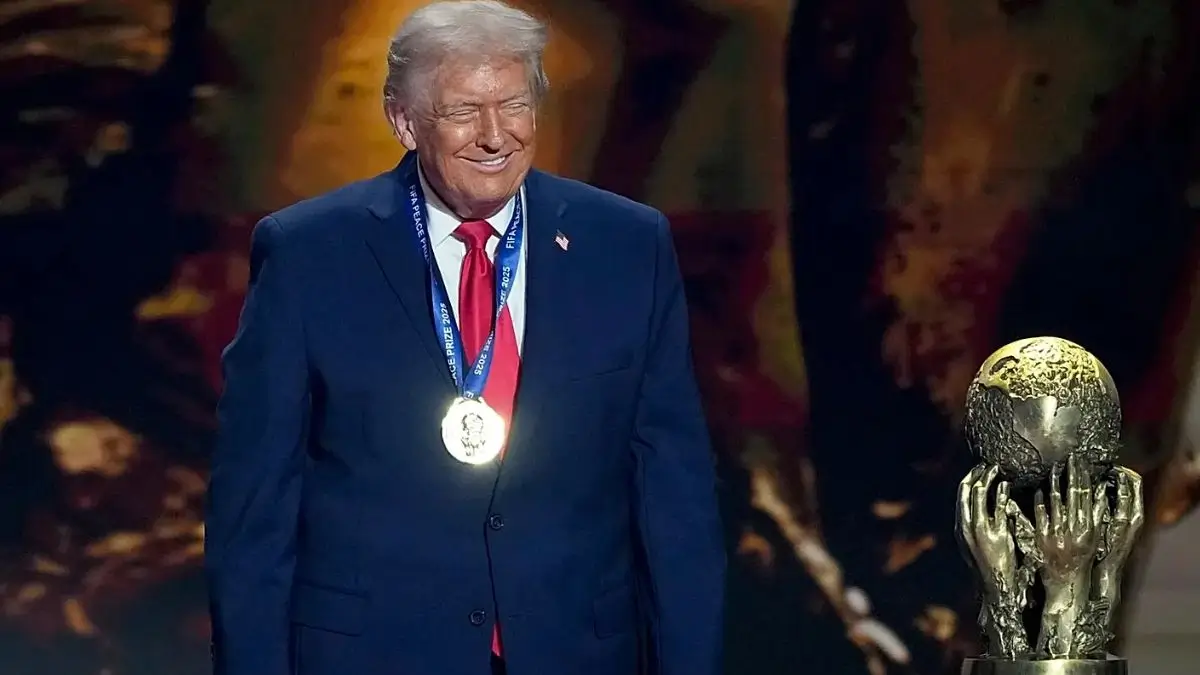
FIFA Peace Prize 2025 winner Donald Trump was awarded at the 2026 World Cup draw, highlighting FIFA’s new role in global diplomacy and soft power.
Donald Trump Awarded First-Ever FIFA Peace Prize at 2026 World Cup Draw — What Aspirants Must Know
What Happened: FIFA Peace Prize Goes to Trump
On 5 December 2025, at the draw ceremony for the 2026 FIFA World Cup — held at the John F. Kennedy Center for the Performing Arts in Washington, D.C. — Donald J. Trump was awarded the first-ever FIFA Peace Prize.
The Peace Prize, newly established by FIFA in November 2025, aims to honour individuals whose actions have significantly promoted peace, unity and global harmony through extraordinary efforts. The trophy — described as a gold-plated globe held aloft by multiple hands — along with a certificate and medal, was presented to Trump by the head of FIFA, Gianni Infantino.
In his acceptance remarks, Trump called the honour “one of the great honours of my life,” while Infantino hailed him for what the football governing body described as “exceptional and extraordinary actions” toward global peace and unity.
The Significance of the Award: A Shift for FIFA
Traditionally known purely as the global governing body of football, FIFA’s decision to introduce a Peace Prize marks a major expansion of its role — from sporting oversight to global diplomacy and political symbolism.
By honouring a sitting political leader (and a former U.S. President), FIFA has signalled that its influence — at least symbolically — extends into international affairs and global politics. This marks a shift in how global sports institutions may try to position themselves.
Controversy and Global Reactions
The decision to award the Peace Prize to Trump at the World Cup draw has generated widespread controversy and criticism. Many observers — including rights groups, media commentators, and football stakeholders — have raised questions about the transparency of the selection process, the political implications, and whether a sports organisation should intervene in geopolitical recognitions. Critics argue that the award undermines FIFA’s claim to neutrality and point to the organisation’s history of corruption and alleged human-rights compromises. They caution that awarding such a prize may be seen as a form of “sportswashing” — using sport to legitimize controversial political figures or regimes.
Immediate Global Impact and Media Coverage
The presentation of the Peace Prize dominated media headlines worldwide, overshadowing the actual World Cup draw for many observers. Reactions varied widely: some media outlets and analysts accepted FIFA’s narrative that the prize recognised real diplomatic achievements; others dismissed it as a blatant exercise in political theatrics and self-promotion.
The event has ignited debate about the role of sport in global politics, the responsibility of sporting bodies, and the criteria for public honours — especially when conferred by organisations not traditionally associated with diplomacy or peace-building.

Why This News Matters — For Government Exam Aspirants
Broader Implications for Global Politics & Diplomacy
For students preparing for civil services (like IAS), defence, police or banking exams — this is not just a sports story. It reflects how non-state or supra-national organisations — here, a global sports body — are increasingly influencing international norms, diplomacy and soft-power narratives. This signals a blurring of lines between politics, diplomacy, culture and sport.
Understanding this helps aspirants grasp modern geopolitics: how institutions beyond governments (sports federations, NGOs, global media) can engage in symbolic diplomacy, push narratives, and influence global public opinion.
Relevance to Contemporary International Relations Syllabus
Many competitive exams include questions on global governance, international organisations, soft power, public diplomacy and civil society’s role. The awarding of a peace prize by FIFA — rather than a governmental or inter-governmental body — is a perfect example of “soft-power diplomacy,” “non-traditional diplomacy,” and the evolving nature of global institutions.
Moreover, the controversy around transparency, criteria, and human rights — aspects highlighted by this event — align well with exam topics such as ethical governance, role of institutions, institutional accountability, and influence of non-state actors.
Awareness for Current Affairs Section
Current affairs sections in exams often ask for recent developments with global relevance. This news fits well into sections like “International Affairs,” “Global Institutions & Governance,” or “Sport and Diplomacy.” Given that the 2026 World Cup will be among the biggest global sporting events, the related controversies and geopolitical undercurrents will likely remain relevant for months.
Historical Context: From Sports Governing Body to Diplomacy Player
FIFA’s Traditional Role and Long Shadow of Controversy
The Fédération Internationale de Football Association (FIFA) has historically been the apex body for association football worldwide — primarily overseeing tournaments, rules, club and country competitions. Its actions have typically been constrained to the domain of sport. However, over time, FIFA has also courted criticism for corruption, commercialisation, and human-rights controversies—especially in the context of hosting major tournaments.
The Birth of the FIFA Peace Prize
On 5 November 2025, FIFA announced the creation of the FIFA Peace Prize — titled “Football Unites the World.” The prize was billed to honour individuals whose exceptional actions contribute toward global peace and unity. This meant a major conceptual expansion of FIFA’s mandate from sports governance into global moral and diplomatic recognition.
When the prize was first introduced, sceptics argued that the criteria, selection process, and the underlying motivations lacked clear international-standard transparency. Doubts were raised about whether a sports federation should take on the role of awarding global peace honours.
Why Awarding It to a Political Figure is Historic — and Controversial
That FIFA chose a prominent and polarising political figure — the former U.S. President — as the first recipient marked a significant departure from convention. Sports organisations typically avoid direct involvement in global political controversies. This move by FIFA underscores a growing trend: global non-state institutions seeking a role in identity-building, diplomacy, and global narratives. The decision has reignited long-standing debates on sports neutrality, ethics in global sporting governance, and the influence of soft power through sports.
Key Takeaways from This News
| # | Key Takeaway |
|---|---|
| 1 | The FIFA Peace Prize is a newly established award (2025) aimed at honouring individuals with exceptional contributions to global peace and unity. |
| 2 | The first recipient of the inaugural FIFA Peace Prize — awarded on 5 December 2025 — was Donald J. Trump, at the 2026 World Cup draw ceremony. |
| 3 | The award signifies a major shift in FIFA’s role — from purely a sports governing body to a global institution engaging in diplomatic symbolism and international recognition. |
| 4 | The decision sparked widespread controversy around transparency, political neutrality, and appropriateness of a sports body awarding a political leader — drawing criticism from human rights groups, analysts, and media. |
| 5 | For aspirants of civil services, defence, police or banking exams, this development offers an important case study in soft power diplomacy, role of global institutions, and the evolving nature of international governance beyond governments. |
FAQs: Frequently Asked Questions
1. What is the FIFA Peace Prize?
The FIFA Peace Prize, introduced in November 2025, is an award established to honour individuals who have made exceptional contributions to global peace, unity, and harmony through extraordinary actions.
2. Who was the first recipient of the FIFA Peace Prize?
Donald J. Trump, former U.S. President, was awarded the first FIFA Peace Prize during the 2026 World Cup draw ceremony on 5 December 2025.
3. Where was the 2026 FIFA World Cup draw held?
The draw ceremony took place at the John F. Kennedy Center for the Performing Arts in Washington, D.C., USA.
4. Who presented the FIFA Peace Prize to Donald Trump?
Gianni Infantino, the President of FIFA, presented the inaugural Peace Prize to Donald Trump.
5. Why is this award significant?
The award marks a historic shift for FIFA, expanding its role from purely a sports governing body to a global institution engaging in diplomacy and soft power initiatives.
6. Was there any controversy regarding the award?
Yes, the award generated criticism regarding transparency, FIFA’s neutrality, and whether a sports organization should honour a political leader. Many analysts called it a possible instance of “sportswashing.”
7. How is this news relevant for competitive exams?
It highlights the role of non-state organisations in international diplomacy, soft power, and global governance — topics commonly included in civil service, banking, defence, and police exams.
8. What is the symbolic significance of FIFA awarding a Peace Prize?
It represents a trend where sports and global cultural organisations seek influence beyond their traditional roles, blending soft power, diplomacy, and social messaging.
Some Important Current Affairs Links




