








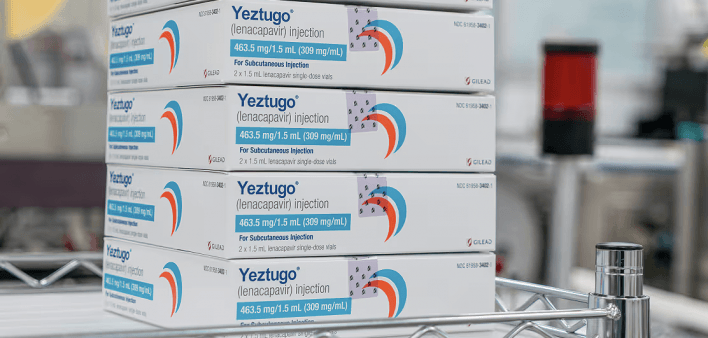
FDA approved HIV prevention shot Yeztugo (lenacapavir) in June 2025 as the first twice-yearly injection for HIV PrEP, offering nearly 100% efficacy and transforming public health strategies globally.
.
🧬 US FDA Approves Twice‑Yearly HIV Prevention Shot
On June 18, 2025, the U.S. Food and Drug Administration (FDA) granted approval to lenacapavir, branded as Yeztugo, marking a pivotal shift in pre‑exposure prophylaxis (PrEP). Developed by Gilead Sciences, this long‑acting injectable works by inhibiting the HIV capsid protein. Remarkably, it demonstrated nearly 100% efficacy in clinical trials among high-risk populations—96% in cisgender women, and 100% in men who have sex with men (MSM) and gender-diverse individuals
This subcutaneous injection, administered every six months, contrasts sharply with daily oral PrEP pills like Truvada and Descovy, offering greater convenience and potentially higher adherence The FDA’s approval also follows lenacapavir’s earlier authorization in 2022 for treating drug-resistant HIV under the name Sunlenca
💡 Clinical Efficacy & Mechanism Explained
Lenacapavir targets the HIV capsid—the protein shell protecting the virus—which disrupts its replication. This new regimen initiates with oral loading doses followed by biannual injections Clinical data highlights:
- Cisgender women in Africa: 0% infections in the injection group vs. 2% with daily pills
- MSM and gender-diverse individuals globally: trial showed nearly 100% effectiveness
These results rival an effective vaccine, but lenacapavir isn’t a vaccine—it prevents infection pharmacologically
💰 Pricing, Coverage & Access Barriers
Yeztugo is priced at $28,218 per year (two injections) in the U.S., or about $14,109 per dose While Gilead anticipates insurance will cover it, concerns remain regarding out-of-pocket costs and coverage gaps amid evolving Medicaid policies
Internationally, Gilead has entered royalty-free licensing with six generic manufacturers to supply 120 low- and middle-income countries––enough for 2 million recipients at no profit until generics are available Still, access is uneven—middle-income countries may be left out .
🌍 Implications for HIV Prevention
Public health leaders view this approval as a potential game‑changer:
- Improved adherence: By eliminating daily pill fatigue and stigma tied to pill-taking
- Vaccine research impact: Its effectiveness raises ethical challenges for HIV vaccine trial designs
- Policy & infrastructure needs: Success hinges on robust funding, healthcare access, community outreach, and logistical support .

🕰 Why This News Matters
Understanding lenacapavir’s approval is crucial for aspirants in government exams—especially in General Studies, Health & Social Justice, and Public Policy:
- Healthcare Strategy: Reflects modern strategies in disease prevention and pharmaceutical innovations.
- Global Health & Policy: Illuminates complexities in international public health financing, drug distribution, and equity.
- Science & Technology Scope: Highlights progress in pharmacology, capsid inhibitors, and long-acting therapeutics.
- Regulatory & Ethical Dimensions: Raises discussion points about FDA processes, trial ethics, and access disparities.
These insights can fuel precise answer-writing in exams related to healthcare policies, international cooperation, and scientific ethics.
🕰 Historical Context
- Capsid inhibitor innovation: Lenacapavir belongs to a novel class targeting the viral capsid—first approved for treatment in December 2022 as Sunlenca
- Progress in long‑acting PrEP: Prior to Yeztugo, FDA approved injectable cabotegravir (Apretude) in 2021 for bi-monthly use
- HIV prevention evolution: From daily pills (Truvada circa 2012) to modern injectables, reflecting advances in adherence solutions amid global HIV policy initiatives like PEPFAR and UNAIDS.
- Funding fluctuations: As U.S. support wanes, infrastructure support and equitable access remain vital to realising this breakthrough
📊 Key Takeaways from FDA Approval of Yeztugo
| S.No | Key Takeaway |
|---|---|
| 1 | First twice-yearly PrEP injection approved June 18, 2025 by FDA |
| 2 | Nearly 100% efficacy in clinical trials for high-risk groups |
| 3 | $28,218/year U.S. list price; insurance and assistance expected |
| 4 | Royalty-free licensing for generics in 120 low/middle-income nations |
| 5 | Vaccine trials face ethical challenges due to lenacapavir’s effectiveness |
✅ Frequently Asked Questions (FAQs)
Q1. What is Yeztugo and how is it different from other HIV PrEP methods?
Ans: Yeztugo is a long-acting injectable PrEP drug, scientifically known as lenacapavir. Unlike daily oral PrEP pills like Truvada and Descovy, Yeztugo is administered just twice a year, making adherence easier and stigma around daily medication less of a barrier.
Q2. Who developed Yeztugo and what does it target?
Ans: Yeztugo has been developed by Gilead Sciences. It is a capsid inhibitor, which means it targets the protein shell of the HIV virus, disrupting its replication.
Q3. When was Yeztugo approved by the FDA for HIV prevention?
Ans: The US FDA approved Yeztugo for HIV prevention on June 18, 2025.
Q4. How effective is Yeztugo in clinical trials?
Ans: In trials, Yeztugo showed 96% efficacy in cisgender women and 100% efficacy among men who have sex with men (MSM) and gender-diverse individuals.
Q5. Will Yeztugo be accessible to developing countries?
Ans: Yes, Gilead has signed royalty-free agreements with generic manufacturers to provide access to 120 low- and middle-income countries, especially in Africa, until generics are fully available.
Q6. What ethical issues does this drug raise?
Ans: Due to its high efficacy, it could potentially complicate the design and justification of future placebo-controlled HIV vaccine trials.
Q7. What is the price of Yeztugo in the US?
Ans: It costs approximately $28,218 per year (or $14,109 per injection) in the United States, although insurance and government programs may help offset the cost.
Some Important Current Affairs Links