





China Shenzhou-21 space mission 2025 sends the nation’s youngest astronaut, Wu Fei, and lab mice to the Tiangong Space Station to study life in microgravity, marking a new milestone in China’s journey toward a 2030 lunar mission.
China’s Shenzhou-21 Mission Launches Youngest Astronaut and Lab Mice to Tiangong Space Station
Mission Launch and Crew Details
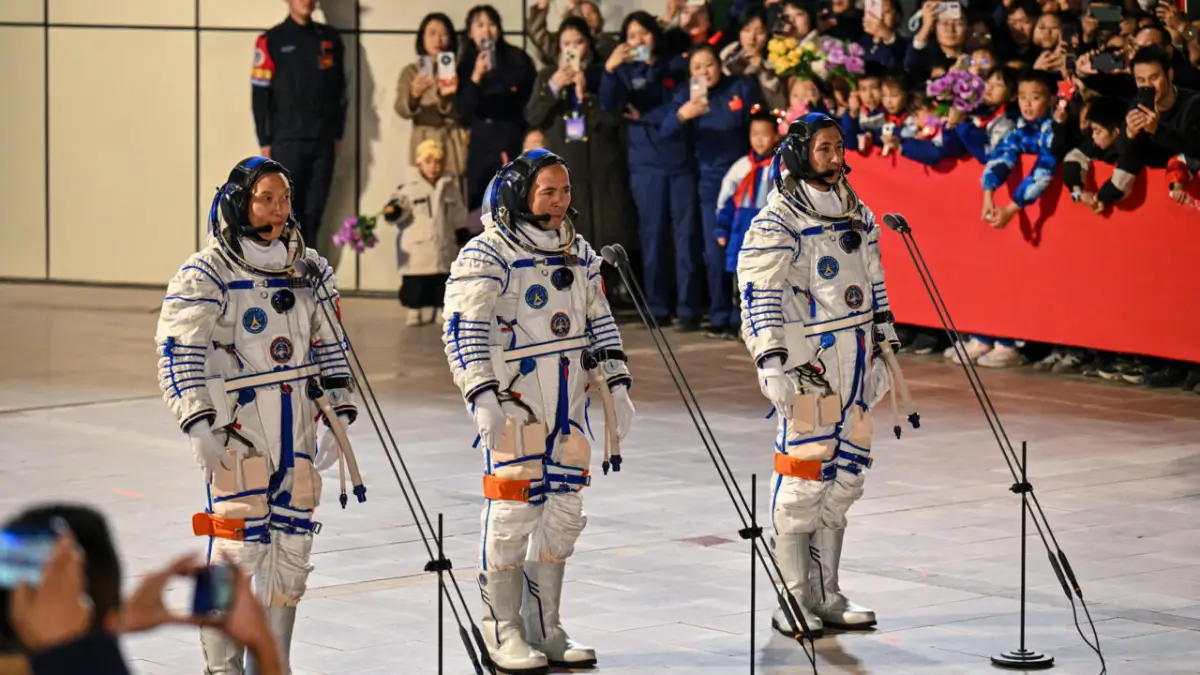
On November 1, 2025, the Shenzhou‑21 spacecraft successfully lifted off from the Jiuquan Satellite Launch Centre in China’s Gobi Desert aboard a Long March‑2F rocket, marking a significant milestone in China’s expanding space ambitions. The launch took place at 11:44 pm local time (1544 GMT) and is on track to dock with China’s orbital station. The crew consists of three astronauts: commander Zhang Lu, engineer Wu Fei (aged 32), and specialist Zhang Hongzhang. They are slated to spend six months aboard the station performing scientific experiments and station maintenance.
Youngest Astronaut in China’s History
Engineer Wu Fei, at just 32 years of age, has become China’s youngest astronaut to venture into orbit. His inclusion underscores China’s focus on training a new generation of spacefarers as the country progresses toward more ambitious missions, including lunar exploration. His senior crew colleagues bring experience while Wu Fei represents the country’s forward-looking investment in talent.
Biological Experiments with Lab Mice in Orbit
A special highlight of Shenzhou-21 is its biological research payload: four laboratory mice—two males and two females—aboard the spacecraft. This marks China’s first in-orbit mammalian experiment of this kind. Scientists aim to investigate how microgravity affects mammalian physiology, including reproduction and bodily responses in space, providing knowledge essential for long-duration human missions. The crew will also undertake tasks such as station maintenance, spacewalks, installing debris shields, and engaging in educational outreach.
Strategic Importance for China’s Space Vision
Under the leadership of Xi Jinping, China has laid out a “space dream” strategy, aiming to establish itself as a global space power. Having already achieved historic firsts such as landing the Chang’e‑4 on the Moon’s far side in 2019 and sending a rover to Mars in 2021, China is now moving toward a crewed lunar mission by 2030. The Tiangong Space Station, completed in 2022, serves as the backbone of China’s independent human spaceflight programme, offering a platform for experimentation, training and international cooperation.
China’s Independent Role and Global Ambitions
Since being excluded from the International Space Station in 2011, China has embarked on a path of self-reliance in space. The Shenzhou-21 mission not only demonstrates China’s rising technical competence, but also its intent to take a more prominent role in global space science and exploration. The findings from the orbital experiments and the operational experience gained will feed into future missions — possibly deep-space exploration efforts with extended crewed missions.

Why This News is Important
Strategic Implications for Global Space Race
The launch of Shenzhou-21 holds significance for the global space community. It signals China’s accelerating pace in human spaceflight and scientific exploration, positioning it alongside other major space-faring nations. For students preparing for government exams across sectors — whether civil service, defence, railways or banking — this reflects broader international trends in technology, diplomacy and strategic competition.
Relevance to Science & Technology and Current Affairs Syllabus
For competitive exams (such as UPSC, state PSCs, SSC, and others) that test awareness of science & technology developments and their geopolitical impact, this mission provides a recent example of space exploration, national ambition, and scientific research. The inclusion of the youngest astronaut and lab mice experiments provides tangible details that make the story more exam-friendly: candidate should recall names, mission, objectives, and context.
Connections to India’s Space Endeavours
While focusing on China, this development also has indirect relevance to India’s space programme and broader Asia-Pacific region ambitions. The fact that China is escalating crewed missions places pressure on other nations including India to step up their capabilities. For aspirants in sectors like defence or civil services, this underscores the strategic dimension of science and technology in national security and policy.
Insight into Long-Duration Space Research
The presence of lab mice aboard the mission highlights the emphasis on long-duration human spaceflight research. For exams covering science innovation, space technology or even general knowledge, this is a concrete illustration of how microgravity-induced biological effects are being researched — a topic that connects to life sciences, physics and engineering.
Historical Context
The human spaceflight programme of China has steadily advanced over the last two decades. After initial crewed flights, China launched the Tiangong space station in parts and completed it in 2022, providing a permanent orbital platform under its control. The Chang’e lunar probes and Mars rover missions demonstrated China’s extraterrestrial ambitions well before the Moon-landing goal for 2030. China’s exclusion from the International Space Station (ISS) in 2011 meant that it had to build independent systems for crew transport and habitation. The Shenzhou series of spacecraft has been the human spaceflight vehicle family, culminating now in Shenzhou-21. Past missions included biological experiments (such as plant growth, small animals) but rarely mammalian reproduction in orbit; the current mice experiment marks an evolution. This builds on earlier work in other nations (e.g., USA, Russia) with rodents, but by China, this is the first time they are launching lab mice for mammalian research in orbit. The growing trend of young astronauts (e.g., 32-year-old Wu Fei) also mirrors global space agencies’ shift to younger, multi-disciplinary crews to support longer missions.
Key Takeaways from China’s Shenzhou-21 Mission
| S. No. | Key Takeaway |
|---|---|
| 1 | The Shenzhou-21 mission launched on November 1, 2025, from Jiuquan Satellite Launch Centre, aiming to dock with the Tiangong Space Station. |
| 2 | Crew includes Zhang Lu (commander), Wu Fei (engineer and China’s youngest astronaut at age 32), and Zhang Hongzhang (specialist). |
| 3 | The mission carries four laboratory mice (two male, two female) for the first in-orbit mammalian biological experiment by China. |
| 4 | The mission forms part of China’s wider “space dream” strategy under Xi Jinping, aiming for a crewed lunar mission by 2030. |
| 5 | China’s independent space programme, built after exclusion from the ISS, is now operating a permanent orbital station (Tiangong) and expanding its role in global space science. |
FAQs: Frequently Asked Questions
1. What is the main objective of China’s Shenzhou-21 mission?
The primary goal of the Shenzhou-21 mission is to carry out long-duration scientific experiments aboard the Tiangong Space Station, including the first mammalian biological study involving lab mice in microgravity.
2. Who is the youngest astronaut in China’s history to go to space?
Wu Fei, aged 32, is China’s youngest astronaut to embark on a space mission. He serves as the engineer on the Shenzhou-21 mission.
3. From where was the Shenzhou-21 spacecraft launched?
The Shenzhou-21 spacecraft was launched from the Jiuquan Satellite Launch Centre, located in the Gobi Desert, China.
4. How many astronauts are part of the Shenzhou-21 crew?
There are three astronauts in the Shenzhou-21 crew — Commander Zhang Lu, Engineer Wu Fei, and Specialist Zhang Hongzhang.
5. Why are lab mice being sent into space on this mission?
Lab mice are being used to study how microgravity affects mammalian physiology and reproduction, which will help scientists prepare for long-duration human missions in deep space.
6. What is the significance of the Tiangong Space Station for China?
Tiangong serves as China’s permanent orbital laboratory and symbolizes the country’s self-reliance in space exploration after being excluded from the International Space Station in 2011.
7. What is China’s long-term space exploration goal?
China aims to conduct a crewed lunar mission by 2030, develop independent deep-space research programs, and expand its international collaborations.
8. How is this mission important for government exam preparation?
This news is relevant under the Science and Technology, International Relations, and Current Affairs sections of competitive exams such as UPSC, State PSCs, SSC, Defence, and Banking exams.
Some Important Current Affairs Links