

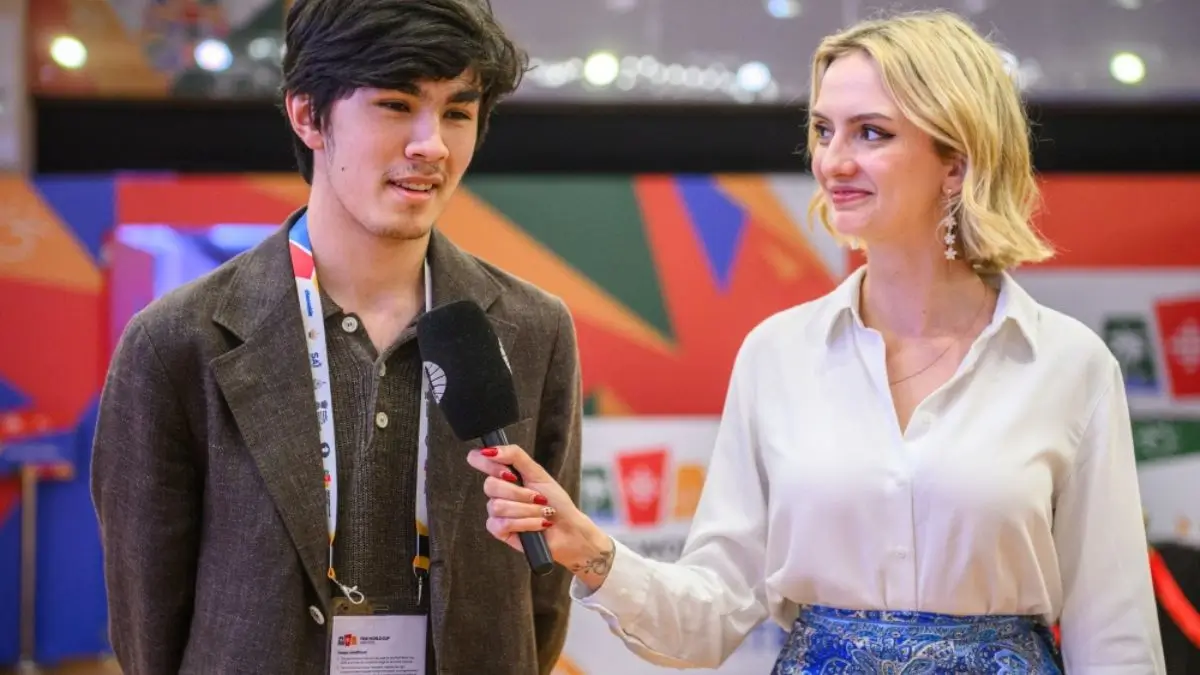
2025 FIDE World Cup winner Javokhir Sindarov becomes youngest World Cup champion at 19 after defeating Wei Yi in Goa; qualifies for 2026 Candidates — complete exam-ready analysis.
Javokhir Sindarov Crowned 2025 FIDE World Cup Champion — Historic Win in Goa
On 26 November 2025, the Uzbek chess prodigy Javokhir Sindarov clinched the title of the 2025 FIDE World Cup champion after prevailing over Chinese grandmaster Wei Yi in a tense tiebreak final held in Goa, India.
Starting from a field of 206 competitors, Sindarov emerged victorious — proving his mettle in classical games as well as rapid/blitz tiebreaks. The final match saw two classical draws, after which Sindarov outplayed Wei Yi in the tiebreak to secure the championship.
At just 19 years old, Sindarov has become the youngest ever winner of the FIDE World Cup under the tournament’s current format. With this victory, he also earned qualification to the upcoming 2026 Candidates Tournament, putting him on the path toward the World Championship cycle.
The win is especially significant as Sindarov entered the tournament as the 16th seed — making him also the lowest-seeded player to win the title this year.

Why This News Is Important for Exam Aspirants
In many competitive government exams in India — whether for banking, railways, defence, civil services (like IAS, PCS), or teaching — current affairs play a vital role. The historic victory of a teenager like Sindarov carries relevance for several reasons:
- Global Achievement & Youth Excellence: Sindarov’s win underscores the rise of young prodigies on international stage, signifying shifting patterns in global competition. It can be used to highlight youth achievements, a frequent topic under “Recent International Events.”
- Chess & India/Global Sports Awareness: Though Sindarov is Uzbek, the tournament took place in India (Goa). For Indian aspirants, this reinforces awareness of major international events hosted domestically — useful for sports-related current affairs questions.
- Significance for International Chess Cycle: As Sindarov qualifies for the 2026 Candidates Tournament, it affects future global chess dynamics — a good factoid for questions on world championships, sports governance or future events.
- Illustration of Upsets & Underdog Triumphs: His underdog status and triumph may be cited to explain unpredictability in sports — a theme that often comes up in GK questions or essay topics (e.g., “Importance of sportsmanship” or “Rise of new talent in international arena”).
- Broader Relevance to Youth & Talent Discussion: For exam essays or interview discussions, Sindarov’s success can be referenced when discussing youth in India/Asia excelling in global competitions, hard work, and potential.
Hence, this news is a valuable addition to any aspirant’s current affairs preparation, especially for sections covering international sports, achievements of young talents, and events hosted in India.
Historical Context: Background of FIDE World Cup & Sindarov’s Journey
The FIDE World Cup — now in its 11th edition for 2025 — is a single-elimination chess tournament, bringing together top players from across the world. The 2025 edition was hosted in Goa, India, from 31 October to 27 November 2025 and featured 206 participants.
Historically, the World Cup has witnessed victories from established chess legends. Past winners include grandmasters from Russia, Azerbaijan, and other chess-strong nations. However, Sindarov’s win marks the first time a player from Uzbekistan has lifted the trophy, adding a new chapter in chess history.
Sindarov is not a new arrival on the world chess scene. Born on 8 December 2005, he became a grandmaster in 2018 — at just 12 years, 10 months and 8 days — making him among the youngest grandmasters ever. Over the years, he has knocked out several high-ranked opponents from strong countries, showcased resilience, and steadily climbed the rating ladder.
The 2025 victory thus represents not just a single triumph but the culmination of years of consistent performance, marking the emergence of a new generation in global chess — one where youth, talent, and grit are redefining traditional hierarchies.
Key Takeaways from This News
| S.No | Key Takeaway |
|---|---|
| 1 | Javokhir Sindarov won the 2025 FIDE World Cup held in Goa and became the youngest ever champion under the tournament’s current format. |
| 2 | Sindarov defeated Wei Yi in the final via tiebreaks after two classical-game draws. |
| 3 | With this win, Sindarov — the 16th seed — became the lowest-seeded and youngest champion, highlighting a major upset. |
| 4 | Sindarov qualified for the 2026 Candidates Tournament, putting him on the path toward the World Chess Championship cycle. |
| 5 | The 2025 FIDE World Cup featured 206 players and was held in Goa, India — marking India as a host of a major global chess event. |
FAQs
Q1. Who is Javokhir Sindarov?
A1. Javokhir Sindarov is an Uzbek chess grandmaster born on 8 December 2005. He became a grandmaster at the age of about 12 years and is one of the youngest ever to achieve this title.
Q2. What is the significance of the 2025 FIDE World Cup win for Sindarov?
A2. Winning the World Cup at age 19 makes Sindarov the youngest ever champion of the event under its current format. It also qualifies him for the 2026 Candidates Tournament — a crucial step toward competing for the World Championship.
Q3. Where was the 2025 FIDE World Cup held and how many players participated?
A3. The 2025 FIDE World Cup was held in Goa, India, and featured 206 players in a single-elimination format.
Q4. Who did Sindarov defeat in the final, and how?
A4. He defeated Chinese grandmaster Wei Yi in the final match. After two classical-game draws, Sindarov won in the rapid/blitz tiebreaks to secure the title.
Q5. What does this victory mean for international chess dynamics?
A5. Sindarov’s win signals a shift — rising talents from countries like Uzbekistan are breaking through on the global stage. It also suggests greater competitiveness and unpredictability, demonstrating that youth and underdog players can outperform established elites.
Some Important Current Affairs Links