










Indian Navy Salvage Operation: Discover how Indian defence forces executed a high-risk mid-sea salvage mission of MV Wan Hai 503 off the Kerala coast. Ideal for civil service and defence exam prep.
Indian Navy Executes Daring Mid‑Sea Salvage Operation on Burning MV Wan Hai 503
Helicopter Insertion Amid Adverse Conditions
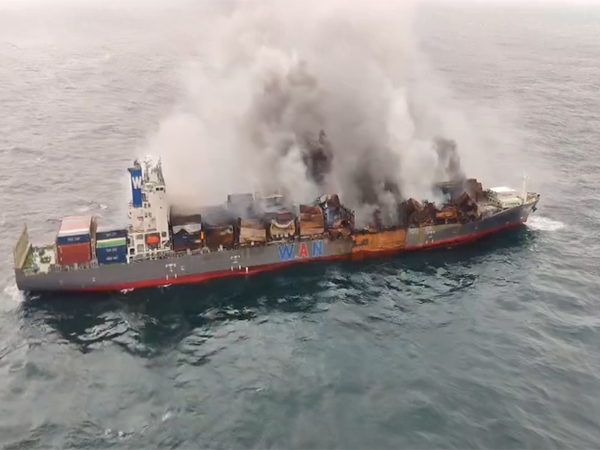
On June 13, 2025, the Indian Navy carried out a high‑stakes aerial insertion of a salvage team onto the Singapore-flagged container ship MV Wan Hai 503, which had been ablaze since June 9, approximately 42–44 nautical miles off the Kerala coast near Kannur
A Sea King helicopter from INS Garuda based in Kochi winched down the crew despite strong winds, poor visibility, and ongoing fire on the deck
Tow Line Connection & Transfer to Tug
Once on board, the salvage team secured a 600‑metre tow line to the ocean-going tug Offshore Warrior, transferring tow control from the Coast Guard to the tug
Following the connection, the team was successfully extracted via helicopter.
Joint Operations & Ongoing Measures
The mission involved coordinated efforts from the Indian Navy, Coast Guard, Air Force, and private salvors like T&T Salvage and Bureau Veritas’ TMC Marine
Coast Guard vessels Saksham, Vikram, Samarth, and MV Sharda have been supporting tow and cooling operations
Environmental Risk Management
The ship, tilted to port, continued to emit smoke after being towed to deeper waters—about 35–45 nautical miles off the coast—at a reduced speed of 1.5–1.8 knots to ensure the safe distance from land
The Kerala State Disaster Management Authority cautioned coastal residents about drifting containers landing near Ernakulam, Alappuzha, and Kollam
Why This News Is Important
Enhancing Disaster Management Protocols
This operation showcases India’s advanced maritime disaster response capabilities. For aspirants preparing for civil services and defence exams, it highlights how the Navy, Coast Guard, IAF, and state authorities coordinate during emergencies involving hazardous cargo at sea.
Safeguarding Coastal and Marine Ecosystems
Transporting a burning vessel carrying massive amounts of fuel and potentially toxic containers away from the shoreline was vital in protecting India’s coastal ecology. Knowledge of such operations is relevant for environmental governance and geography-linked syllabi.
Strengthening Disaster Preparedness and Cooperative Frameworks
This joint operation is a practical demonstration of inter-agency coordination, a key theme for banking, railways, and police exams focusing on law and order and public safety management.
Strengthening India’s International Maritime Standing
Executing such a high-risk salvage mission project India’s stature as a respected maritime power in the Indian Ocean Region—a geopolitical aspect that civil service aspirants should be aware of.
Historical Context
India has progressively enhanced its maritime disaster and emergency response mechanisms over the past decade. The adoption of Operation Sankalp in 2019 formalized India’s role in securing the maritime commons in the Indian Ocean, including responses to piracy, attacks, and accidents This operation builds on previous real-world missions such as the 2024 rescue of MV Sky II in the Red Sea, where the Navy demonstrated the ability to combine air, sea, and special forces in complex situations .
MV Wan Hai 503’s incident resonates with India’s evolving strategy: proactive defence measures to address both security threats and environmental emergencies in maritime zones.
Key Takeaways from MV Wan Hai 503 Operation
| S. No. | Key Takeaway |
|---|---|
| 1 | Event date: June 9, 2025, container explosion caused a fire aboard MV Wan Hai 503, 42–44 nm off Kannur coast. |
| 2 | On June 13, the Indian Navy executed an aerial insertion of a salvage team from INS Garuda using a Sea King chopper. |
| 3 | A 600‑m tow line was connected to tug Offshore Warrior, transferring tow control for safe distancing. |
| 4 | Collaborative effort: Navy, Coast Guard, IAF, private salvors, and local agencies worked in synergy. |
| 5 | Environmental precaution: the burning ship was towed 35–45 nm offshore; coastal areas alerted against drifting containers. |
FAQs: Frequently Asked Questions
Q1. What is MV Wan Hai 503?
MV Wan Hai 503 is a Singapore-flagged container ship that caught fire due to a container explosion off the coast of Kannur, Kerala, on June 9, 2025.
Q2. Which Indian forces were involved in the salvage operation?
The operation involved coordinated efforts from the Indian Navy, Indian Coast Guard, Indian Air Force, and private salvors like T&T Salvage and Bureau Veritas’ TMC Marine.
Q3. What made the salvage operation challenging?
The operation was conducted mid-sea under harsh weather conditions, including high winds, low visibility, and the ongoing onboard fire, which required aerial insertion of the salvage team by a Sea King helicopter.
Q4. Why is this operation significant for government exam aspirants?
It showcases inter-agency disaster response, maritime safety, and environmental management — all important topics for civil services, defence, police, and other government competitive exams.
Q5. What environmental precautions were taken?
To prevent environmental damage and coastal hazards, the burning vessel was towed 35–45 nautical miles away from the shore, and residents were cautioned about drifting containers.
Some Important Current Affairs Links




