










Introduction: Strategic Importance of IAF Stations
The Indian Air Force (IAF) plays a pivotal role in safeguarding the nation’s airspace and ensuring aerial supremacy. As of 2025, the IAF operates over 60 air stations across India, strategically positioned to address various defense and operational requirements. These stations are categorized under seven commands: Western, Eastern, Central, Southern, South Western, Training, and Maintenance. Each command oversees multiple stations, ensuring comprehensive coverage of the nation’s vast geographical expanse.
Western Air Command: The Largest Operational Command
Headquartered in New Delhi, the Western Air Command is the largest among the seven, overseeing 16 air stations spread across Jammu & Kashmir, Punjab, Haryana, Himachal Pradesh, and parts of Uttar Pradesh. Key stations under this command include:
- Ambala AFS: Known for housing the Rafale fighter jets.
- Halwara AFS: Hosts squadrons of Su-30MKI aircraft.
- Hindon AFS: Recognized as the largest airbase in Asia, it plays a crucial role in transport and special operations.
Eastern Air Command: Guardians of the Eastern Front
Based in Shillong, Meghalaya, the Eastern Air Command manages 15 air stations in the eastern and northeastern regions. Notable stations include:
- Hasimara AFS: Equipped with Rafale fighter jets.
- Tezpur AFS: Houses Su-30MKI squadrons.
- Chabua AFS: Plays a significant role in monitoring the Indo-China border.
Central Air Command: The Heartland’s Shield
Operating from Prayagraj, Uttar Pradesh, the Central Air Command supervises air stations in Uttar Pradesh, Madhya Pradesh, and surrounding states. Prominent stations are:
- Agra AFS: A vital transport base, home to aircraft like the C-130J Super Hercules.
- Bareilly AFS: Hosts Su-30MKI squadrons.
- Maharajpur AFS: Known for its Mirage 2000 fighter jets.
Southern Air Command: Maritime and Southern Defense
Headquartered in Thiruvananthapuram, Kerala, this command focuses on the southern peninsula and maritime operations. Key stations include:
- Sulur AFS: Houses the indigenous HAL Tejas aircraft.
- Thanjavur AFS: Equipped with Su-30MKI jets for maritime strike roles.
- Car Nicobar AFS: Strategic for operations in the Andaman and Nicobar Islands.
South Western Air Command: Western Frontier’s Sentinel
Based in Gandhinagar, Gujarat, this command oversees 12 air stations in Gujarat, Maharashtra, and Rajasthan. Significant stations are:
- Jodhpur AFS: A frontline base with multiple fighter squadrons.
- Jamnagar AFS: Plays a crucial role in coastal defense.
- Bhuj AFS: Strategically important due to its proximity to the Pakistan border.
Training and Maintenance Commands: Ensuring Operational Excellence
- Training Command: Located in Bengaluru, Karnataka, it oversees pilot and technical training across various institutions.
- Maintenance Command: Headquartered in Nagpur, Maharashtra, it ensures the upkeep and serviceability of IAF assets.
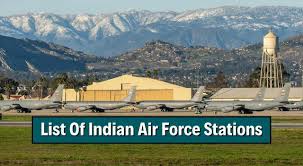
Why This News is Important
Relevance for Competitive Exams
Understanding the distribution and significance of IAF stations is crucial for aspirants of defense services, civil services, and other government positions. Questions related to the IAF’s organizational structure, key bases, and their strategic importance frequently appear in exams like UPSC, CDS, AFCAT, and SSC.
Strategic and National Security Implications
The positioning of air stations reflects India’s defense strategy, especially concerning border security with neighboring countries. Awareness of these stations aids in comprehending India’s preparedness and response mechanisms to potential threats.
Historical Context: Evolution of IAF Stations
Since its inception in 1932, the IAF has expanded its infrastructure to meet the growing defense needs of the nation. Post-independence, the focus shifted to establishing bases that could effectively monitor and defend India’s vast borders. Over the decades, the IAF has modernized its stations, incorporating advanced technology and infrastructure to enhance operational readiness.
Key Takeaways from “Comprehensive Overview of Indian Air Force Stations in 2025”
| S.No | Key Takeaway |
|---|---|
| 1. | The IAF operates over 60 air stations across India, categorized under seven commands. |
| 2. | Hindon AFS in Uttar Pradesh is the largest airbase in Asia. |
| 3. | Western Air Command is the largest, overseeing 16 air stations. |
| 4. | Eastern Air Command manages 15 stations, focusing on the northeastern frontier. |
| 5. | Training and Maintenance Commands ensure the IAF’s operational efficiency through training and equipment upkeep. |
FAQs: Frequently Asked Questions
1. How many Indian Air Force (IAF) stations are there in India as of 2025?
As of 2025, the Indian Air Force operates over 60 air stations across the country, strategically distributed under seven operational and support commands.
2. Which is the largest Indian Air Force base in Asia?
Hindon Air Force Station in Uttar Pradesh is the largest in Asia, playing a major role in transport and special operations.
3. What are the seven commands of the IAF?
The seven IAF commands are: Western, Eastern, Central, Southern, South Western, Training, and Maintenance Command.
4. Which IAF station houses the Rafale fighter jets?
Ambala AFS (Haryana) and Hasimara AFS (West Bengal) are among the bases housing the Rafale fighter jets.
5. Why are IAF stations important for competitive exams?
IAF stations are part of general awareness and defence-related current affairs, often asked in exams like UPSC, CDS, AFCAT, SSC, and State PSCs.
Some Important Current Affairs Links