



India Brazil submarine MoU: India and Brazil signed a tripartite agreement with Mazagon Dock Shipbuilders for Scorpene-class submarine maintenance, training, and lifecycle support, strengthening maritime security and defence cooperation.
India and Brazil Sign Tripartite MoU on Maintenance of Scorpene-Class Submarines
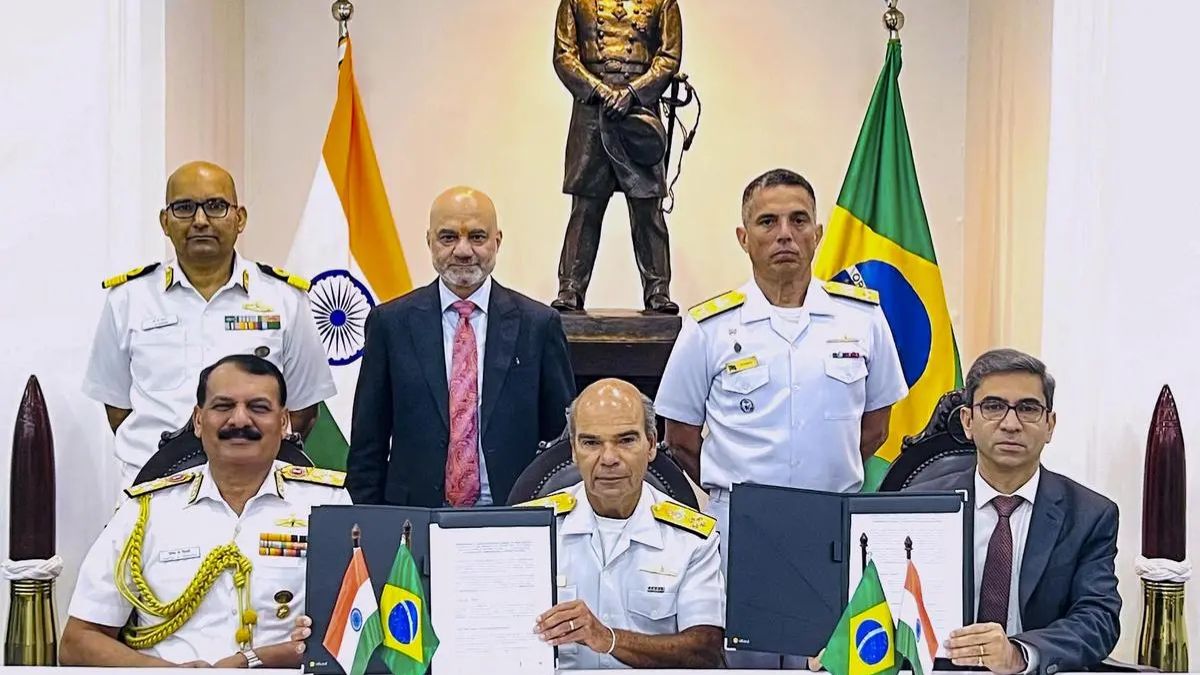
In a significant development for India’s maritime and defence cooperation, India and Brazil signed a tripartite Memorandum of Understanding (MoU) focused on the maintenance and life-cycle support of Scorpene-class submarines and other naval platforms. This strategic pact was signed during the official visit of Admiral Dinesh K. Tripathi, Chief of Naval Staff (CNS) of the Indian Navy, to Brazil from December 9 – 12, 2025.
The MoU brings together three key stakeholders: the Indian Navy, the Brazilian Navy, and Mazagon Dock Shipbuilders Limited (MDL), a major Indian defence shipyard responsible for building submarines under Project-75.
Strengthening Maritime Defence Cooperation
The agreement establishes a framework for structured exchange of technical information, maintenance methodologies, logistics support systems, and personnel training. It paves the way for enhanced cooperation between both navies and defence industries in terms of sharing expertise on submarine upkeep, repair strategies, spare parts support, and lifecycle management.
Focus on Life-Cycle Support and Training
Under the MoU, India and Brazil will cooperate on several fronts:
- Exchange of best practices in maintenance and overhaul procedures
- Joint training programmes for naval personnel
- Experience sharing to improve operational readiness
- Collaboration on defence research and development in submarine technologies
Part of Deepening Strategic Partnership
This pact reflects a broader deepening of India-Brazil strategic partnership, particularly in the defence and security domain. The agreement builds on long-standing bilateral ties and reflects mutual interests in maritime security, shared technological advancements, and capacity building. Both nations operate Scorpene-class diesel-electric submarines, making this cooperation crucial for their respective naval capabilities.
Implications for Naval Capabilities
By formalising cooperation on maintenance and technical exchange, the MoU is expected to enhance the operational availability and longevity of submarine fleets for both countries. This will also support joint research efforts and innovation in submarine lifecycle technologies, promoting defense industrial collaboration that can benefit both nations.

Why This News Is Important for Government Exam Aspirants
Strategic Defence Cooperation in Global Affairs
Understanding this MoU is essential for aspirants preparing for UPSC, State PSCs, CDS, NDA, CAPF, and other competitive exams because it reflects India’s evolving defence diplomacy with a key partner in Latin America. It highlights how India is engaging beyond its traditional neighbourhood to build defence partnerships that extend global strategic reach.
Maritime Security and Defence Readiness
The agreement underscores India’s commitment to strengthening maritime security through collaboration and knowledge exchange, a key topic in the International Relations & Security segment of current affairs. Aspirants should note how bilateral defence MoUs support operational readiness and technological exchange
Industry and Technological Synergy
For exams covering economics, defence production, and technology, this MoU illustrates how defence industries like Mazagon Dock Shipbuilders Limited (MDL) play a role in international cooperation. It also shows how bilateral defence agreements can foster R&D and innovation, pertinent for questions related to “Make in India” and defence manufacturing.
Global South Partnerships
The pact reflects the growing strategic alignment among Global South countries, especially in defence collaboration. Aspirants should connect this with the broader context of India-Brazil strategic ties and India’s role as a key maritime power in the Indo-Pacific region.
Historical Context: India-Brazil Naval Ties & Scorpene Submarines
India-Brazil Strategic Partnership
India and Brazil have maintained friendly diplomatic ties for decades, formalised as a Strategic Partnership in 2006. Over the years, cooperation has grown across fields including trade, science, defence, and education. Brazil’s position as a major naval power in Latin America and India’s leadership in the Indian Ocean have set the stage for enhanced defence collaboration.
Scorpene-Class Submarine Background
The Scorpene-class submarines are advanced diesel-electric attack submarines designed by the French Naval Group. India’s Project-75 saw six Scorpene submarines — collectively called Kalvari-class — being built at Mazagon Dock Shipbuilders Limited under technology transfer. These submarines are central to India’s undersea warfare capabilities. Brazil also operates Scorpene-class submarines as part of its naval modernisation programme, creating a shared operational platform.
Evolution of Defence Collaboration
Past discussions between Indian and Brazilian naval leaders included visits, training exchanges, and shared exercises, signifying a gradual build-up to the present tripartite MoU. This cooperation is seen not just as a technical arrangement but as part of a wider defence diplomacy strategy that enhances interoperability and mutual support in maritime domains.
Key Takeaways from India-Brazil Tripartite MoU on Scorpene Maintenance
| S.No | Key Takeaway |
|---|---|
| 1. | India and Brazil signed a tripartite MoU on maintenance of Scorpene-class submarines with the Indian Navy, Brazilian Navy, and Mazagon Dock Shipbuilders Limited. |
| 2. | The MoU was signed during CNS Admiral Dinesh K. Tripathi’s visit to Brazil (Dec 9–12, 2025). |
| 3. | It focuses on technical information exchange, logistics support, training, and lifecycle maintenance cooperation. |
| 4. | The agreement enhances life-cycle support and naval readiness for both countries’ submarine fleets. |
| 5. | This MoU strengthens India-Brazil defence ties, reflecting broader strategic and maritime cooperation. |
FAQs: Frequently Asked Questions
1. What is the India-Brazil tripartite MoU about?
The MoU is a tripartite agreement between the Indian Navy, Brazilian Navy, and Mazagon Dock Shipbuilders Limited (MDL) focused on maintenance, lifecycle support, and training for Scorpene-class submarines. It aims to enhance operational readiness and technical cooperation.
2. When and where was the MoU signed?
The MoU was signed during Admiral Dinesh K. Tripathi’s visit to Brazil from December 9 to 12, 2025.
3. What are Scorpene-class submarines?
Scorpene-class submarines are diesel-electric attack submarines designed by the French Naval Group. India’s Project-75 Kalvari-class submarines and Brazil’s submarines are based on this design.
4. Which Indian shipyard is involved in this agreement?
Mazagon Dock Shipbuilders Limited (MDL), a leading Indian defence shipyard responsible for constructing India’s Scorpene-class submarines, is part of the MoU.
5. What areas of cooperation does the MoU cover?
The MoU covers maintenance best practices, logistics support, personnel training, technical exchange, and collaborative R&D for submarine life-cycle management.
6. How does this MoU impact India-Brazil strategic relations?
This agreement strengthens bilateral defence ties, improves maritime security cooperation, and promotes joint technological and industrial collaboration.
7. Why is this news important for government exam aspirants?
It highlights India’s defence diplomacy, maritime security strategies, and international collaborations, key topics in UPSC, State PSC, CDS, CAPF, and other exams.
8. What is the significance of lifecycle support in submarines?
Lifecycle support ensures operational readiness, maintenance efficiency, and longevity of the submarines, which is critical for national security and maritime defence.
9. Has India collaborated with other countries on submarine technology before?
Yes, India has partnered with France, Russia, and other nations for submarine technology transfer, construction, and operational support under projects like Project-75 and Project-75I.
10. What is the broader strategic context of India-Brazil naval cooperation?
The MoU reflects growing Global South defence collaborations, enhancing maritime security, technological exchange, and defence industrial cooperation between India and Brazil.
Some Important Current Affairs Links