







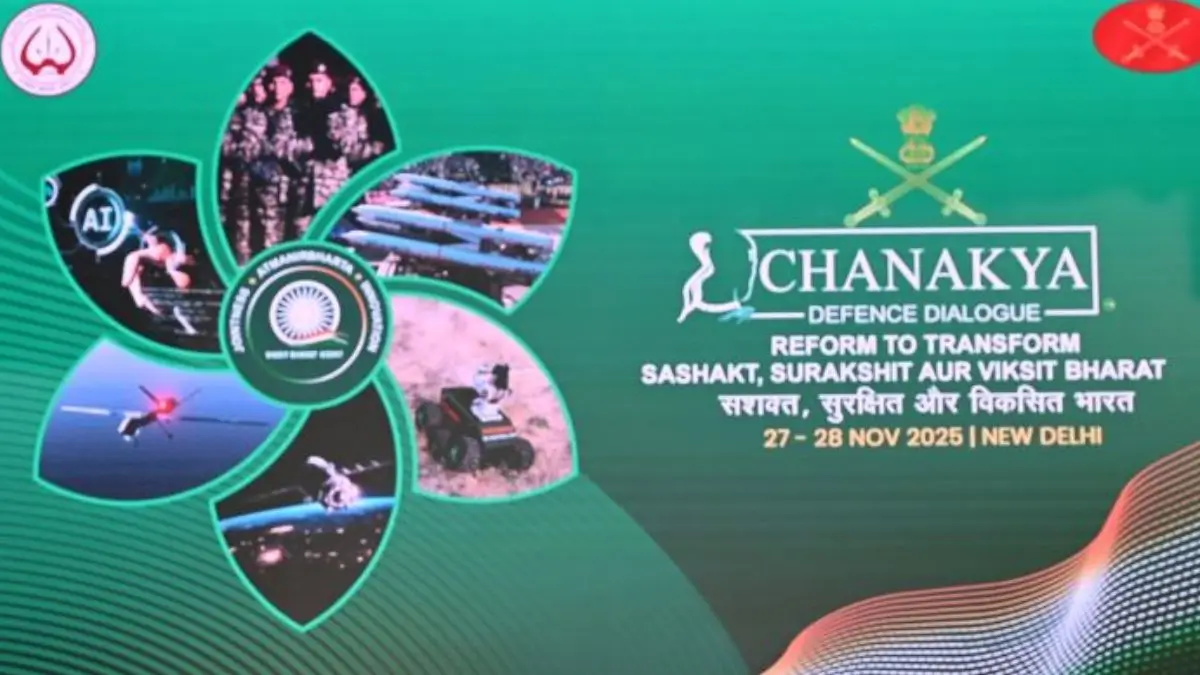
Chanakya Defence Dialogue India 2025 highlights Indian Army modernization, multi-domain warfare strategy, and long-term defence reforms roadmap. Key insights for civil services and UPSC exam preparation.
Indian Army Hosts Chanakya Defence Dialogue 2025
Overview
The third edition of the Chanakya Defence Dialogue (CDD) 2025 was held by Indian Army in New Delhi on 27–28 November 2025. The two-day event, under the theme “Reform to Transform: Sashakt, Surakshit aur Viksit Bharat”, brought together senior military leaders, defence strategists, scholars, diplomats, experts from private-sector defence industry, and youth representatives. The Dialogue reaffirmed India’s commitment to transforming its defence posture by aligning military modernisation with emerging global security trends.
During the Dialogue, the Army unveiled a comprehensive three-phase roadmap to modernize itself by 2047 — aiming at creating a future-ready, integrated, self-reliant force
Key Themes and Discussions
Visionary Inauguration
The event was inaugurated by Droupadi Murmu, the President of India, who lauded the professionalism and dedication of the Indian Armed Forces. She emphasized that India’s deterrence posture is anchored not in aggression but in moral clarity and responsible action, rooted in the civilisational ethos of “Vasudhaiva Kutumbakam” (the world is one family). Murmu highlighted the need for armed forces to be adaptive, agile and prepared across all domains — from conventional warfare to peacekeeping, humanitarian assistance, and emerging theatres such as cyber and space.
Army Chief’s Roadmap to 2047
Upendra Dwivedi, Chief of Army Staff, outlined the Army’s three-phase transformation strategy:
- Phase I (HOP 2032): Accelerated reorganisation, doctrinal reforms, and absorption of new technologies.
- Phase II (STEP 2037): Consolidation of reforms into structural readiness and enhanced operational synergy.
- Phase III (JUMP 2047): Achieving a fully digitised, self-reliant, agile force aligned with India’s long-term national development goals for 2047.
He identified four “key drivers” for this transformation: deeper self-reliance through indigenisation; faster innovation in critical technologies; systemic adaptation of defence structures; and stronger synergy between military, industry and academia.
Focus on Modernisation, Technology & Multi-Domain Warfare
The sessions at CDD-2025 emphasised the rising significance of technology in modern warfare — including AI, autonomous systems, hypersonics, cyber and space capabilities. Experts discussed how future conflicts will be multi-domain and asymmetric, requiring agility, innovation, and readiness across traditional and non-traditional domains.
Another major focus was on civil–military fusion — leveraging capabilities and expertise from academia, private defence industry and think-tanks to support military modernisation and strategic autonomy

Why this News is Important
Strategic Implications for National Security
In a rapidly shifting global order, marked by geopolitical tensions, technological disruptions, and evolving conflict paradigms, the transformation roadmap unveiled during CDD-2025 signals India’s intent to remain prepared and future-ready. The shift from conventional to multi-domain war-fighting — encompassing land, cyber, space, and cognitive domains — underlines how India is aligning its defence strategy with 21st-century challenges. For aspirants of defence, civil services or security-related government exams, this reflects a paradigm shift in national security policy and will likely influence future defence-related questions.
Relevance for Job Aspirants Across Sectors
For candidates preparing for roles like defence, police, civil services (e.g. IAS, IPS), and other government jobs — understanding this Dialogue is vital. It provides insight into India’s long-term strategic vision, defence reforms, and national security priorities. Given increasing emphasis on self-reliance and indigenisation, future recruitments — even beyond armed forces — might prioritize skill sets aligned with technology, cyber security, disaster response, and civil–military cooperation.
Reflection of India’s Long-Term Vision
CDD-2025 isn’t just about short-term procurement or capacity building; it outlines a roadmap up to 2047. This aligns with India’s broader ambition of becoming a developed, self-reliant nation. For students preparing for government exams, especially those with a general studies or current affairs component, this Dialogue offers a timely and significant example of how defence, policy, and national development interlink.
Historical Context
The concept behind the Dialogue draws inspiration from the ancient strategist Chanakya — known for his political acumen and strategic thinking. The first edition of the Chanakya Defence Dialogue 2023 was held in 2023, highlighting the need for reforms in defence doctrine, self-reliance and strategic thinking. CDD has since become an intellectual platform where military leadership, policy-makers, academia and industry converge to debate India’s security challenges and future direction.
In the current global environment — characterised by multipolar power blocs, hybrid threats, cyber-attacks, space and information warfare — CDD-2025 comes at a critical juncture. The previous decades saw India gradually modernising its armed forces, but often with dependence on foreign procurement. Starting with initiatives like “Make in India” and “Atmanirbhar Bharat”, the focus has shifted to domestic capability building, innovation and reducing dependency on foreign vendors. CDD-2025 thus represents the culmination of evolving defence discourse — from legacy weapon procurement to forging a modern, self-reliant, technology-driven force.
Moreover, with the world seeing an increasing number of conflicts (over 50 ongoing major and minor conflicts globally), as noted by the Army Chief during the Dialogue, CDD-2025 underlines India’s attempt to prepare for a volatile future through long-term strategy rather than reactive measures.
Key Takeaways from This News: Chanakya Defence Dialogue 2025
| # | Key Takeaway |
|---|---|
| 1 | The Indian Army hosted Chanakya Defence Dialogue 2025 in New Delhi on 27–28 November under the theme “Reform to Transform: Sashakt, Surakshit aur Viksit Bharat.” |
| 2 | A three-phase transformation roadmap was unveiled: Phase I by 2032 (HOP 2032), Phase II by 2037 (STEP 2037), Phase III by 2047 (JUMP 2047) — aiming for a fully modernised, integrated and self-reliant force by 2047. |
| 3 | Key strategic drivers include indigenisation, faster technology innovation, structural adaptation, and stronger synergy between military, industry and academia |
| 4 | Emphasis on multi-domain warfare readiness: land, cyber, space, information and cognitive domains — reflecting the changing nature of modern conflicts. |
| 5 | The Dialogue underscores India’s broader vision of achieving “Viksit Bharat by 2047,” linking defence modernisation with national development and self-reliance. |
FAQs: Frequently Asked Questions
1. What is the Chanakya Defence Dialogue 2025?
The Chanakya Defence Dialogue 2025 is the third edition of an annual strategic forum hosted by the Indian Army, bringing together military leaders, defence experts, industry representatives, and policymakers to discuss national security, defence reforms, and multi-domain warfare.
2. What was the theme of CDD 2025?
The theme was “Reform to Transform: Sashakt, Surakshit aur Viksit Bharat”, emphasizing reforms for a stronger, secure, and developed India by 2047.
3. Who inaugurated the Chanakya Defence Dialogue 2025?
The event was inaugurated by President Droupadi Murmu, who highlighted India’s commitment to moral and responsible military deterrence and multi-domain readiness.
4. What is the three-phase roadmap announced by the Army Chief?
- Phase I (HOP 2032): Accelerated reorganisation, doctrinal reforms, technology adoption.
- Phase II (STEP 2037): Consolidation of reforms and operational synergy.
- Phase III (JUMP 2047): Fully digitised, agile, self-reliant force aligned with India’s 2047 vision.
5. Why is CDD 2025 important for government exam aspirants?
It provides insights into India’s long-term defence strategy, national security priorities, and modernisation plans — crucial topics for civil services, defence, police, and administrative exams.
6. Which sectors are emphasized in India’s defence modernization plan?
The focus is on technology, multi-domain warfare, indigenisation, civil-military cooperation, and innovation in areas like AI, autonomous systems, cyber, and space.
7. What historical inspiration does the Dialogue follow?
CDD is inspired by Chanakya, the ancient Indian strategist, emphasizing political acumen, strategic thinking, and planning for national security.
8. What are the key drivers of India’s Army transformation?
The four key drivers are indigenisation, technology innovation, structural adaptation, and synergy between military, industry, and academia.
9. How does CDD 2025 align with India’s 2047 vision?
It maps out a long-term strategy to achieve a modern, self-reliant, and agile defence force that contributes to India’s overall national development by 2047.
10. Where was the Chanakya Defence Dialogue 2025 held?
The Dialogue was hosted in New Delhi, India, on 27–28 November 2025.
Some Important Current Affairs Links