


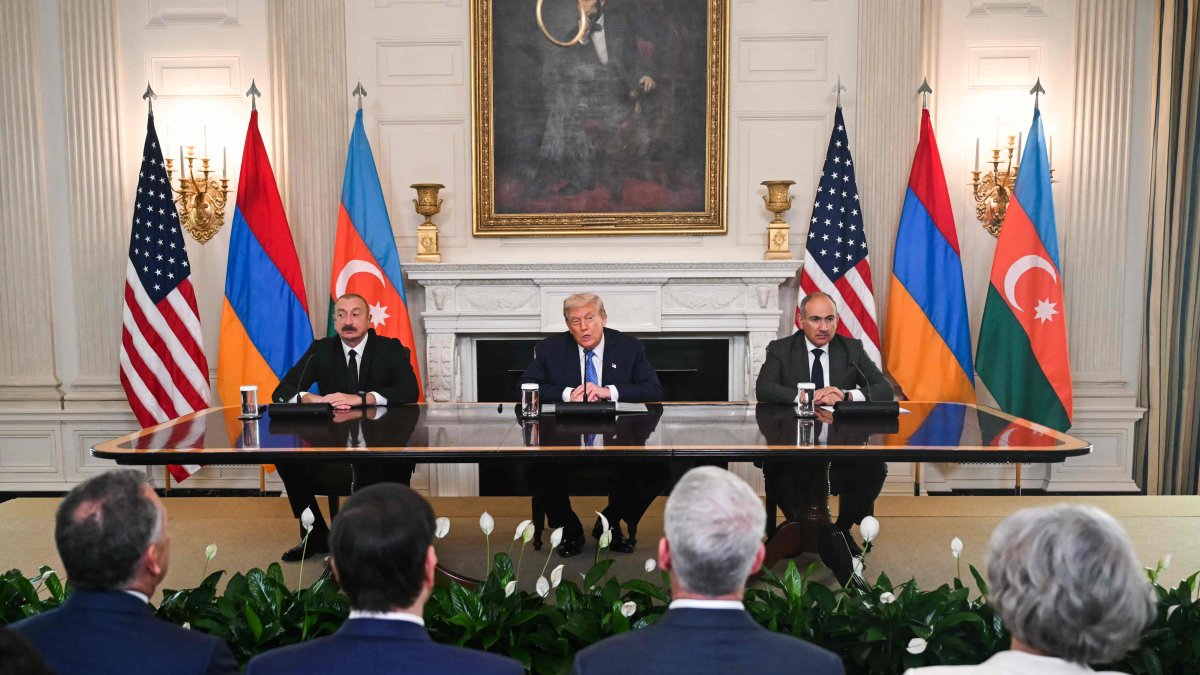
Armenia Azerbaijan peace deal 2025 signed at White House introduces TRIPP corridor, ending decades-long conflict and reshaping South Caucasus geopolitics with US mediation.
Armenia and Azerbaijan Sign Historic Peace Deal at White House Summit
Peace Deal Sealed Under U.S. Mediation
On August 8, 2025, Armenian Prime Minister Nikol Pashinyan and Azerbaijani President Ilham Aliyev signed a landmark peace agreement at the White House, mediated by U.S. President Donald Trump Marking a pivotal moment in Caucasus geopolitics, the accord aims to bring decades of hostilities to a close.
Introduction of the ‘Trump Route for International Peace and Prosperity’ (TRIPP)
A centerpiece of the agreement is the TRIPP corridor—a strategic transit route linking Azerbaijan with its Nakhchivan exclave, passing through Armenia under Armenian sovereignty, with development rights granted to the United States for 99 years The corridor is designed for rail, oil, gas, fiber optics, and potentially electricity infrastructure, envisioned to stimulate investment and regional connectivity
Economic and Strategic Rebalancing in the South Caucasus
The deal realigns the region significantly—boosting U.S. influence while diminishing Russian sway amid Russia’s strained global standing post-Ukraine invasion Notably, both Armenia and Azerbaijan signed bilateral cooperation pacts with the U.S. on energy, technology, and economic sectors
Mixed Reactions from Neighbours and Global Actors
- Turkey—a key Azerbaijani ally—welcomed the deal as transformative for trade and Euro-Asian connectivity
- Iran, on the other hand, expressed apprehension, warning the corridor could threaten regional stability and even become “a graveyard for Trump’s mercenaries”

Why This News Is Important
Strategic Resolution of a Prolonged Conflict
This peace agreement has the potential to end nearly four decades of armed conflict over Nagorno-Karabakh—a fraught and deadly chapter that claimed countless lives and displaced communities
Transforming Regional Geopolitics
The accord shifts the regional power balance decisively. It diminishes Russian influence and amplifies U.S. engagement in the South Caucasus, affecting global strategic computations
Opening Channels for Economic Integration
By reviving transportation links via the TRIPP corridor, the deal promises to integrate the region into broader global trade networks, facilitating energy exports and infrastructure development
Precedent for Diplomacy and Peacebuilding
This agreement enhances the U.S.’s credentials as an international mediator. Both Pashinyan and Aliyev endorsed Trump’s role—echoing calls to nominate him for the Nobel Peace Prize
Historical Context
Origins of the Nagorno-Karabakh Conflict
The conflict traces back to the late 1980s, when the Nagorno-Karabakh region—a predominantly Armenian-populated enclave—sought independence from Azerbaijan during the waning days of the Soviet Union Over ensuing decades, the region witnessed intense fighting and intermittent ceasefires, but peace remained elusive.
Recent Land Shifts and Negotiation Efforts
In 2023, Azerbaijan reclaimed control over Nagorno-Karabakh, leading to the exodus of nearly 100,000 Armenians Border demarcation between Armenia and Azerbaijan began in 2024, including the contentious return of several villages, as initial groundwork toward reconciliation
From Minsk Group Mediation to U.S. Intervention
Previously, the OSCE Minsk Group—co-led by Russia, France, and the U.S.—handled peace efforts with limited success. The new deal, brokered solely by the U.S., effectively sidelines this structure and marks a new phase in negotiations
Key Takeaways from This News
| S.No. | Key Takeaway |
|---|---|
| 1. | On August 8, 2025, Armenia and Azerbaijan signed a U.S.-mediated peace deal at the White House, aiming to end decades of conflict. |
| 2. | The agreement includes the creation of the TRIPP corridor—a transit route linking mainland Azerbaijan to Nakhchivan, under Armenian law but with U.S. development rights for 99 years. |
| 3. | It marks a significant geopolitical realignment, boosting U.S. influence and weakening Russian dominance in the region. |
| 4. | The deal opens economic pathways via enhanced trade, energy infrastructure, and regional connectivity. |
| 5. | Regional reactions are mixed—Turkey supports it; Iran views it warily, reflecting broader strategic tensions. |
FAQs – Frequently Asked Questions
1. When was the Armenia–Azerbaijan peace agreement signed?
The peace agreement was signed on August 8, 2025 at the White House in Washington, D.C.
2. Who mediated the peace deal between Armenia and Azerbaijan?
The deal was mediated by U.S. President Donald Trump.
3. What is the TRIPP corridor mentioned in the peace agreement?
The TRIPP (Trump Route for International Peace and Prosperity) is a proposed transit route linking mainland Azerbaijan with the Nakhchivan exclave through Armenian territory, under Armenian sovereignty, with U.S. development rights for 99 years.
4. Which infrastructures will the TRIPP corridor facilitate?
It will facilitate rail transport, oil and gas pipelines, fiber optic cables, and possibly electricity transmission lines.
5. How does the peace deal affect Russian influence in the South Caucasus?
It reduces Russian influence while significantly increasing U.S. presence in the region.
6. What was the main cause of the Armenia–Azerbaijan conflict?
The conflict centered on the Nagorno-Karabakh region, a predominantly Armenian-populated area within Azerbaijan’s borders.
7. Which countries have reacted positively to the peace deal?
Turkey welcomed the deal, seeing it as beneficial for regional trade and connectivity.
8. Which country expressed opposition to the peace corridor?
Iran expressed strong reservations, warning it could destabilize the region.
9. What year did Azerbaijan regain control of Nagorno-Karabakh?
Azerbaijan regained control of Nagorno-Karabakh in 2023.
10. Why is this peace deal significant for international diplomacy?
It demonstrates the effectiveness of direct U.S. mediation and sets a precedent for resolving long-standing geopolitical disputes.
Some Important Current Affairs Links




