
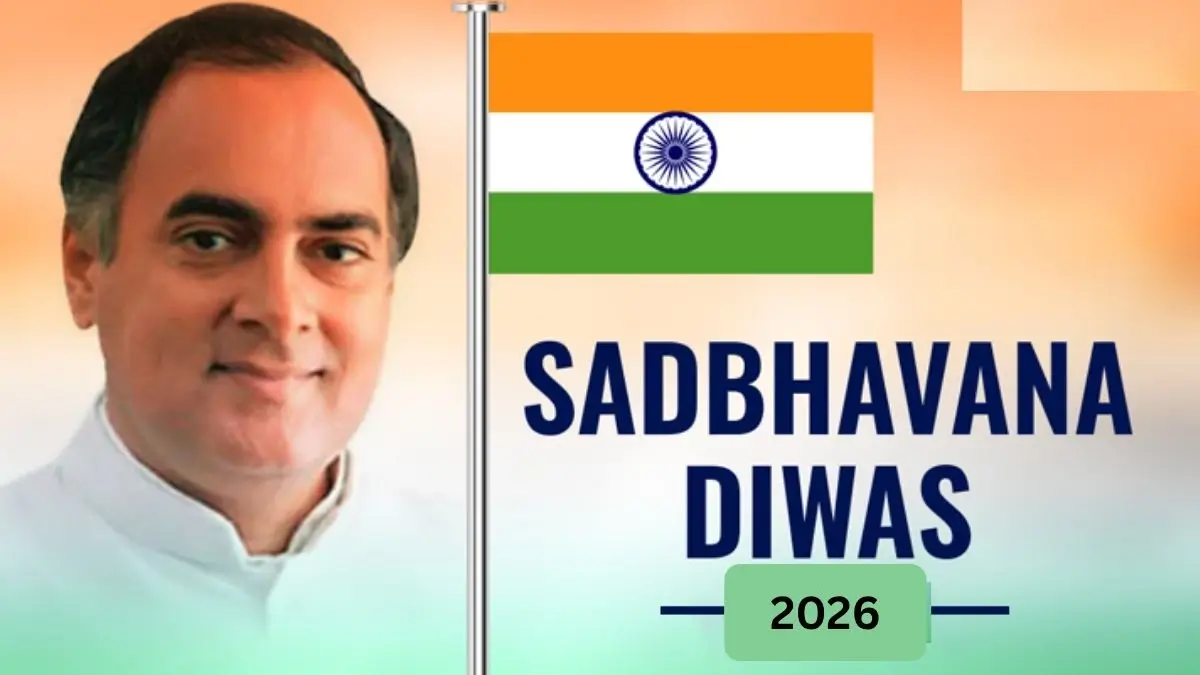
Sadbhavana Diwas 2026 is observed on 20 August to mark Rajiv Gandhi’s birth anniversary. Know its significance, history, Rajiv Gandhi’s tenure, major reforms and key exam facts.
Sadbhavana Diwas 2026: Date and Significance
Sadbhavana Diwas 2026 will be observed on 20 August 2026 to commemorate the birth anniversary of former Prime Minister Rajiv Gandhi. The day promotes goodwill, national integration, communal harmony, peace and emotional unity among India’s diverse communities. The term Sadbhavana broadly refers to goodwill and harmony.
Rajiv Gandhi Birth Anniversary 2026
Rajiv Gandhi was born on 20 August 1944 in Bombay, now Mumbai. His 82nd birth anniversary in 2026 provides an important occasion to study his political career, contribution to India’s modernization and the historical circumstances under which he became Prime Minister. For government-exam aspirants, his career is particularly relevant to questions on modern Indian political history, governance, education, technology and national integration.
How Rajiv Gandhi Became Prime Minister
Rajiv Gandhi entered national politics after the death of his younger brother Sanjay Gandhi and became a Member of Parliament from Amethi in 1981. His political career changed dramatically on 31 October 1984, when Prime Minister Indira Gandhi was assassinated. Rajiv Gandhi was subsequently appointed Prime Minister and took charge at the age of 40, making him the youngest person to hold the office at that time.
1984 General Election and Political Mandate
Following Indira Gandhi’s assassination, the country went through a period of intense political uncertainty. The 1984 Lok Sabha election resulted in a massive victory for the Congress under Rajiv Gandhi’s leadership. This gave the new Prime Minister a strong parliamentary mandate and created an opportunity for his government to pursue its development and modernization agenda.
Rajiv Gandhi and Technological Modernisation
Rajiv Gandhi’s tenure is closely associated with efforts to modernise India’s technology and telecommunications sectors. His government encouraged the expansion of computerisation and telecommunications and promoted the use of modern technology in administration and economic development. These initiatives contributed to the long-term transformation of India’s information and communication infrastructure.
Education Reforms under Rajiv Gandhi
Education was another important area of his government’s policy agenda. The National Policy on Education, 1986 sought to improve access to education and strengthen the country’s educational system. The policy is an important topic for competitive examinations because it represents a significant post-independence effort to establish a broader national framework for education.
Panchayati Raj and Grassroots Democracy
Rajiv Gandhi also advocated strengthening democratic institutions at the grassroots level. His government pursued constitutional reforms intended to provide greater recognition and stability to Panchayati Raj institutions. Although the major constitutional amendments giving constitutional status to Panchayats and Municipalities were enacted later in the 1990s, the initiatives during Rajiv Gandhi’s period contributed to the policy debate that eventually led to the 73rd and 74th Constitutional Amendments.
Rajiv Gandhi and National Integration
The ideals associated with Sadbhavana Diwas focus on emotional unity, peaceful coexistence and national integration. Rajiv Gandhi’s political career unfolded during a period marked by significant social and political challenges. The observance therefore provides an opportunity to understand the importance of maintaining harmony in a country characterised by diversity of language, religion, culture and region.
Rajiv Gandhi’s Tenure and Major Challenges
Rajiv Gandhi’s government faced several complex domestic and international challenges. His tenure included debates surrounding the Shah Bano case, the Bofors controversy, the Punjab crisis and developments in Sri Lanka. These issues are important for civil-service and other government examinations because they illustrate the interaction between political decision-making, social issues, foreign policy and national security.
Rajiv Gandhi’s Role in Foreign Policy
Rajiv Gandhi also played an active role in India’s foreign policy during the Cold War period. India maintained its commitment to the broader principles of the Non-Aligned Movement while strengthening relations with major global powers and neighbouring countries. His government also became involved in the Sri Lankan conflict, including India’s deployment of the Indian Peace Keeping Force following the 1987 Indo-Sri Lanka Accord.
Rajiv Gandhi’s Assassination and Legacy
Rajiv Gandhi was assassinated on 21 May 1991 at Sriperumbudur in Tamil Nadu during the 1991 election campaign. His assassination ended the life of a former Prime Minister who had become an important figure in India’s modern political history. He was posthumously awarded the Bharat Ratna in 1991.
Why Sadbhavana Diwas Matters for Government Exams
For students preparing for UPSC, State PCS, SSC, banking, railways, defence, police and teaching examinations, Sadbhavana Diwas is relevant because it combines important facts from polity, history, governance and current affairs. Key facts include 20 August, Rajiv Gandhi’s birth anniversary, his tenure as Prime Minister from 1984 to 1989, the National Policy on Education 1986 and the broader themes of national integration and communal harmony.
Sadbhavana Diwas 2026: Exam Perspective
The observance should be studied not merely as an important day but as a gateway to understanding India’s political development during the 1980s. Questions may ask about Rajiv Gandhi’s age when he became Prime Minister, his predecessor, his tenure, the National Policy on Education, the Indo-Sri Lanka Accord, his assassination and the meaning and purpose of Sadbhavana Diwas.

Why This News Is Important
Importance for National Integration
Sadbhavana Diwas is significant because it highlights the importance of national integration in a country with considerable social, linguistic, religious and regional diversity. The observance encourages citizens to value peaceful coexistence and emotional unity. These themes are closely connected with the constitutional ideals of fraternity, equality and secularism.
Importance for Modern Indian History
The life and political career of Rajiv Gandhi form an important chapter in post-independence Indian history. His rise to the Prime Minister’s Office after the assassination of Indira Gandhi in 1984 and his subsequent electoral mandate represent a major political transition. Understanding this period helps students connect current affairs with historical developments.
Importance for Governance and Technology
Rajiv Gandhi’s government is frequently associated with India’s early push towards technological modernisation, telecommunications and computerisation. These developments are relevant to understanding the foundations of India’s later growth as an information-technology and services economy.
Importance for Education Policy
The National Policy on Education 1986 is another major examination point. It represented an important attempt to develop a comprehensive framework for education in independent India. Students preparing for teaching examinations and civil services should understand its objectives and historical significance.
Importance for Competitive Examinations
Sadbhavana Diwas can generate questions in the General Awareness, Current Affairs, History, Polity and Static GK sections of competitive examinations. Remembering the date, personality associated with the observance, Prime Ministerial tenure, major policies and historical events can help aspirants answer both direct factual and analytical questions.
Historical Context: Background of Sadbhavana Diwas and Rajiv Gandhi
Rajiv Gandhi’s Political Background
Rajiv Gandhi belonged to the Nehru-Gandhi political family and was the son of Prime Minister Indira Gandhi and grandson of India’s first Prime Minister, Jawaharlal Nehru. Unlike many political leaders, he initially pursued a career as a commercial pilot before entering active politics. His entry into politics became more prominent during the early 1980s.
Entry into National Politics
Rajiv Gandhi became a Member of Parliament from Amethi in 1981. After the assassination of Indira Gandhi on 31 October 1984, he assumed the office of Prime Minister. His age of 40 made him the youngest person to become India’s Prime Minister. He remained Prime Minister until 1989.
The 1980s as a Period of Transformation
The 1980s were an important period in India’s political, technological and social development. The country was experiencing rapid changes in communication technology while simultaneously confronting serious political and security challenges. Rajiv Gandhi’s government attempted to respond to this changing environment through modernisation-oriented policies.
National Policy on Education, 1986
The National Policy on Education introduced in 1986 was a major policy milestone. It sought to expand educational opportunities, improve quality and address disparities in access to education. Its historical importance makes it particularly relevant for teacher recruitment examinations and civil-service preparation.
Constitutional Decentralisation Debate
During Rajiv Gandhi’s tenure, efforts were made to strengthen local self-government through constitutional recognition of Panchayati Raj institutions and urban local bodies. The proposals did not initially become constitutional amendments, but the issue remained important and eventually contributed to the passage of the 73rd and 74th Constitutional Amendments in 1992, which came into force in 1993.
Origin of Sadbhavana Diwas
Sadbhavana Diwas is observed on 20 August in memory of Rajiv Gandhi and promotes harmony, goodwill and national integration. Available historical accounts place the beginning of the observance in 1992, following Rajiv Gandhi’s assassination in 1991. The Rajiv Gandhi National Sadbhavana Award was also instituted in 1992 to recognise contributions to communal harmony, national integration and peace.
Relevance of the Observance Today
The continuing observance of Sadbhavana Diwas reflects the broader importance of social harmony in India’s democratic system. For students, it connects an important national observance with constitutional values, post-independence political history and the development of public policy.
Key Takeaways from Sadbhavana Diwas 2026: Rajiv Gandhi and Modern India
| S. No. | Key Takeaway |
|---|---|
| 1 | Sadbhavana Diwas is observed on 20 August every year to commemorate the birth anniversary of former Prime Minister Rajiv Gandhi and promote goodwill, harmony and national integration. |
| 2 | Rajiv Gandhi became Prime Minister in 1984 at the age of 40, following the assassination of his mother and then Prime Minister Indira Gandhi. |
| 3 | Rajiv Gandhi served as Prime Minister from 1984 to 1989 and his tenure is associated with technological modernisation, telecommunications and education reforms. |
| 4 | The National Policy on Education, 1986 was introduced during Rajiv Gandhi’s tenure and remains an important milestone in India’s post-independence education policy. |
| 5 | Sadbhavana Diwas was first observed in 1992, while the Rajiv Gandhi National Sadbhavana Award was also instituted in 1992 to recognise contributions to communal harmony, national integration and peace. |
FAQs: Sadbhavana Diwas 2026
1. When is Sadbhavana Diwas observed?
Sadbhavana Diwas is observed every year on 20 August to commemorate the birth anniversary of former Prime Minister Rajiv Gandhi and promote goodwill, peace, communal harmony and national integration.
2. Whose birth anniversary is commemorated on Sadbhavana Diwas?
Sadbhavana Diwas commemorates the birth anniversary of Rajiv Gandhi, who served as the Prime Minister of India from 1984 to 1989.
3. When was Rajiv Gandhi born?
Rajiv Gandhi was born on 20 August 1944 in Bombay, now known as Mumbai.
4. When did Rajiv Gandhi become the Prime Minister of India?
Rajiv Gandhi became Prime Minister on 31 October 1984, following the assassination of his mother and then Prime Minister, Indira Gandhi.
5. How old was Rajiv Gandhi when he became Prime Minister?
Rajiv Gandhi was 40 years old when he became Prime Minister, making him the youngest person to hold the office at that time.
6. What was the tenure of Rajiv Gandhi as Prime Minister?
Rajiv Gandhi served as Prime Minister from 1984 to 1989.
7. Which important education policy was introduced during Rajiv Gandhi’s tenure?
The National Policy on Education, 1986 was introduced during his tenure. It is an important topic for teaching, civil services and other government examinations.
8. What is the main objective of Sadbhavana Diwas?
The observance promotes national integration, communal harmony, peace, goodwill and emotional unity among India’s diverse communities.
9. What technological developments are associated with Rajiv Gandhi’s government?
His government is associated with efforts towards computerisation, telecommunications and technological modernisation, which contributed to India’s subsequent development in information and communication technology.
10. What were the 73rd and 74th Constitutional Amendments?
The 73rd and 74th Constitutional Amendments, enacted in 1992 and implemented in 1993, gave constitutional recognition to Panchayati Raj institutions and urban local bodies. Rajiv Gandhi’s government had earlier attempted constitutional reforms concerning grassroots democracy.
Some Important Current Affairs Links