







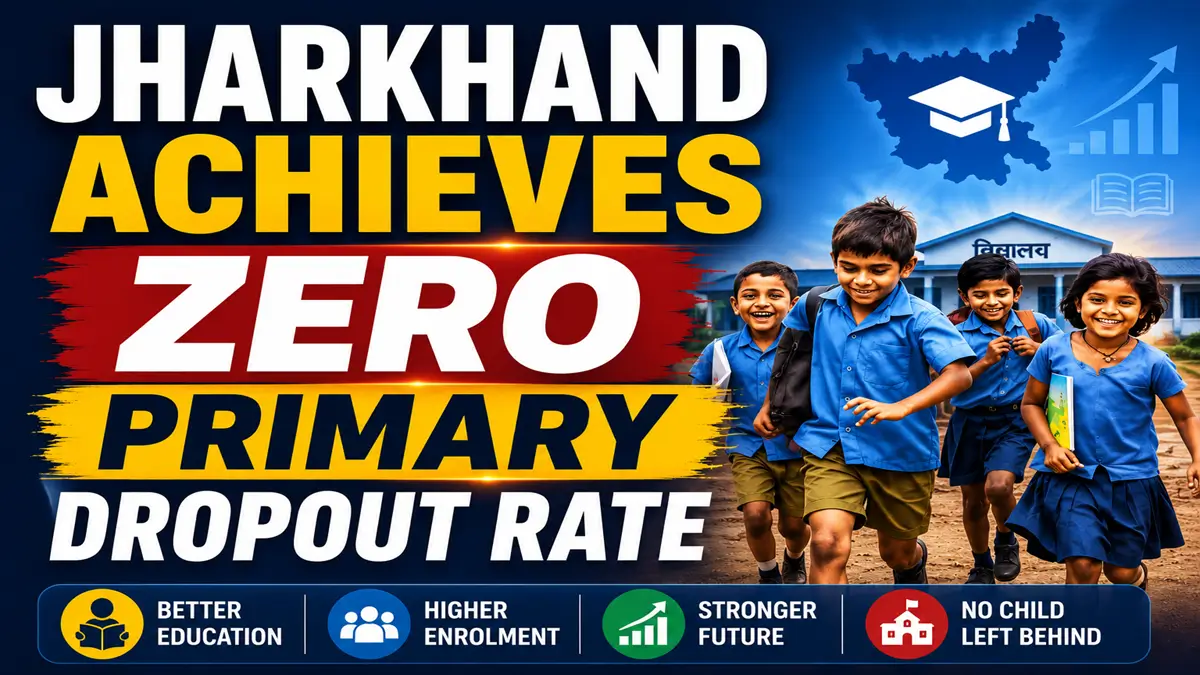
Jharkhand zero primary dropout rate 2024-25 marks a major education milestone under UDISE+ data, highlighting improved school retention, welfare schemes, and key reforms in India’s education system.
Jharkhand Achieves Zero Primary Dropout Rate in 2024-25: Major Milestone in School Education
Introduction to the Achievement
Jharkhand has achieved a historic milestone in the field of school education by recording a zero primary dropout rate in the academic year 2024-25. This remarkable progress was highlighted through data linked to the Unified District Information System for Education Plus (UDISE+) and reports discussed by policy institutions in India. The achievement reflects the success of various educational reforms, welfare schemes, awareness campaigns, and community participation programs implemented in the state.
The development is considered highly significant because dropout rates have remained a major challenge in India, especially in rural, tribal, and economically weaker regions. Jharkhand’s success demonstrates that focused policy implementation and consistent educational outreach can substantially improve student retention.
Significant Improvement in Dropout Rates
The state witnessed a dramatic fall in dropout rates across multiple educational levels over the past decade. The primary dropout rate declined from 6.41% in 2014-15 to 0% in 2024-25. Similarly, upper primary dropout rates reduced from 7.42% to 1.7%, while secondary school dropout rates dropped sharply from 23.2% to 3.5%.
This reduction indicates that more children are continuing their education instead of leaving school midway. The achievement becomes more important because school dropout is often linked to poverty, child labour, migration, early marriage, and lack of educational infrastructure.
Role of Government Welfare Schemes
Several welfare initiatives contributed to this educational success. Financial assistance schemes for girls, scholarships, free textbooks, uniforms, mid-day meals, and awareness campaigns encouraged parents to keep children in schools. Jharkhand’s education department also conducted surveys to identify out-of-school children and bring them back into the education system.
The Savitribai Phule Kishori Samriddhi Yojana played an important role in supporting girls’ education. Under this scheme, financial incentives were provided to girls from Class VIII to XII, helping reduce economic barriers that often force students to discontinue education.
Importance of UDISE+ Data
The UDISE+ system has become an important educational database for tracking school-level indicators such as enrolment, infrastructure, teachers, and dropout rates. It helps policymakers identify gaps in education delivery and implement corrective measures.
The data also showed improvement in transition rates between different educational stages across India. Better transition rates indicate that students are increasingly moving from primary to upper primary and secondary levels without dropping out.
Challenges Still Remain
Despite this major achievement, Jharkhand continues to face several educational challenges. Reports indicate that the state still has a large number of teacher vacancies, particularly at the elementary level. Thousands of schools continue to function with a single teacher, which affects the quality of education.
Another concern is that many children remain vulnerable to dropping out because of poverty, migration, lack of transportation, and social inequalities. Experts believe that maintaining the zero dropout rate will require continuous monitoring, infrastructure improvement, teacher recruitment, and community engagement.
National Significance of the Achievement
Jharkhand’s success has national significance because it provides a model for other Indian states struggling with school dropouts. States with high dropout rates can study Jharkhand’s strategies related to welfare schemes, awareness campaigns, and educational monitoring systems.
Education experts believe that reducing dropout rates is essential for improving literacy, employment opportunities, gender equality, and overall socio-economic development. The achievement also supports India’s broader educational goals under the National Education Policy (NEP) 2020.

Why This News is Important
Importance for Competitive Examinations
This news is highly important for students preparing for government examinations such as UPSC, SSC, Banking, Railway, Defence, State PCS, Police, and Teaching exams because it is connected to important themes like education reforms, social development, government welfare schemes, and human resource development.
Questions related to dropout rates, literacy, school education indicators, UDISE+, and government initiatives are frequently asked in competitive examinations. Candidates should remember that Jharkhand achieved a zero primary dropout rate in 2024-25 and significantly reduced secondary dropout rates.
Importance for Social and Economic Development
Education plays a major role in national development. Lower dropout rates mean more children are receiving formal education, which improves literacy and employment opportunities. Educated populations contribute positively to economic growth, healthcare awareness, and social equality.
Reducing school dropouts is also essential for preventing child labour, early marriage, and exploitation of vulnerable children. This achievement therefore represents progress in both educational and social sectors.
Importance for Policy and Governance
The success of Jharkhand demonstrates how effective governance, welfare schemes, and data-driven policymaking can improve educational outcomes. Policymakers across India may study Jharkhand’s model for improving student retention and educational access.
The news is also relevant in the context of Sustainable Development Goals (SDGs), especially Goal 4, which focuses on quality education for all.
Historical Context
School Dropout Problem in India
India has historically faced serious challenges related to school dropouts, especially in rural and tribal areas. Economic hardship, child labour, social discrimination, gender inequality, and poor school infrastructure have contributed to high dropout rates.
States with large tribal populations, including Jharkhand, often faced additional challenges such as migration, lack of transportation, and shortage of teachers.
Formation of UDISE+
The Unified District Information System for Education Plus (UDISE+) was introduced to create a comprehensive database of school education in India. It helps the government monitor enrolment, infrastructure, teacher availability, and student performance across schools.
The data collected through UDISE+ supports evidence-based policymaking and educational planning.
Government Efforts to Improve Education
Over the years, both the Central Government and state governments launched several schemes to improve school enrolment and reduce dropouts. Important initiatives include:
- Mid-Day Meal Scheme
- Samagra Shiksha Abhiyan
- Beti Bachao Beti Padhao
- Scholarship programs for girls and marginalized communities
- Free textbooks and uniforms
- Residential schools for tribal students
These initiatives gradually improved school participation and retention rates across India.
National Education Policy 2020
The National Education Policy (NEP) 2020 placed strong emphasis on universal school education, foundational literacy, digital learning, and reducing dropout rates. States were encouraged to strengthen educational infrastructure and ensure equitable access to quality education.
Jharkhand’s recent success aligns with the objectives of NEP 2020 and demonstrates progress toward inclusive education.
Key Takeaways from This News
| S.No. | Key Takeaway |
|---|---|
| 1 | Jharkhand achieved a zero primary dropout rate in 2024-25. |
| 2 | Primary dropout rates declined from 6.41% in 2014-15 to 0% in 2024-25. |
| 3 | Secondary dropout rates in Jharkhand reduced from 23.2% to 3.5%. |
| 4 | UDISE+ plays an important role in tracking educational indicators across India. |
| 5 | Teacher shortages and infrastructure gaps remain major challenges despite educational progress. |
FAQs (Frequently Asked Questions)
1. What is the main achievement of Jharkhand in 2024-25 education data?
Jharkhand has achieved a zero primary school dropout rate in the academic year 2024-25, marking a significant improvement in its school education system.
2. Which system is used to track dropout rates in India?
The UDISE+ (Unified District Information System for Education Plus) is used to track key education indicators such as enrolment, dropout rates, infrastructure, and teacher availability.
3. What factors helped reduce dropout rates in Jharkhand?
Key factors include government welfare schemes, mid-day meals, scholarships, awareness campaigns, free educational resources, and efforts to bring out-of-school children back into classrooms.
4. Which government scheme supports girls’ education in Jharkhand?
The Savitribai Phule Kishori Samriddhi Yojana provides financial support to girls from Class VIII to XII, encouraging them to continue their education.
5. Why is reducing dropout rate important for India?
Reducing dropout rates improves literacy, employment opportunities, social equality, and supports national development goals such as NEP 2020 and SDG 4 (Quality Education).
6. Does Jharkhand still face educational challenges despite this achievement?
Yes, challenges like teacher shortages, single-teacher schools, infrastructure gaps, and poverty-related issues still exist.
Some Important Current Affairs Links