





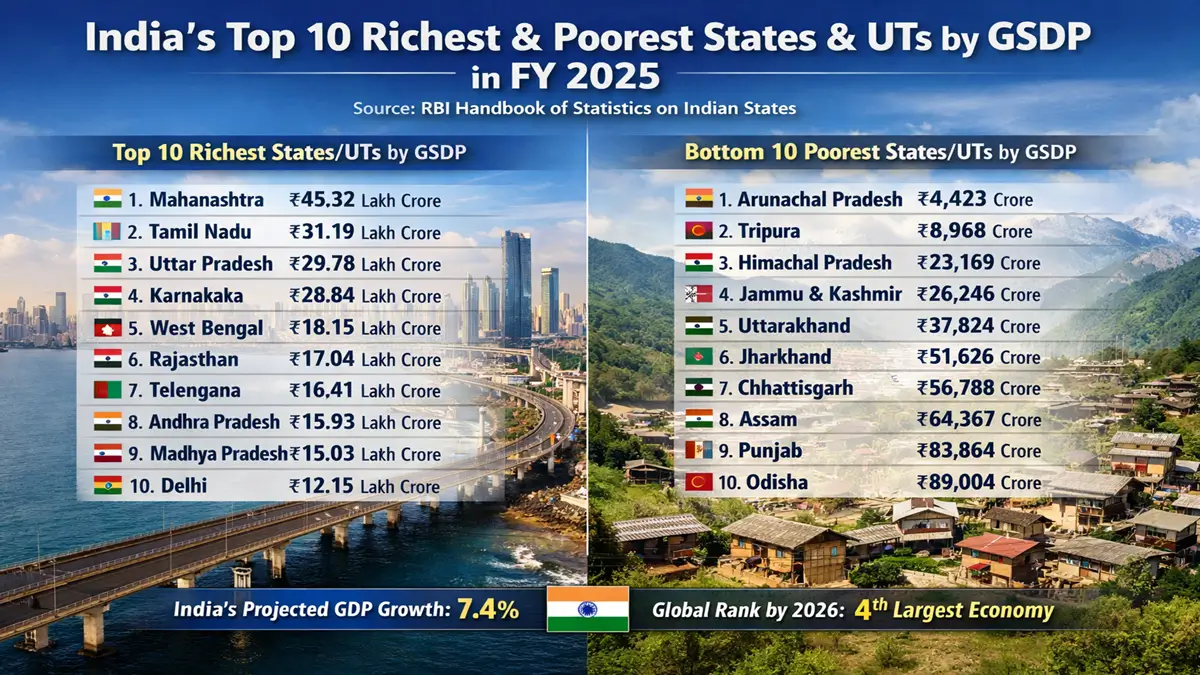
India richest states GSDP 2025 – Check the top 10 richest and poorest Indian states and UTs by GSDP in FY2025. Detailed analysis, FAQs, MCQs, and key facts for UPSC, SSC, Banking, Railways, Defence and PCS exams.
India’s Top 10 Richest & Poorest States/UTs by GSDP in FY2025
India’s economy has shown strong resilience and growth in FY2025, with states contributing differently to the nation’s economic output. Gross State Domestic Product (GSDP) reflects the value of all goods and services produced within a state in a year. Using current price estimates from the RBI Handbook of Statistics on Indian States, Maharashtra continues to dominate as the largest state economy, while several smaller states and Union Territories remain at the bottom of the list.
🏆 Top 10 Richest States/UTs by GSDP
- Maharashtra: ₹45.32 lakh crore
- Tamil Nadu: ₹31.19 lakh crore
- Uttar Pradesh: ₹29.78 lakh crore
- Karnataka: ₹28.84 lakh crore
- West Bengal: ₹18.15 lakh crore
- Rajasthan: ₹17.04 lakh crore
- Telangana: ₹16.41 lakh crore
- Andhra Pradesh: ₹15.93 lakh crore
- Madhya Pradesh: ₹15.03 lakh crore
- Delhi: ₹12.15 lakh crore
These states lead India’s economic growth, driven by a mix of manufacturing, services, agriculture, technology, and infrastructure development. Maharashtra’s economy is powered by its financial capital, Mumbai, while southern states like Tamil Nadu and Karnataka benefit from industrial clusters, exports, and IT services.
📉 Bottom 10 States/UTs by GSDP
- Arunachal Pradesh: ₹4,423 crore
- Tripura: ₹8,968 crore
- Himachal Pradesh: ₹23,169 crore
- Jammu & Kashmir: ₹26,246 crore
- Uttarakhand: ₹37,824 crore
- Jharkhand: ₹51,626 crore
- Chhattisgarh: ₹56,788 crore
- Assam: ₹64,367 crore
- Punjab: ₹83,864 crore
- Odisha: ₹89,004 crore
Smaller economies generally reflect limited industrialisation, geographic constraints, or smaller populations. For example, states in the North-East like Arunachal Pradesh and Tripura have significantly lower GSDP compared to larger states.

📌 Why This News Is Important for Government Exam Aspirants
🧠 Exam-Relevant Economic Indicators
Understanding state-wise GSDP rankings is vital for government exam preparation, especially for subjects like Economics, Indian Economy, Government Schemes, and Current Affairs. GSDP highlights economic health, development disparity, infrastructure levels, and planning needs across India’s states and Union Territories.
📍 Useful for Competitive Exams
In exams such as UPSC Civil Services (IAS/PCS), SSC, Banking, Railways, Teaching, and Police Exams, questions often focus on:
- India’s economic contributors (states/UTs)
- Size of state economies and their rankings
- Regional disparity and development indices
- Economic policy impacts on states
Knowing which states have the largest and smallest economies helps aspirants connect current affairs to broader economic topics.
🧩 Policy and Governance Implications
These rankings also influence policymaking and budget allocation. States with lower GSDP might receive more Central assistance under various schemes, which are frequently asked in exams. For example, questions can ask about how schemes like the Back-to-Back Loan Facility or State Infrastructure Support aim to reduce disparity.
📜 Historical Context
🏛 Evolution of State Economies in India
Since economic liberalisation in 1991, India’s states have seen differentiated growth. States with strong industrial bases like Maharashtra and Tamil Nadu grew rapidly due to manufacturing, services, and export sectors. Meanwhile, hilly and North-Eastern states remained smaller in economic size due to structural challenges like accessibility and limited industrialisation.
📈 GSDP as a Modern Metric
The concept of GSDP (Gross State Domestic Product) emerged as a key development metric to assess regional economic performance. Over the past decade, southern and western states consistently led the charts because of infrastructure, human capital, and investment flow. States like Uttar Pradesh rose significantly, reflecting improved manufacturing and service sectors.
🌍 Economic Disparity
Economists and policymakers focus on economic disparity between large and small states to ensure balanced national growth. This data feeds into reports by the Reserve Bank of India (RBI) and the Finance Ministry that influence budgetary policies and development programs.
⭐ Key Takeaways from India’s GSDP Rankings FY2025
| S.No. | Key Takeaway |
|---|---|
| 1 | Maharashtra is the richest state by GSDP with ₹45.32 lakh crore. |
| 2 | Tamil Nadu and Uttar Pradesh follow in the top three largest state economies. |
| 3 | Smaller states and UTs, like Arunachal Pradesh and Tripura, have the lowest GSDP values. |
| 4 | Economic size reflects industrialisation, services, and infrastructure, not just population. |
| 5 | These rankings are important for competitive exams in understanding India’s economic geography. |
FAQs for Government Exam Aspirants
1. What is GSDP?
Gross State Domestic Product (GSDP) is the total monetary value of all final goods and services produced within a state or Union Territory during a financial year. It reflects the economic strength of a particular state.
2. Which state has the highest GSDP in FY2025?
Maharashtra ranks first in FY2025 with the highest GSDP among Indian states, continuing its position as India’s largest state economy.
3. Which states are among the top three richest states by GSDP in FY2025?
The top three states are Maharashtra, Tamil Nadu, and Uttar Pradesh.
4. Which states are among the lowest in terms of GSDP?
Some of the lowest-ranked states include Arunachal Pradesh and Tripura, mainly due to smaller population size and limited industrial base.
5. Who releases GSDP data in India?
The Reserve Bank of India (RBI) compiles and publishes state-wise economic data through its Handbook of Statistics.
6. Why is GSDP important for competitive exams?
Questions related to economic indicators, state rankings, and regional disparities are frequently asked in UPSC, SSC, Banking, Railways, Defence, Teaching, and State PCS exams.
7. What is the difference between GDP and GSDP?
GDP measures the economic output of the entire country, whereas GSDP measures the output of an individual state.
8. Which sectors contribute most to high GSDP states?
Manufacturing, services (IT, finance), infrastructure, exports, and agriculture significantly contribute to higher GSDP in leading states.
9. Does higher GSDP mean higher per capita income?
Not necessarily. A large population may reduce per capita income despite high GSDP.
10. How does GSDP influence government policy?
It affects fund allocation, development planning, Finance Commission recommendations, and centrally sponsored schemes.
Some Important Current Affairs Links