






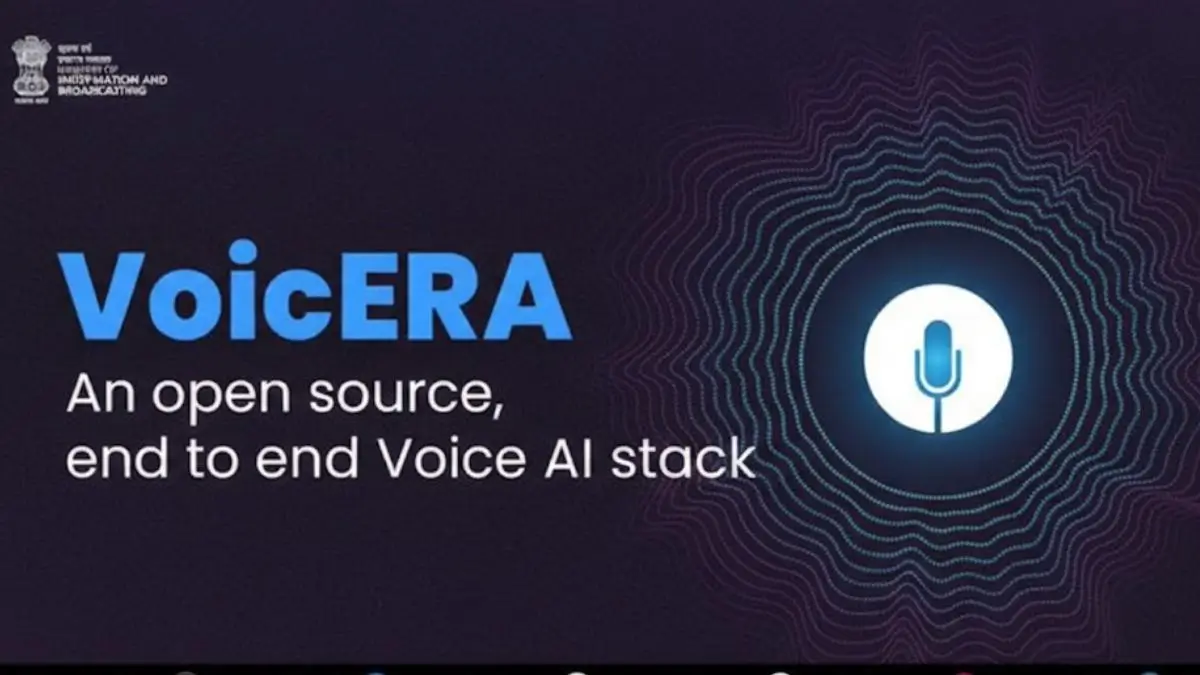
VoicERA AI Stack on BHASHINI is India’s new open-source voice AI platform launched under Digital India to promote multilingual digital inclusion and strengthen Digital Public Infrastructure.
VoicERA AI Stack Launch on BHASHINI: India’s Leap in Voice-Powered Digital Public Infrastructure
India has taken a significant step in strengthening its digital capabilities with the launch of VoicERA, an open-source Voice Artificial Intelligence (AI) stack on the BHASHINI National Language Infrastructure. The platform was unveiled at the India AI Impact Summit 2026 by the Ministry of Electronics and Information Technology (MeitY), under the Digital India BHASHINI Division of the Digital India Corporation.
The new platform is designed to serve as a national execution layer for scalable voice and language AI applications across sectors. VoicERA offers modular, interoperable features that can be deployed both on the cloud and on-premise to help government agencies, research institutions, and startups build voice-enabled services without vendor dependence.
What Is VoicERA and Why It Matters
VoicERA stands out because it is open-source, meaning developers and organisations can freely adopt, customise and innovate using its components. Unlike proprietary systems, open-source AI technology promotes transparency, reduces duplication of efforts, and avoids vendor lock-in — a critical factor for sovereign technology growth.
Built with contributions from leading Indian institutions such as EkStep Foundation, IIIT Bangalore, and AI4Bharat, VoicERA supports real-time speech recognition, conversational AI, and multilingual telephony systems. The integration with BHASHINI — India’s national language AI infrastructure — boosts its potential to serve citizens in local languages at a population-wide scale.
Expanding BHASHINI’s Capabilities
BHASHINI was originally established to enhance language translation and natural language processing services for India’s diverse linguistic landscape. With VoicERA, its scope grows to include voice-first interfaces and speech-based interactions. This expansion makes digital platforms easier to use for citizens who may prefer speaking over typing, especially in rural or under-served regions.
For instance, departments offering agricultural advisories, education support, grievance redressal, and citizen services can now integrate voice systems — empowering people to access information in their preferred language using simple spoken commands.
A New Era of Voice as Digital Interface
Officials have described the launch as a step toward a new “Voice Era” where citizens can “speak to the State and be understood.” The initiative aligns with India’s broader efforts in building Digital Public Infrastructure (DPI) — platforms designed for open access, scalability, and interoperability such as Aadhaar, UPI, and DigiLocker.
By integrating VoicERA into the DPI framework, India aims to foster innovation, enhance accessibility, and promote digital inclusion — especially for regional language speakers and citizens with limited literacy in English or digital interfaces.

Why This News Is Important for Competitive Exams
Digital Public Infrastructure and National Technology Goals
The launch of VoicERA on the BHASHINI infrastructure represents a key development in India’s Digital Public Infrastructure (DPI) ecosystem. DPI is a foundational component of India’s digital strategy aimed at creating open, scalable systems that deliver secure, efficient, and citizen-centric digital services at a national scale. Competitive exams such as UPSC, SSC, State PSC, and others regularly include questions about India’s digital initiatives, governance frameworks, and public technology platforms — making this news highly relevant.
VoicERA’s open-source design provides a blueprint for inclusive technology development that breaks down barriers related to language and digital access. Since India is home to more than 22 official languages, multilingual voice AI capability supports wider access to services like education, health, agriculture, and grievance redressal. This aligns with national priorities like Digital India, AI for All, and equitable technology adoption — themes frequently tested in Polity & Governance and Science & Technology sections of exams.
Promoting Innovation and Technology Sovereignty
Another aspect is the push towards technology sovereignty — reducing dependencies on foreign proprietary platforms and promoting indigenous innovation. VoicERA’s development in collaboration with Indian academic and non-profit institutions highlights how public-private partnership models can strengthen national capabilities. Aspirants preparing for positions in administrative services, defence, and civil services must understand how digital policy decisions support India’s socio-economic goals.
Historical Context: Evolution of Language AI in India
India has made continuous progress in language technology over the past decade. Initiatives like the National Language Translation Mission (NLTM) — which evolved into the BHASHINI project — were launched to bridge language barriers in digital communication. Over time, BHASHINI has grown from translation tools to supporting speech recognition and natural language processing across multiple languages.
Earlier, AI language tools were largely proprietary and focused on English or global languages. Recognising India’s linguistic diversity, the government pushed for open infrastructure that serves regional languages and supports local innovation. Platforms such as Project Vaani and other open-data sets help fuel this ecosystem, building speech data that reflects India’s multilingual reality.
VoicERA’s introduction represents the next stage — moving beyond text and translation toward speech-enabled experiences. This reflects global trends in user interfaces shifting from typing to voice input and natural conversation, which enhances accessibility for people with limited literacy or digital experience.
Key Takeaways from VoicERA AI Stack Launch
| S.No. | Key Takeaway |
|---|---|
| 1. | VoicERA is an open-source Voice AI stack launched by MeitY on the BHASHINI National Language Infrastructure. |
| 2. | The platform supports multilingual voice recognition, conversational AI, and telephony systems for population-scale deployment. |
| 3. | VoicERA is designed to be modular, interoperable, and cloud/on-premise deployable to avoid vendor lock-in. |
| 4. | Integration with BHASHINI expands India’s language technology ecosystem from translation to voice-first interfaces. |
| 5. | The launch marks a strategic step in Digital Public Infrastructure, promoting inclusive access to digital services for regional language speakers. |
FAQs for Competitive Exam Preparation
1. What is VoicERA and who launched it?
VoicERA is an open-source Voice AI stack launched by the Ministry of Electronics and Information Technology (MeitY) under the Digital India BHASHINI Division. It is designed to enable scalable multilingual voice-based digital services across India.
2. What is BHASHINI?
BHASHINI (Bhasha Interface for India) is India’s National Language Translation Mission platform aimed at providing AI-powered language translation, speech recognition, and natural language processing tools to promote digital inclusion across Indian languages.
3. Under which larger initiative does BHASHINI function?
BHASHINI operates under the broader Digital India initiative, which focuses on transforming India into a digitally empowered society and knowledge economy.
4. What is the main objective of VoicERA?
The main objective of VoicERA is to create an open, interoperable, and sovereign voice AI infrastructure that supports real-time speech recognition, conversational AI, and multilingual telephony systems for government and private services.
5. Why is VoicERA significant for India’s Digital Public Infrastructure (DPI)?
VoicERA strengthens India’s DPI ecosystem by enabling voice-first access to public services, especially for citizens who are not comfortable with text-based or English-dominated interfaces.
6. How does open-source technology benefit India?
Open-source platforms promote transparency, reduce vendor lock-in, lower costs, encourage innovation, and enhance technological sovereignty — important themes in governance and science & technology exams.
7. Which exam sections can include questions from this topic?
Questions may appear in UPSC (Prelims & Mains), SSC, Banking, State PSCs, Defence exams, and other competitive exams under Science & Technology, Governance, Digital Initiatives, and Government Schemes.
8. What is meant by Digital Public Infrastructure (DPI)?
DPI refers to foundational digital systems such as Aadhaar, UPI, and DigiLocker that provide scalable and inclusive public services across India.
Some Important Current Affairs Links