





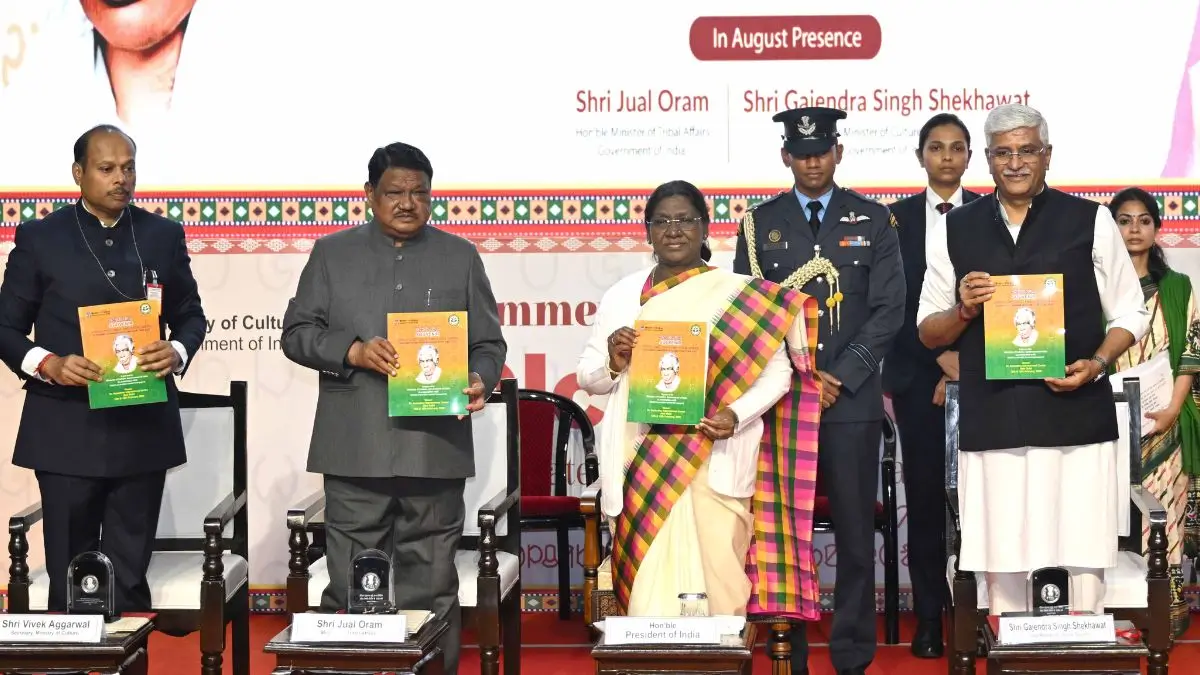
Ol Chiki script centenary celebration inaugurated by President Droupadi Murmu in New Delhi. Learn key facts about Santhali language, Raghunath Murmu, Eighth Schedule inclusion, and exam-important points for UPSC, SSC, Banking, Railways and State PSC exams.
President Droupadi Murmu Flags Off Centenary Celebrations of the Ol Chiki Script in New Delhi
📌 Overview of the Event
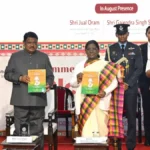
On 16 February 2026, the President of India, Smt. Droupadi Murmu, inaugurated the year-long centenary celebrations marking 100 years of the Ol Chiki script at the Dr. Ambedkar International Centre, New Delhi. The ceremony was organised by the Ministry of Culture in collaboration with the Fagun Foundation and brought together dignitaries from government, tribal communities, and cultural organisations.
🗣️ Significance of President’s Address
President Droupadi Murmu described the Ol Chiki script as a “powerful symbol of Santhali identity” and a unifying cultural force for the Santhal community. She stressed that while children learn mainstream languages like Hindi, English, Odia, and Bengali, they should also be encouraged to learn their mother tongue — specifically Santhali in its original Ol Chiki script — to preserve cultural heritage.
🎖️ Cultural and National Elements of the Celebration
The centenary function began with the national song and formal rendition of the National Anthem by the President’s Band, followed by traditional Santhali music performed by a tribal choir. A commemorative coin and postal stamp were launched by President Murmu to mark this historic milestone. Additionally, a special exhibition showcasing the journey and contribution of the Ol Chiki script was organised for attendees and students alike.
📚 Educational and Linguistic Context
The President highlighted that before 1925, the Santhali language was written in multiple external scripts — such as Roman, Devanagari, Bengali, and Odia — which could not accurately represent its phonetics. In 1925, Pandit Raghunath Murmu invented the Ol Chiki script to address this gap, providing the Santhali language with a dedicated writing system. Today, Ol Chiki stands not only as a script but also as a symbol of cultural pride, identity, and community unity for Santhal people across India and abroad.
🎨 Cultural Performances and Recognition
The vibrant event also included traditional dance performances, demonstrations of Santhali art, and recognition of key contributors who have worked to preserve and promote the Ol Chiki script. Several personalities were felicitated for their contributions to enriching Santhali literature and linguistic heritage.

📍 Why This News Is Important for Exam Aspirants
🧠 Cultural Awareness and India’s Linguistic Diversity
This news highlights the importance of tribal languages and scripts, reflecting India’s linguistic diversity, an area frequently tested in General Studies (GS) papers of UPSC and other civil services exams. The Ol Chiki script plays a pivotal role in representing India’s commitment to inclusive cultural preservation.
📜 Significance in Education and Language Policy
President Murmu’s emphasis on preserving mother tongues underscores current government policy priorities related to language education, particularly under nationally recognised scripts. Understanding language preservation strategies is vital for questions in education, national policy, and cultural identity sections of competitive exams.
📢 Representation of Tribal Communities
This centenary event directs focus on the Santhal tribal community, one of India’s major tribal groups. Their language and script are now spotlighted at the national level — a topic relevant to tribal studies, governance, and social inclusion sections.
📈 Government Initiatives and National Symbols
Releasing a commemorative coin and stamp adds to India’s long list of symbolic actions by the state to celebrate cultural milestones. These initiatives are common fodder in current affairs sections of banking and SSC exams.
📜 Historical Context: The Ol Chiki Script & Its Legacy
📘 Origin of the Ol Chiki Script
The Ol Chiki script was invented in 1925 by Pandit Raghunath Murmu to serve the Santhali language, which previously lacked its own writing system and was written using other regional scripts that couldn’t capture its unique sounds.
🗣️ Inclusion in the Eighth Schedule
Santhali — written in Ol Chiki — was formally recognised as one of India’s constitutionally acknowledged languages when it was included in the Eighth Schedule of the Indian Constitution through the 92nd Constitutional Amendment Act, 2003.
🕊️ Cultural Impact
Over the last 100 years, the Ol Chiki script has played a crucial role in preserving and promoting Santhali literature, traditions, and cultural identity within and beyond tribal populations across states such as Jharkhand, Odisha, West Bengal, Assam, and Bihar.
📊 Key Takeaways from “Centenary Celebrations of the Ol Chiki Script”
| S.No | Key Takeaway |
|---|---|
| 1. | President Droupadi Murmu inaugurated the 100-year centenary celebrations of the Ol Chiki script in New Delhi. |
| 2. | The Ol Chiki script was invented by Pandit Raghunath Murmu in 1925 for the Santhali language. |
| 3. | President Murmu called the script a “powerful symbol of Santhali identity” and urged its wider promotion. |
| 4. | On the occasion, a commemorative coin and postal stamp were released. |
| 5. | The event highlighted the importance of preserving tribal languages and mother tongues in Indian cultural policy. |
Frequently Asked Questions (FAQs)
1. Who inaugurated the 100-year celebration of the Ol Chiki script?
The centenary celebrations were inaugurated by the President of India, Droupadi Murmu, in New Delhi.
2. What is the Ol Chiki script?
Ol Chiki is a writing system specifically developed for the Santhali language to accurately represent its phonetics and linguistic structure.
3. Who invented the Ol Chiki script?
The script was invented in 1925 by Raghunath Murmu, a scholar and social reformer from the Santhal community.
4. Why was the Ol Chiki script created?
Before 1925, Santhali was written in scripts like Devanagari, Bengali, Odia, and Roman, which could not fully capture its unique sounds. Ol Chiki was created to provide a dedicated script for the language.
5. Which tribal community is associated with the Ol Chiki script?
The script is associated with the Santhal tribe, one of the largest tribal communities in India.
6. In which year was Santhali included in the Eighth Schedule of the Indian Constitution?
Santhali was included in the Eighth Schedule through the 92nd Constitutional Amendment Act, 2003.
7. Where was the centenary celebration inaugurated?
The event was held at the Dr. Ambedkar International Centre in New Delhi.
8. Which ministry organized the event?
The celebration was organized by the Ministry of Culture in collaboration with cultural organizations.
9. Why is this news important for competitive exams?
It is relevant for topics such as Indian Polity (Eighth Schedule), Art & Culture, Tribal Affairs, Language Preservation, and Government Initiatives.
10. Which states have a significant Santhal population?
Santhals are primarily found in Jharkhand, Odisha, West Bengal, Bihar, and Assam.
Some Important Current Affairs Links