








Global Corruption Perceptions Index 2025 decline explained with rankings, India’s position, and key facts important for UPSC, SSC, banking and other government exams.
📉 Global Corruption Perceptions Index 2025 Shows Decline in Average Score
The Global Corruption Perceptions Index (CPI) 2025, released by Transparency International, highlights a worrying trend in global governance. According to the latest CPI report, the global average score has dropped to 42 out of 100 — the lowest in more than a decade. The CPI ranks 182 countries and territories on a scale where 0 indicates high corruption and 100 suggests very clean governance.
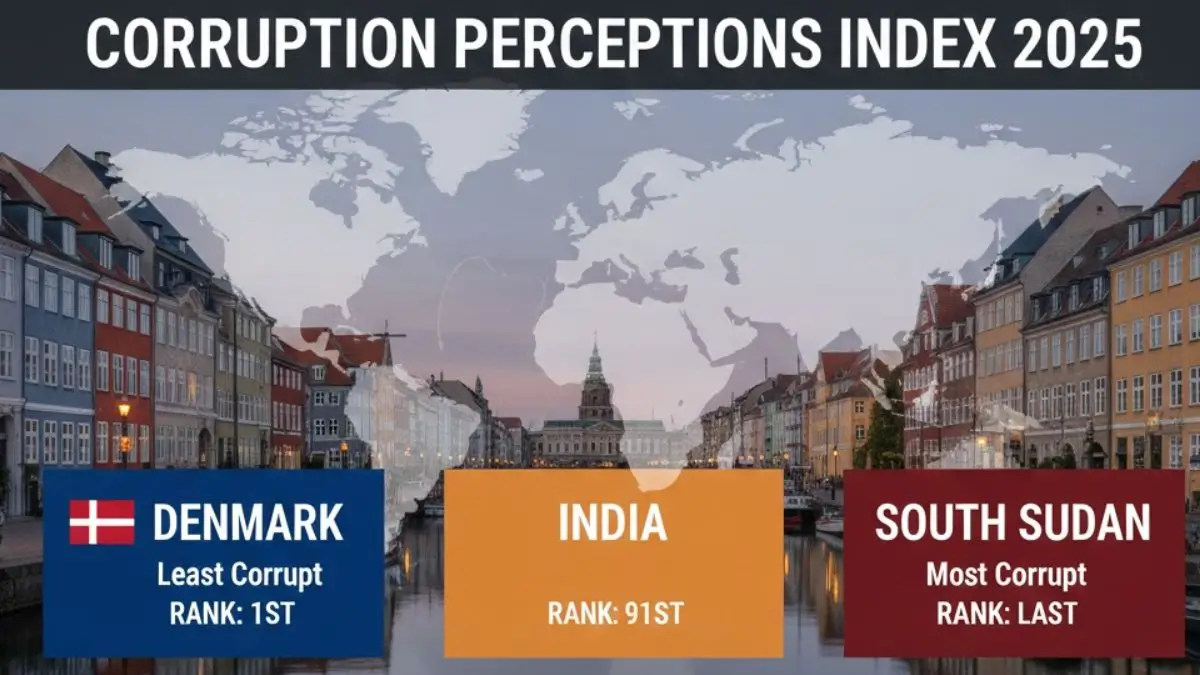
This year’s report indicates that 122 countries score below 50, showing that corruption remains widespread across the world. The number of nations scoring above 80 — considered comparatively clean — has sharply declined over recent years. Denmark maintained its position as the least corrupt country with a score of 89, followed by Finland and Singapore. At the bottom end are countries with serious governance challenges such as South Sudan and Somalia, both scoring as low as 9.
The CPI’s methodology relies on expert assessments and business surveys that measure perceptions of public sector corruption, including bribery, lack of accountability, and misuse of public office. Notably, even traditionally strong democracies like the United States, the United Kingdom, France, and New Zealand have seen declining scores, indicating that corruption concerns are not limited to fragile states alone.
🌍 India’s Standing in CPI 2025
India has shown slight improvement, moving up in the rankings to 91st position with a score of 39. While this is marginally higher than the previous year, India remains below the global average. Experts say that India’s result reflects ongoing governance reforms, but challenges like bureaucratic red tape, lack of transparency, and institutional weaknesses persist.
📊 *Trend Analysis: Why Scores are Declining?
The downward trend in global CPI scores highlights weakening anti-corruption leadership and shrinking civic space in many countries. Across several regions, governments have introduced restrictions on civil society, making it harder for independent watchdogs, journalists, and NGOs to hold power accountable. Countries that have demonstrated improvement over time — such as Estonia, Bhutan, and South Korea — credit sustained policy reforms and strong internal oversight mechanisms.

🧠 Why This News Is Important for Government Exam Aspirants
Understanding global indices like the Corruption Perceptions Index (CPI) is crucial for students preparing for competitive government exams because such topics frequently appear under International Organizations, Governance, Global Affairs, and Current Affairs. The CPI is one of the world’s most widely recognized measures of corruption — often referenced in UPSC, SSC CGL/CHSL, Banking exams (IBPS, SBI), Teacher Eligibility Tests (TET/CTET), Police, Defense, and PCS exams.
Corruption directly impacts governance, the rule of law, and economic development — subjects integral to the General Studies papers of UPSC (Prelims and Mains) and State PCS exams. Knowledge of how countries fare in terms of transparency and integrity helps students critically assess global rankings and India’s position in the world. This is particularly relevant for essay writing, ethics papers, and interview stages where questions about public accountability and governance reforms may be asked.
In addition, the decline in CPI scores for several established democracies highlights that corruption is no longer just a developing nation problem — it can manifest in any political system. Therefore, aspirants must connect such global trends to domestic policy priorities like e-governance, citizen charters, RTI Act, and anti-corruption institutions — areas commonly tested in exams.
📜 Historical Context: Corruption Perceptions Index
The Corruption Perceptions Index (CPI) was first published by Transparency International in 1995 and has since become a benchmark for measuring perceived public sector corruption across countries. The CPI compiles data from independent expert assessments and business surveys to rate countries on a 0–100 scale.
Over the years, the CPI has underscored major global governance trends. In its early editions, most developed nations dominated the top ranks, while many developing nations struggled with low scores due to weak institutions. However, recent reports show that even some advanced democracies are slipping in CPI rankings, pointing to broader challenges in accountability and transparency.
This index influences global policy dialogues, bilateral aid decisions, and economic rankings. Nations often use CPI results to benchmark reforms, strengthen institutional checks and balances, and drive policy shifts aimed at reducing corruption. For exam aspirants, CPI is a key factor in understanding global governance frameworks, UN Sustainable Development Goals (SDG 16 on peace, justice, and institutions), and global comparisons of institutional integrity.
📌 Key Takeaways from Global Corruption Perceptions Index 2025
| Sr. No. | Key Takeaway |
|---|---|
| 1 | The global average CPI score fell to 42 in 2025, the lowest in over a decade. |
| 2 | Denmark topped the 2025 CPI with a score of 89, making it the least corrupt nation. |
| 3 | India ranked 91st with a score of 39, showing slight improvement but remaining below average. |
| 4 | 122 out of 182 countries scored below 50, indicating widespread corruption challenges. |
| 5 | Even developed democracies like the US, UK, and France registered declines, highlighting global governance weaknesses. |
FAQs: Global Corruption Perceptions Index 2025
1. What is the Global Corruption Perceptions Index 2025?
The Global Corruption Perceptions Index 2025 is an annual ranking released by Transparency International that measures perceived levels of public sector corruption in countries worldwide on a scale from 0 (highly corrupt) to 100 (very clean).
2. How many countries are ranked in the Corruption Perceptions Index 2025?
The index evaluates more than 180 countries and territories based on expert assessments and business surveys related to corruption in the public sector.
3. Which country ranked first in CPI 2025?
Denmark secured the top position in the 2025 rankings, making it the least corrupt country according to the index.
4. What is India’s rank in the CPI 2025?
India ranked 91st with a score of 39, showing slight improvement compared to the previous year but still remaining below the global average.
5. Why is the Corruption Perceptions Index important for competitive exams?
The index is frequently asked in UPSC, SSC, Banking, Railways, Defence, and State PCS exams under international reports, governance, and global indices sections.
6. What factors are considered while preparing the CPI?
The CPI uses multiple independent data sources including expert opinions, institutional assessments, and surveys that examine bribery, misuse of public office, and accountability.
7. What does a low CPI score indicate?
A low score indicates a high perception of corruption, weak institutions, and governance challenges.
8. Which UN Sustainable Development Goal is linked to anti-corruption efforts?
CPI findings are closely linked to SDG 16, which focuses on peace, justice, and strong institutions.
Some Important Current Affairs Links




