








UGC caste discrimination regulations 2026 aim to promote equity in Indian higher education. Learn about Equal Opportunity Centres, penalties, and policy impact for students.
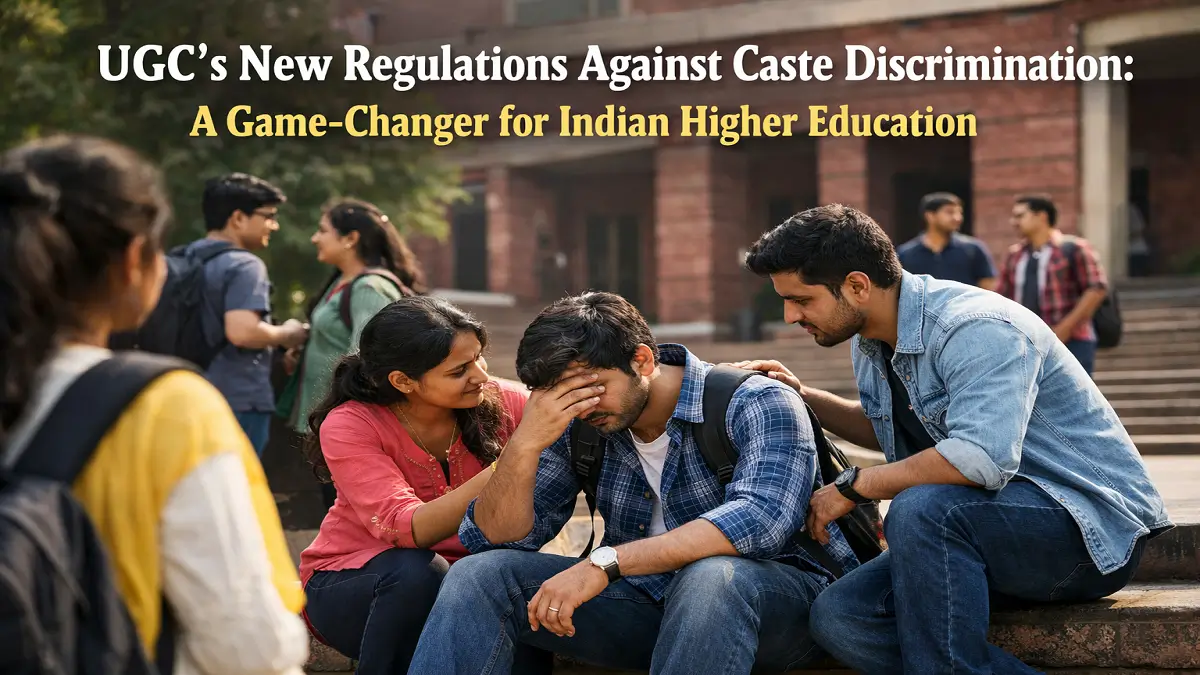
UGC’s New Regulations Against Caste Discrimination: A Game-Changer for Indian Higher Education
Introduction: A Major Policy Shift by UGC
In January 2026, the University Grants Commission (UGC) introduced new regulations to tackle caste-based discrimination in Indian higher education institutions. These rules, titled the University Grants Commission (Promotion of Equity in Higher Education Institutions) Regulations, 2026, aim to strengthen inclusivity, promote equal opportunities, and offer concrete mechanisms to prevent discrimination on campuses. Unlike previous non-binding guidelines, the 2026 regulations are enforceable, carrying penalties for non-compliance.
Why the Regulations Were Introduced
Caste discrimination remains a significant challenge within Indian universities and colleges. Academic reports have highlighted unequal treatment of students from historically disadvantaged groups such as Scheduled Castes (SCs), Scheduled Tribes (STs), and Other Backward Classes (OBCs). Instances of exclusion from activities, social segregation, hostile environments in hostels and classrooms, and limited access to opportunities have long hindered student welfare and academic performance. The UGC’s new regulations intend to address these long-standing inequities by making institutional accountability mandatory rather than discretionary.
Key Features of the New UGC Regulations
Mandatory Equal Opportunity Centres (EOCs)
Under the 2026 regulations, every higher education institution must establish an Equal Opportunity Centre (EOC). These centres serve as the primary body for handling complaints related to discrimination and for promoting fairness and equal access to resources and opportunities.
Equity Committees with Inclusive Representation
Each EOC will be supported by an Equity Committee, which must include representatives from SCs, STs, OBCs, women, and persons with disabilities. The head of the institution chairs these committees, ensuring that diverse voices contribute to decision-making and grievance handling.
Reporting and Transparency Obligations
Institutions are now required to submit reports on discrimination complaints received, actions taken, and progress made toward improving inclusivity. Bi-annual reports from EOCs and annual compliance reports to the UGC will create greater transparency and accountability.
National Monitoring Mechanism
The regulations also empower the UGC to set up a national monitoring committee comprised of representatives from statutory bodies and civil society. This mechanism will periodically review implementation and recommend improvements.
Penalties for Non-Compliance
One of the most significant aspects of the new regulations is enforcement. Institutes that fail to comply with the rules could face serious consequences, such as being barred from UGC schemes, prohibited from offering degree or online programmes, and even removed from the UGC’s list of recognised institutions.
Controversies and Resistance
Despite its progressive aims, the new UGC regulations have also triggered protests and legal challenges. Critics argue that the caste-specific definition of discrimination excludes general category individuals from seeking redress under the new framework. This has prompted petitions in the Supreme Court, which has, in fact, put the implementation of the new rules on hold, citing concerns about vagueness and potential misuse of the provisions.
Impact on Higher Education
If implemented effectively, these regulations have the potential to transform Indian higher education by institutionalising equity and combating discrimination in a structured and enforceable manner. For students from marginalised communities, this could mean safer, more supportive campus environments and better access to opportunities historically denied to them.

Why This News Is Important
Promotion of Constitutional Values
This news is crucial because it highlights the Indian government’s effort to enforce constitutional principles such as equality before the law and non-discrimination (Articles 14 and 15 of the Constitution of India). The new UGC regulations aim to create a fair academic environment where students are not denied opportunities due to caste.
Relevance for Government Exam Aspirants
For students preparing for competitive government exams such as UPSC, PSCs, SSC, banking, railways, defence, and teaching positions, this development is highly relevant under General Studies Paper-II (Polity & Governance), Paper-I (Indian Society and Social Issues), and Ethics Paper (Human Values and Social Justice). It reflects how policy interventions are designed to uphold social justice and inclusion—key topics often tested in exams.
Insight into Contemporary Policy Debates
The ongoing debate — including protests, legal scrutiny, and Supreme Court stay — provides important context on how policy measures are challenged and interpreted in democratic institutions. Understanding such dynamics helps aspirants critically analyse public policy, governance, and law.
Historical Context: Evolution of Anti-Discrimination Framework in India
Early Constitutional Safeguards
Since independence, India’s Constitution has enshrined equality and non-discrimination as fundamental rights. Articles 14, 15, and 17 prohibit discrimination on various grounds and abolished “untouchability.” Over several decades, these principles laid the foundation for affirmative action and social justice measures.
Reservation and Social Justice Policies
To address historical injustices, India adopted reservation policies in government jobs and educational institutions for SCs, STs, and OBCs. These measures sought to ameliorate centuries of marginalisation and create opportunities for upliftment.
Previous UGC Guidelines
Prior to 2026, the UGC’s anti-discrimination framework was largely advisory. Institutions were encouraged to set up SC/ST Cells or committees, but there was no strong enforcement mechanism or accountability structure. This often led to inconsistent implementation across universities.
Need for New Regulations
Persistent caste bias and documented instances of discrimination underscored the limitations of soft guidelines. The 2026 regulations aimed to convert advisory provisions into binding requirements, marking a significant shift in policy design.
Key Takeaways from UGC’s New Anti-Discrimination Regulations 2026
| S.No | Key Takeaway |
|---|---|
| 1 | UGC 2026 Regulations aim to curb caste discrimination and promote equity in higher education. |
| 2 | Every institute must establish an Equal Opportunity Centre (EOC). |
| 3 | Equity Committees with inclusive representation are mandatory. |
| 4 | Non-compliance can lead to loss of recognition or funding. |
| 5 | The Supreme Court has temporarily stayed the implementation of the regulations due to legal challenges. |
FAQs: Frequently Asked Questions
1. What are the new UGC regulations introduced in 2026?
The University Grants Commission (UGC) introduced the University Grants Commission (Promotion of Equity in Higher Education Institutions) Regulations, 2026. These regulations aim to prevent caste-based discrimination in universities and colleges by enforcing mandatory Equal Opportunity Centres (EOCs) and Equity Committees with diverse representation.
2. Who will benefit from these regulations?
Students from Scheduled Castes (SCs), Scheduled Tribes (STs), Other Backward Classes (OBCs), women, and persons with disabilities are expected to benefit the most. The regulations ensure safer campuses, equitable access to academic resources, and a formal grievance redressal mechanism.
3. What is an Equal Opportunity Centre (EOC)?
An EOC is a dedicated institutional body that handles complaints related to caste discrimination, promotes inclusivity, and monitors implementation of policies in higher education institutions.
4. What are the penalties for non-compliance?
Institutions failing to implement these regulations may face serious consequences such as loss of UGC recognition, ineligibility for UGC funding, or prohibition from offering degrees and online programs.
5. Why has the Supreme Court stayed the implementation?
The Supreme Court issued a temporary stay due to legal challenges regarding the definition of caste discrimination and concerns about potential misuse or ambiguity in the regulations.
6. Why is this news important for government exam aspirants?
It is relevant for exams like UPSC, State PSCs, SSC, banking, railways, and teaching positions as it falls under topics like Polity, Social Justice, Ethics, and Indian Society, which are often tested in competitive exams.
Some Important Current Affairs Links