








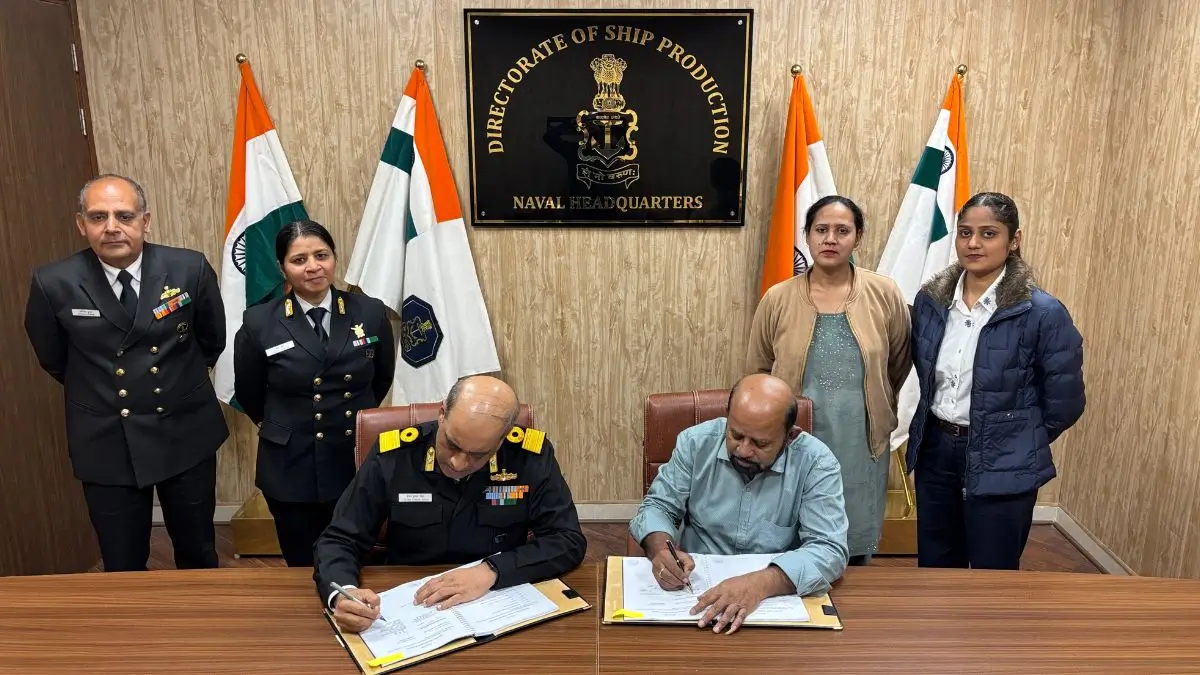
Indian Navy Bottom Opening Barges contract signed with MSME shipyard Suryadipta Projects Pvt Ltd, enhancing logistics support, Make in India initiatives, and maritime self-reliance.
Indian Navy Signs Contract for Indigenous Bottom Opening Barges — Boost to Atmanirbhar Bharat
In a strategic move to strengthen India’s naval logistics and augment indigenous defence production, the Indian Navy has signed a contract for the construction and delivery of three 200-tonne Bottom Opening Non-Propelled Barges. The agreement was formalised on 16 January 2026 with M/s Suryadipta Projects Private Limited, an MSME shipyard based in Thane, Maharashtra. These barges will be designed and built entirely in India under the Indian Register of Shipping (IRS) rules, reaffirming India’s commitment to quality standards as well as the national shipbuilding ecosystem.
The barges are non-propelled auxiliary vessels with bottom opening capability, enabling them to support the Indian Navy’s logistical and operational requirements across varied maritime environments. Their primary role will be to facilitate the handling, transport, and transfer of supplies, stores and materials at sea or at naval bases — essential functions for sustained naval operations.
This contract highlights an important shift in Indian defence procurement — giving priority to Micro, Small and Medium Enterprises (MSMEs) and boosting the domestic shipbuilding industry. By entrusting such strategic naval contracts to home-grown shipyards, the Indian Navy is encouraging technology development, capacity expansion, job creation, and innovative craftsmanship within the Indian industrial base.
Furthermore, the project aligns with the Make in India and Aatmanirbhar Bharat initiatives, which aim to reduce dependency on foreign suppliers and elevate India’s self-reliance in defence manufacturing. The contract also contributes to the government’s Maritime India Vision 2030, which emphasises strengthening maritime infrastructure and enhancing strategic capabilities.
As these barges take shape in domestic shipyards, they will not only enhance the Indian Navy’s operational flexibility but also act as catalysts for empowering smaller industrial players in the defense and maritime domains.

Why This News is Important
Strategic Significance in Defence Logistics
The signing of this contract marks a key development in bolstering the Indian Navy’s auxiliary logistics capacity — a vital but often overlooked element of naval strategy. Bottom opening barges are crucial for transferring supplies, ammunition, and equipment between vessels or from shore to ships. With three new barges under construction, the Navy’s capacity for sustained operations — whether in coastal waters or during prolonged missions — will be significantly enhanced.
Boost to Aatmanirbhar Bharat & MSME Growth
Awarding the contract to an MSME shipyard underscores the Indian government’s thrust on promoting domestic industry, especially smaller enterprises. Such contracts not only bring revenue to local businesses but also help build technological competence, generate skilled employment and strengthen the defence industrial base.
Alignment with National Maritime Vision
This project is aligned with the Maritime India Vision 2030, which aims to increase self-reliance in maritime infrastructure and defence. Building these barges domestically supports this long-term vision while contributing tangibly to India’s strategic autonomy and global maritime presence.
Historical Context: India’s Evolving Naval Self-Reliance
India’s push towards indigenous defence manufacturing — particularly in naval platforms — has gained momentum over the past decade. Initiatives like Make in India (launched in 2014) and more recently Aatmanirbhar Bharat have reshaped procurement strategies across the armed forces. Traditionally reliant on foreign suppliers, India’s defence sector is now increasingly turning to local shipyards, design agencies and MSMEs to build platforms ranging from support vessels to frontline warships.
Historically, the Indian Navy has commissioned or contracted numerous auxiliary vessels through domestic yards — from ammunition barges to floating docks and specialised support craft. Often constructed under the Indian Register of Shipping classification, these platforms reflect both international safety standards and indigenous shipbuilding prowess.
This trend complements other significant developments, such as the Navy’s indigenous aircraft carrier and shallow water craft programmes, advanced warship construction, and participation of MSME shipyards in critical defence projects. Together, these efforts underscore a systematic transition from import dependence to domestic capability development in India’s maritime defence architecture.
Key Takeaways from “Indian Navy Signs Contract for Indigenous Bottom Opening Barges”
| Sr. No. | Key Takeaway |
|---|---|
| 1 | Indian Navy signed a contract on 16 January 2026 for three Bottom Opening Non-Propelled Barges. |
| 2 | The contract was awarded to M/s Suryadipta Projects Pvt Ltd, an MSME shipyard in Thane. |
| 3 | Barges will be built entirely in India under Indian Register of Shipping (IRS) rules. |
| 4 | The project supports Make in India and Aatmanirbhar Bharat initiatives in defence manufacturing. |
| 5 | These barges will strengthen the Indian Navy’s logistics and operational support capabilities. |
FAQs: Frequently Asked Questions
Q1. What is the recent contract signed by the Indian Navy?
A: The Indian Navy signed a contract for the construction of three 200-tonne Bottom Opening Non-Propelled Barges with M/s Suryadipta Projects Pvt Ltd, an MSME shipyard in Thane, Maharashtra.
Q2. What is the primary role of these bottom opening barges?
A: These barges are auxiliary vessels designed for transporting supplies, materials, and equipment at sea or naval bases. They are non-propelled but have a bottom opening mechanism for easy unloading.
Q3. How does this contract support Make in India and Aatmanirbhar Bharat initiatives?
A: By awarding the contract to an Indian MSME shipyard, the project promotes domestic manufacturing, technology development, skilled employment, and reduces reliance on foreign suppliers.
Q4. Under which standards will the barges be constructed?
A: The barges will be built in India according to the Indian Register of Shipping (IRS) classification rules, ensuring safety and quality compliance.
Q5. How do these barges contribute to India’s maritime strategy?
A: They enhance the Indian Navy’s operational and logistical capacity, facilitating sustained naval operations and aligning with Maritime India Vision 2030.
Q6. Who is M/s Suryadipta Projects Pvt Ltd?
A: It is an MSME shipyard based in Thane, Maharashtra, engaged in indigenous shipbuilding and now contributing to strategic naval projects.
Q7. How does this move benefit MSMEs?
A: It provides MSMEs with strategic contracts, fosters technological innovation, builds industrial capacity, and creates jobs in the defence sector.
Some Important Current Affairs Links