









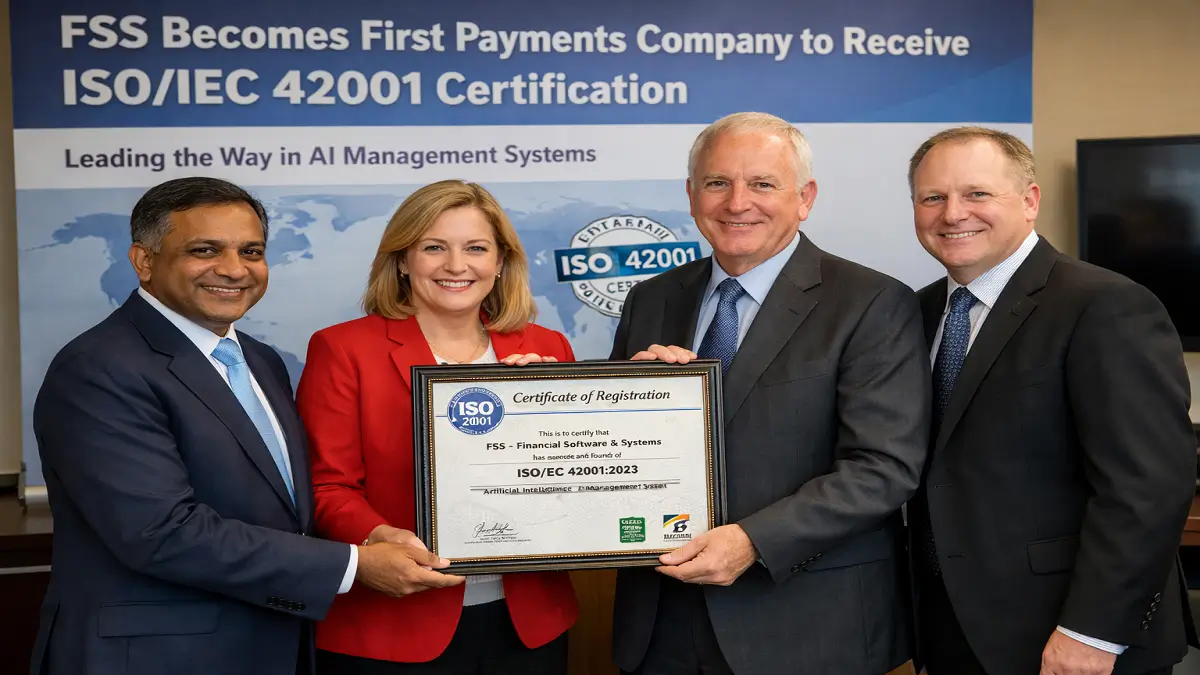
ISO/IEC 42001 certification achieved by FSS highlights responsible AI governance in digital payments, enhancing fraud detection, compliance, and secure financial transactions.
FSS Becomes First Payments Company to Receive ISO/IEC 42001 Certification
Financial Software and Systems (FSS), a global leader in payments technology and transaction processing, achieved a major milestone on January 6, 2026. It became the first payments company across India, the Middle East (ME), Asia-Pacific (APAC) and South Africa (SA) to be awarded the prestigious ISO/IEC 42001 certification for responsible and ethical use of Artificial Intelligence (AI).
What is ISO/IEC 42001 Certification?
The ISO/IEC 42001 certification is the world’s first international standard for Artificial Intelligence Management Systems (AIMS). Developed by the International Organization for Standardization (ISO) and the International Electrotechnical Commission (IEC), it provides a global framework for organizations to govern AI responsively, with transparency, accountability and risk management at its core.
This standard ensures that AI systems operate ethically, are free from significant bias, and align with international norms and compliance requirements. The certification assesses AI governance frameworks across design, deployment, monitoring, and continuous improvement processes, making it especially crucial for sectors where AI drives critical decisions.
FSS’s AI Integration in Payments
FSS’s advanced AI is deeply embedded in its digital payments platforms. The technology supports key use cases, including:
- Fraud detection and risk management
- Real-time transaction monitoring
- Reconciliation and dispute management
- Operational automation
By attaining ISO/IEC 42001 certification, FSS has demonstrated robust enterprise-wide AI governance with consistent monitoring and risk evaluation. Its AI systems are now structured to detect and mitigate risks such as algorithmic bias, unintended outcomes, and non-compliance even after deployment.
Independent Assessment and Leadership Role
FSS’s AI governance framework was independently audited and validated by TÜV SÜD, a globally recognised certification and assurance body. Achieving the Certification Lead status reflects FSS’s high maturity level in AI governance, not only adopting the standard but also showcasing leadership in implementing it across large enterprises.
In a rapidly evolving fintech environment, structured AI governance is becoming a strategic advantage. According to FSS’s CEO, V Balasubramanian, effective AI governance is crucial for risk-based decision-making and maintaining trust with regulators, partners, and customers.
Significance for Digital Payments and FinTech
FSS’s achievement marks a significant milestone in the digital payments ecosystem, particularly as AI-driven systems become core to transaction security and user experience. Embedding ethical and accountable AI practices enhances credibility among users and aligns with emerging global regulatory frameworks, including regulatory expectations related to AI transparency and fairness.
This certification places FSS at the forefront of AI governance in fintech and highlights India’s growing influence in responsible AI adoption worldwide.

Why This News Is Important for Government Exam Aspirants
Relevance to Governance, Technology and Economy
This news holds high relevance for competitive exams like SSC, Banking, Railways, Police, Defence, and Civil Services (UPSC/PCS), particularly in sections covering Current Affairs, Governance, Technology & Innovation, and Economy. India’s emergence as a leader in ethical AI governance strengthens the narrative of responsible technological growth, a popular theme in modern exam syllabi.
Interlinkage with Policy and Regulatory Trends
With countries and regulatory bodies placing increased focus on ethical AI and data governance, FSS’s achievement signals how industry leaders align with international standards. Questions on ISO standards, AI regulation, and fintech governance could be asked directly or indirectly in exams.
Significance in Financial and Digital Infrastructure
The adoption of AI is transforming India’s digital payment ecosystem, and ethical AI governance frameworks play a central role in ensuring secure and reliable financial services. This news exemplifies how emerging technologies must be governed responsibly — a key theme in modern governance and policy questions.
Historical Context: AI Governance and ISO Standards in FinTech
Artificial Intelligence (AI) has become foundational in sectors like fintech, healthcare, transport, and governance over the past decade. However, while AI boosted efficiency and automation, it also posed risks related to bias, explainability, data privacy, and accountability. To tackle these challenges, international standard bodies like ISO and IEC began developing frameworks aimed at governing AI systems responsibly.
In 2023, ISO/IEC 42001 was introduced as the first international AI Management Systems standard, outlining structured procedures for enterprises to manage AI life cycles effectively. Its global recognition paved the way for organisations not only to build powerful AI systems but also ensure they are trustworthy, transparent, and compliant with ethical norms.
Before ISO/IEC 42001, other ISO standards like ISO 9001 (quality), ISO 27001 (information security), and ISO 27018 (cloud data protection) were widely used in tech fields. However, none addressed AI-specific risks comprehensively. The launch of ISO/IEC 42001 helped bridge this governance gap, especially for companies extensively using or deploying AI technologies.
FSS’s certification is part of a broader move where global organisations like KPMG, EIS, and Outreach have also adopted ISO/IEC 42001 to underscore responsible AI use. These developments highlight the growing global emphasis on ethical AI management, further underscoring the importance of such standards in future governance and policy questions.
Key Takeaways from “FSS Becomes First Payments Company to Receive ISO/IEC 42001 Certification”
| S. No. | Key Takeaway |
|---|---|
| 1. | FSS became the first payments company in India, ME, APAC & SA to receive ISO/IEC 42001 certification. |
| 2. | ISO/IEC 42001 is the world’s first international standard for Responsible AI Management Systems. |
| 3. | Certification demonstrates FSS’s ethical and structured governance of AI in payments. |
| 4. | AI in FSS supports critical use cases like fraud detection, transaction monitoring, and dispute management. |
| 5. | FSS’s AI governance framework was independently audited by TÜV SÜD. |
FAQs: Frequently Asked Questions
Q1. What is ISO/IEC 42001 certification?
A: ISO/IEC 42001 is the world’s first international standard for Artificial Intelligence Management Systems (AIMS), providing guidelines for ethical, transparent, and responsible AI governance.
Q2. Which company became the first payments company to receive ISO/IEC 42001 certification?
A: Financial Software and Systems (FSS) became the first payments company in India, ME, APAC, and SA to achieve this certification.
Q3. Which areas of FSS’s operations are strengthened by this certification?
A: The certification strengthens AI governance in fraud detection, transaction monitoring, reconciliation, dispute management, and operational automation.
Q4. Which organization audited FSS’s AI governance framework for certification?
A: TÜV SÜD, a globally recognized certification and assurance body, independently audited FSS’s AI governance framework.
Q5. Why is ISO/IEC 42001 important for fintech and payments companies?
A: It ensures ethical and responsible AI usage, reduces risks like algorithmic bias, ensures regulatory compliance, and builds trust among stakeholders.
Q6. Which global regions are included in FSS’s certification achievement?
A: India, Middle East (ME), Asia-Pacific (APAC), and South Africa (SA).
Q7. When was FSS awarded the ISO/IEC 42001 certification?
A: FSS received the certification on January 6, 2026.
Q8. What is the significance of AI governance in digital payments?
A: AI governance ensures secure, transparent, and efficient financial transactions while mitigating risks like fraud, bias, and operational failures.
Some Important Current Affairs Links