


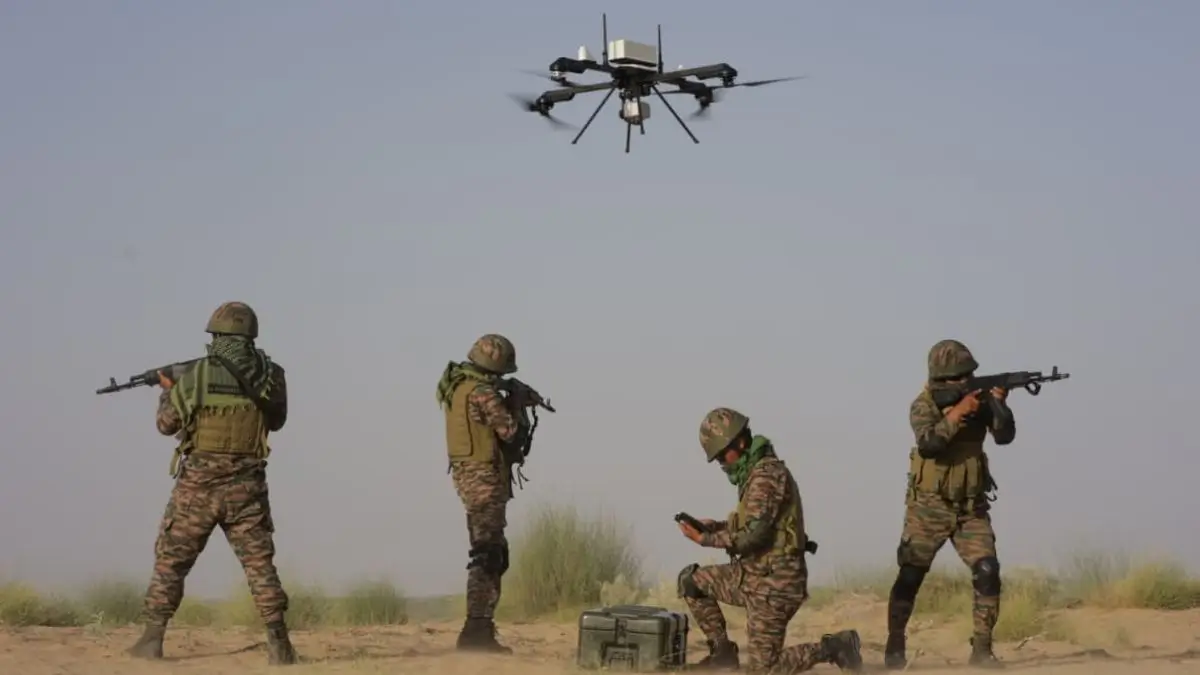
Indian Army VAYU SAMANVAY II Exercise 2025 in the desert sector under Southern Command focused on drone and counter-drone operations, showcasing indigenous technology and India’s push for self-reliance in defence modernization.
Indian Army Conducts VAYU SAMANVAY-II in Desert Sector
Elaborated Article
Overview of the Exercise
The Indian Army recently conducted a major drill called VAYU SAMANVAY‑II in the desert sector under its Southern Command from 28–29 October 2025. The exercise focused on integrating drone and counter-drone operations in a realistic forward desert terrain — effectively testing how ground forces coordinate with aerial unmanned systems and electronic warfare environments.
Purpose and Strategic Significance
VAYU SAMANVAY-II was designed to validate doctrinal concepts for deploying unmanned aerial systems (UAS) and counter-drone assets. The drill emphasised how drones are now frontline instruments not only for reconnaissance but also for offensive payload delivery, while the need to develop resilient counter-UAV capabilities is increasingly critical in modern warfare.
Terrain and Operational Challenges
Conducting the exercise in the desert sector gave the Army an opportunity to stress-test equipment and personnel under harsh conditions. The terrain and environmental factors in a desert—heat, signal interference, mobility over sandy terrain—add additional complexity. The Army used this setting to check endurance of drone systems, signal resilience in an electronically contested environment, and coordination between air-ground assets.
Technological Focus & Doctrinal Innovation
The exercise showcased significant technological elements: unmanned aerial systems including drone swarms, electromagnetic interference and spoofing scenarios to simulate adversarial tech, AI-enabled command and control (C2) systems, and integration of indigenous drone and counter-drone platforms. These capabilities reflect how the Indian Army is adapting to digitised and network-enabled warfare and refining its doctrine accordingly.
Interoperability and Indigenous Capability Building
Another major aspect of VAYU SAMANVAY-II was joint interoperability across multiple arms of the Army and the incorporation of “Make in India” drone systems. Troops tested detection radars, jammers, spoofers and engaged in simulated scenarios of attack, defence and neutralisation using these tech-tools. The emphasis on indigenous platforms dovetails with India’s broader push for self-reliance in defence production.
Implications for Future Operations
By situating the exercise in a forward desert sector and focusing on drone/counter-drone warfare, the Indian Army has signalled its intention to prepare for multi-domain operations where air, land—and potentially cyber and space—domains converge. It also underscores the fact that even in traditionally ground-oriented theatres such as deserts, aerial unmanned assets and electronic warfare will play an increasing role.

Why This News Is Important
Relevance to National Defence Posture
In the evolving security environment, adversaries may utilise unmanned aerial vehicles (UAVs) for surveillance, targeting and delivery of payloads. The Indian Army’s focus on drills like VAYU SAMANVAY-II demonstrates proactive preparation to counter such threats. This matters for national security and for the way India projects and secures its borders, especially in challenging terrains like deserts which may be susceptible to unconventional aerial threats.
Exam-centric Importance for Aspirants
For candidates preparing for government defence or civil service examinations—including positions in teaching, police, banking, railways, defence or civil service like PSCs and IAS—this news item connects strongly with the syllabus areas of ‘Defence & Security’, ‘Technology in Defence’, and ‘Current Affairs’. Understanding such exercises helps in topics like “modernisation of Indian Armed Forces”, “use of drones in defence”, and “indigenisation in defence production”. Recognising how the Army is adapting to new threats gives candidates meaningful material for essay writing, descriptive papers and interview questions.
Broader Strategic Message
The drill reflects a shift in doctrine: from traditional ground-centric warfare to integrated multi-domain operations involving aerial, land, electronic and cyber tools. This pivot is key in India’s Defence Planning, in its “Make in India” emphasis and in its ability to deter threats. The news offers insight into how the military is adapting to future warfare scenarios, which is vital background for any aspirant studying national security trends.
Historical Context
The concept of drone warfare and counter-drone operations has evolved rapidly worldwide over the past decade. The Indian Army has been actively incorporating unmanned aerial systems (UAS) and experimenting with counter-UAV technologies. Earlier exercises such as the tri-service war games and prior Army drills had begun integrating drones for surveillance and strike roles. India’s border challenges—whether in mountainous terrain or in desert regions—have necessitated expanding capabilities into air-space and unmanned systems.
In the Indian context, the desert sector (e.g., western border with Pakistan) has traditionally seen Army manoeuvres and operations focusing on armoured/regimented forces and desert warfare. However with evolving technology threats, the emphasis has shifted to include unmanned and electronic warfare components. VAYU SAMANVAY-II is a progression of this shift—moving from classic desert operations to technologically augmented warfare in desert terrain.
Moreover, with policy moves like the Atmanirbhar Bharat initiative and the Defence Acquisition Procedure prioritising indigenous production, the Indian Army has concurrently been encouraging local industries to deliver drone and counter-drone solutions. Thus, the exercise aligns with both operational imperatives and industrial policy.
Key Takeaways from This News
| S. No. | Key Takeaway |
|---|---|
| 1 | The Indian Army conducted VAYU SAMANVAY-II on 28–29 October 2025 in the desert sector under Southern Command. |
| 2 | The exercise focused on drone (UAS) deployment and counter-drone operations in a forward desert environment. |
| 3 | Terrain selection (desert) allowed testing of endurance, electronic warfare and signal resilience in harsh conditions. |
| 4 | Advanced technologies like drone swarms, AI-enabled command & control, jammers, radars and indigenous systems were featured. |
| 5 | The drill underscores India’s shift toward multi-domain operations and indigenisation of defence technologies. |
FAQs – Frequently Asked Questions
Q1. What is VAYU SAMANVAY-II?
VAYU SAMANVAY-II is a large-scale Indian Army exercise focused on drone and counter-drone operations, conducted under the Southern Command in the desert sector.
Q2. When was VAYU SAMANVAY-II conducted?
The exercise was held from 28 to 29 October 2025 in the desert sector of India.
Q3. Which branch of the Indian Army conducted the exercise?
It was conducted by the Southern Command of the Indian Army.
Q4. What was the main focus of this exercise?
The exercise tested the integration of unmanned aerial systems (UAS) and counter-drone warfare in desert terrain, emphasizing indigenous technology and electronic warfare readiness.
Q5. Why is the desert sector important for such operations?
The desert offers challenging conditions such as high temperatures, open terrain, and limited cover—making it ideal for testing endurance and coordination of aerial and ground systems.
Q6. How does VAYU SAMANVAY-II support India’s “Make in India” initiative?
The exercise featured indigenous drone and counter-drone technologies, aligning with India’s goal of achieving self-reliance in defence manufacturing.
Q7. How is this exercise relevant to government exam aspirants?
It helps candidates understand topics like defence modernization, drone warfare, and technological innovation in national security, which are important for exams like UPSC, CDS, CAPF, SSC, Defence Services, and State PSCs.
Q8. What is the significance of drone technology in modern warfare?
Drone technology is vital for surveillance, reconnaissance, payload delivery, and electronic warfare—making it essential in multi-domain warfare strategies worldwide.
Q9. What other recent exercises by the Indian Army focused on drones?
Previous exercises such as VAYU SAMANVAY-I and joint tri-service drills have also included UAV operations and counter-UAV testing.
Q10. What lessons can be drawn from VAYU SAMANVAY-II for India’s defence future?
It highlights the need for continuous innovation, AI-enabled command systems, and indigenous development to maintain strategic superiority in changing warfare dynamics.
Some Important Current Affairs Links




