








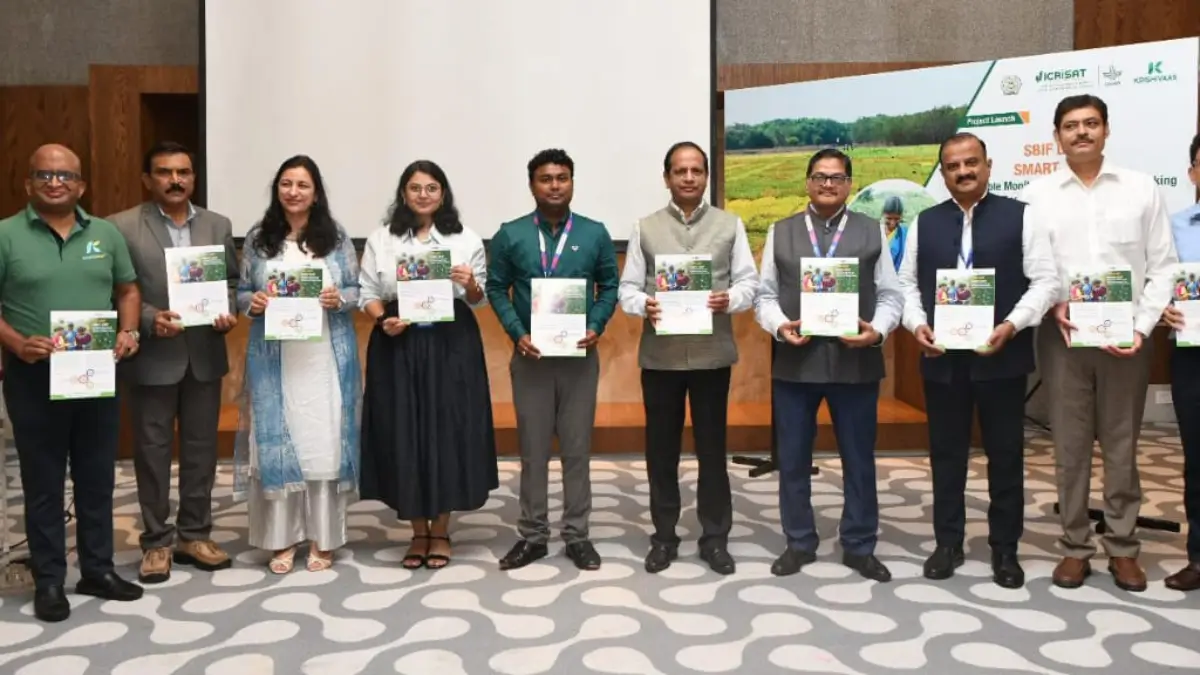
Smart Crop Initiative SBI Foundation has partnered with ICRISAT and UAS Raichur to launch a three-year AI-driven farming project in Telangana and Karnataka, empowering 8,000 farmers through smart data-driven crop management for sustainable agriculture.
SMART-CROP Launched to Promote Smart, Data-Driven Farming
Transforming agriculture through advanced technology
The SBI Foundation (CSR arm of State Bank of India) has collaborated with International Crops Research Institute for the Semi‑Arid Tropics (ICRISAT), University of Agricultural Sciences, Raichur (UAS Raichur) and Agribridge to launch the “SMART‑CROP” initiative — Sustainable Monitoring and Real-time Tracking for Crop Resilience and Optimal Practices.
This three-year project targets over 8,000 small and marginal farmers in the semi-arid regions of Telangana (Sangareddy, Vikarabad) and Karnataka (Bidar, Kalaburagi, Raichur) to equip them with smart, data-driven farming tools.
Project Overview and Scope
Under the SBI Foundation’s LEAP (Livelihood and Entrepreneurship Accelerator Programme) framework, SMART-CROP will deploy satellite imaging, remote sensing, Artificial Intelligence (AI) and Machine Learning (ML) systems to monitor crop health in real-time, especially focusing on pulse crops such as pigeon pea and chickpea which are vital in semi-arid zones.
The initiative aims to help farmers detect early signs of crop stress—due to pests, diseases, nutrient deficiencies, water stress or climate anomalies—thus enabling preventive action rather than purely reactive responses.
Focus on Pulse Cultivation and Resilience
A key component of the project is its emphasis on pulses, which are critical to both nutrition and livelihoods in India’s semi-arid tropics. According to ICRISAT’s Dr. Mamta Sharma, approximately 40% of global crop losses annually stem from pests and diseases. SMART-CROP’s real-time monitoring aims to reduce such losses, particularly in pigeon pea and chickpea production.
By integrating climate-smart practices with digital agriculture tools, the project not only seeks yield improvements but also aims to build resilience against climate change and soil degradation.
Benefits for Farmers and Agriculture Ecosystem
Under SMART-CROP, farmers will receive digital alerts (via remote sensing and weather-based forecasting) for impending threats like pest infestations, disease outbreaks or drought/flood stress. They will also gain training on interpreting data and adopting optimized agronomic practices.
This proactive system is expected to save time, reduce input waste (like unnecessary pesticide use), improve efficiency and safeguard incomes of smallholder farmers. The collaborative model ties research institutions, digital agritech firms and community outreach to create a scalable blueprint for other regions.
Way Forward & Strategic Implications
The launch of SMART-CROP signals a shift in Indian agriculture toward leveraging technology at the grassroots. For state and central-level schemes aimed at doubling farmers’ income, tackling climate risk and promoting sustainable farming, this initiative offers a valuable model. Over its three-year period, its outcomes will be monitored for potential expansion beyond the initial five districts.

Why This News Is Important
Relevance for Competitive Exams
For aspirants of banking, civil services, railways, teaching or police recruitment exams, this initiative embodies multiple thematic areas: sustainable agriculture, technology adoption in rural India, public-private partnerships in CSR space, climate resilience and entrepreneurship in agrarian communities. Knowing such projects adds depth to answers in general studies and current affairs papers.
Significance for Policy & Socio-economic Impact
From a policy perspective, SMART-CROP reflects India’s strategy of integrating cutting-edge digital tools with agriculture to reduce losses, improve productivity and ensure food security. It aligns with national goals like doubling farmer incomes, promoting pulses for nutritional security, and enhancing climate resilience of Indian agriculture. For socio-economics, small and marginal farmers are often vulnerable to crop failures; a data-driven early-warning system offers them a lifeline, boosting livelihoods and reducing agrarian risk.
Implications for Stakeholders
For farmers in the targeted regions (Telangana & Karnataka), this project has immediate benefits: improved yields, reduced losses, better decision-making. For government and institutional stakeholders, this is a replicable model for scaling digital-agriculture interventions. For exam-takers, this news underscores the intersection of technology, agriculture and rural livelihoods—topics increasingly prevalent in exam syllabi across sectors.
Historical Context: Background of Technology-Driven Farming in India
India has a long history of agricultural reform, from the Green Revolution of the 1960s which boosted food-grain production, to the ongoing push for technology adoption in farming. In semi-arid zones especially, low productivity of pulses and high vulnerability to climate shocks have remained major issues. The International Crops Research Institute for the Semi‑Arid Tropics (ICRISAT), established in 1972, has been working on crop improvement and agronomic resilience in such regions.
In recent years, the Indian government has emphasised digital agriculture—initiatives like eNAM (electronic National Agriculture Market), PM-FME (Food Processing Micro Enterprises), and the push for precision farming demonstrate this shift. The use of AI, satellite imagery and remote sensing in agriculture is now seen as vital to manage climate change, reduce crop losses, and improve resource-use efficiency. The SMART-CROP initiative fits directly into this continuum: bringing advanced tech into the hands of smallholders, especially in pulses and semi-arid zones, and aligning CSR efforts (via SBI Foundation) with research-based agriculture solutions.
Key Takeaways from SMART-CROP Initiative
| S.No | Key Takeaway |
|---|---|
| 1 | SMART-CROP stands for “Sustainable Monitoring and Real-time Tracking for Crop Resilience and Optimal Practices”. |
| 2 | It is a 3-year project supported by SBI Foundation’s LEAP programme and led by ICRISAT, UAS Raichur and Agribridge. |
| 3 | The initiative will benefit over 8,000 small and marginal farmers across Telangana (Sangareddy, Vikarabad) and Karnataka (Bidar, Kalaburagi, Raichur). |
| 4 | Advanced technologies such as satellite imaging, remote sensing, AI/ML analytics will be used for early detection of crop stress, pests, diseases and climate risks. |
| 5 | The primary crop focus is on pulses — especially pigeon pea and chickpea — due to their importance in semi-arid regions and high loss potential from pests/diseases (~40% globally). |
Frequently Asked Questions (FAQs) on SMART-CROP Initiative
1. What is the SMART-CROP initiative?
SMART-CROP stands for Sustainable Monitoring and Real-time Tracking for Crop Resilience and Optimal Practices. It is a technology-driven agricultural project launched jointly by SBI Foundation, ICRISAT, UAS Raichur and Agribridge to promote data-driven smart farming.
2. Who are the key partners in the SMART-CROP project?
The key partners include the SBI Foundation (CSR arm of State Bank of India), International Crops Research Institute for the Semi-Arid Tropics (ICRISAT), University of Agricultural Sciences (Raichur), and Agribridge.
3. Which regions will benefit from the SMART-CROP project?
The project targets 8,000 small and marginal farmers in semi-arid districts of Telangana (Sangareddy, Vikarabad) and Karnataka (Bidar, Kalaburagi, Raichur) over a three-year period.
4. What are the main crops under focus?
SMART-CROP primarily focuses on pigeon pea and chickpea, two major pulse crops widely cultivated in India’s semi-arid zones.
5. Which technologies are used in SMART-CROP?
The project integrates satellite imaging, remote sensing, Artificial Intelligence (AI), and Machine Learning (ML) to monitor crops and provide real-time alerts to farmers.
6. What is the objective of SMART-CROP?
Its main goal is to enable early detection of crop stress due to pests, diseases, water deficiency, or climate anomalies, thereby minimizing yield losses and enhancing farmers’ resilience.
7. Under which program of SBI Foundation does this project come?
SMART-CROP is part of the SBI Foundation’s LEAP (Livelihood and Entrepreneurship Accelerator Programme) initiative.
8. How does this project support sustainable agriculture?
By promoting precision farming, reducing wastage of inputs like water and pesticides, and encouraging climate-resilient practices, SMART-CROP supports sustainable agriculture and environmental conservation.
9. What is the duration of the SMART-CROP project?
The project will run for three years initially, during which its scalability and effectiveness will be assessed.
10. Why is this project important for competitive exams?
It covers multiple topics relevant for UPSC, PSCs, Banking, Defence, Teaching, and Railways exams—including CSR initiatives, technology in agriculture, climate resilience, and sustainable rural development.
Some Important Current Affairs Links