









Bharat Yatra Card Launch by Flipkart and Pine Labs introduces India’s first unified public transport payment solution under the NCMC framework, supporting Digital India and One Nation One Card initiatives.
Flipkart and Pine Labs Launch the “Bharat Yatra Card” for Unified Public Transport Payments
A New Era in Seamless Transit Payments
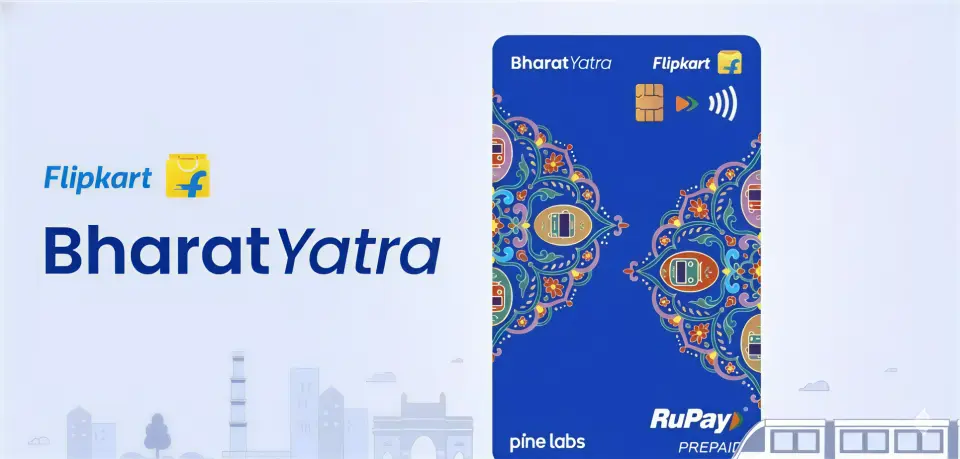
In a strategic partnership, Flipkart, India’s home-grown e-commerce giant, and Pine Labs Limited, a global fintech company, have jointly introduced the “Bharat Yatra Card”—a rechargeable prepaid smart card designed to simplify payments across public transport systems in India.
What the Card Offers
The Bharat Yatra Card is a non-KYC, reloadable card costing ₹50 initially, with an offline usable balance of up to ₹2,000. It is enabled via the national interoperable mobility payment infrastructure, the National Common Mobility Card (NCMC), allowing users to tap and ride on metros, buses and other transit services that accept NCMC payments.
How You Can Use It
Users can purchase the physical card online through the Flipkart app or its quick-commerce arm, Flipkart Minutes. After receipt, activation is done via a QR-code or companion mobile app (available on Android and iOS). Recharge options include UPI apps, the Bharat Yatra app, or via the Bharat Connect (formerly BBPS) platform. For Android phones with NFC, the card balance can be updated simply by tapping the card on the phone.
Initial Roll-out and Future Scope
The card’s initial launch covers major cities including Delhi, Mumbai, Bengaluru, Chennai and Ahmedabad, where metro and bus systems are significantly active. As commuters’ usage of urban transit grows (for example, daily metro ridership in January 2025 was 10.2 million according to India’s Economic Survey), such innovations are timely. Pine Labs’ CEO, B Amrish Rau, described the product as a “step towards a unified, inclusive, and frictionless mobility payment experience for Indians”. Meanwhile, Flipkart Payments’ Vice-President, Gaurav Arora, added that the collaboration combines Flipkart’s reach and Pine Labs’ fintech expertise to deliver a “consumer-first transit payments solution”.
Implications for Commuters
For everyday travellers, the Bharat Yatra Card promises shorter queues at ticket counters, fewer delays due to recharge requirements, and a unified payment option across multiple modes of transit. These attributes are poised to enhance the commuting experience and encourage the adoption of digital payment methods in public transport.
Integration with National Payment Ecosystem
The card’s reliance on the NCMC architecture means that it builds on the government’s vision of “One Nation One Card” for mobility. It also dovetails with payment-system innovations such as UPI (Unified Payments Interface) and integrated bill and top-up platforms like Bharat Connect (formerly BBPS).
Why This News Is Important
Transforming Urban Mobility Payment Systems
The launch of the Bharat Yatra Card signals a shift in how public transport payments are handled in India. Instead of separate tickets, tokens or metro cards, a single reloadable smart card allows access to buses, metros and other transit options. This aligns well with government objectives of digitisation, inclusive access and cashless payments.
Relevance for Government Exam Aspirants
For students preparing for positions such as teachers, banking officers, railways staff, defence and civil service (including IPS or IAS), this news touches upon multiple topics in syllabus: digital payments, fintech collaborations, public-sector infrastructure, urban mobility systems and government policy in transport. Understanding such initiatives helps in answering questions related to economy and governance, transport policy, and digital inclusion.
Historical Context
The National Common Mobility Card (NCMC) Initiative
The NCMC programme, managed by National Payments Corporation of India (NPCI) under the aegis of Ministry of Housing and Urban Affairs (MoHUA), was launched in March 2019 with an aim of creating an open-loop, interoperable transport card usable across metros, buses, tolls and retail payments.
Fintech and E-commerce Collaboration in Mobility
Over the past few years, the Indian transit infrastructure has increasingly moved from cash-based ticketing to digital solutions—smart cards, mobile apps, QR payments, NFC taps. Meanwhile, e-commerce and fintech players have extended beyond retail payments into mobility solutions. The Flipkart-Pine Labs partnership reflects this broader trend of convergence between retail-tech and urban infrastructure.
Government Push for Digital Payments
With frameworks like UPI (launched in 2016) and the Bharat Bill Payment System (BBPS) in place, India has steadily pushed for digital, paperless transactions. Integrating transit payments into this ecosystem makes urban commuting more efficient and transparent. The Bharat Yatra Card is part of this journey.
Key Takeaways from Bharat Yatra Card Launch
| S. No | Key Takeaway |
|---|---|
| 1. | The “Bharat Yatra Card” is a ₹50 recharge-enabled, non-KYC smart card for transit payments via NCMC. |
| 2. | It supports offline balance usage up to ₹2,000 and can be recharged via UPI, Bharat Yatra app or Bharat Connect. |
| 3. | Physical cards can be purchased through Flipkart’s e-commerce platform and its quick-commerce offering Flipkart Minutes. |
| 4. | Initial roll-out targets major metro cities: Delhi, Mumbai, Bengaluru, Chennai, Ahmedabad. |
| 5. | The card aligns with the government’s “One Nation One Card” vision in mobility via NCMC infrastructure. |
Frequently Asked Questions (FAQs)
1. What is the Bharat Yatra Card?
The Bharat Yatra Card is a prepaid, non-KYC smart card launched by Flipkart and Pine Labs to enable seamless and unified payments across India’s public transport systems through the National Common Mobility Card (NCMC) framework.
2. How much does the Bharat Yatra Card cost?
The card is available at an introductory price of ₹50 and can be recharged easily through UPI, the Bharat Yatra app, or Bharat Connect (formerly BBPS).
3. In which cities is the Bharat Yatra Card currently operational?
The card’s initial rollout includes major metropolitan cities such as Delhi, Mumbai, Bengaluru, Chennai, and Ahmedabad, where metro and bus transit systems are NCMC-enabled.
4. How can users recharge or activate the Bharat Yatra Card?
Users can activate the card by scanning a QR code via the Bharat Yatra app and recharge it using UPI apps, Bharat Connect, or directly within the app. NFC-enabled Android phones can also be used to check or update balances.
5. What is the maximum offline spending limit of the Bharat Yatra Card?
The Bharat Yatra Card allows up to ₹2,000 to be used offline for transit and small retail purchases, which makes it convenient for commuters even without an active internet connection.
6. Who regulates the Bharat Yatra Card?
The card is built upon NPCI’s NCMC framework under the Ministry of Housing and Urban Affairs, aligning with the government’s “One Nation One Card” vision.
7. How does the Bharat Yatra Card support Digital India initiatives?
It promotes cashless commuting and aligns with Digital India and smart city initiatives by integrating mobility, fintech, and public infrastructure under one digital framework.
8. Can the Bharat Yatra Card be used for retail purchases?
Yes, beyond transit systems, it can be used at select NCMC-enabled retail stores for small-value purchases, further expanding its usability.
9. What is the significance of Flipkart and Pine Labs’ partnership?
The collaboration merges Flipkart’s extensive digital reach with Pine Labs’ fintech expertise to enhance the accessibility and convenience of mobility payments nationwide.
10. Why is this topic important for government exam preparation?
This topic relates to fintech innovation, transport policy, digital governance, and public-private partnerships—frequent themes in exams like UPSC, SSC, Banking, Railways, and State PSCs.
Some Important Current Affairs Links




