





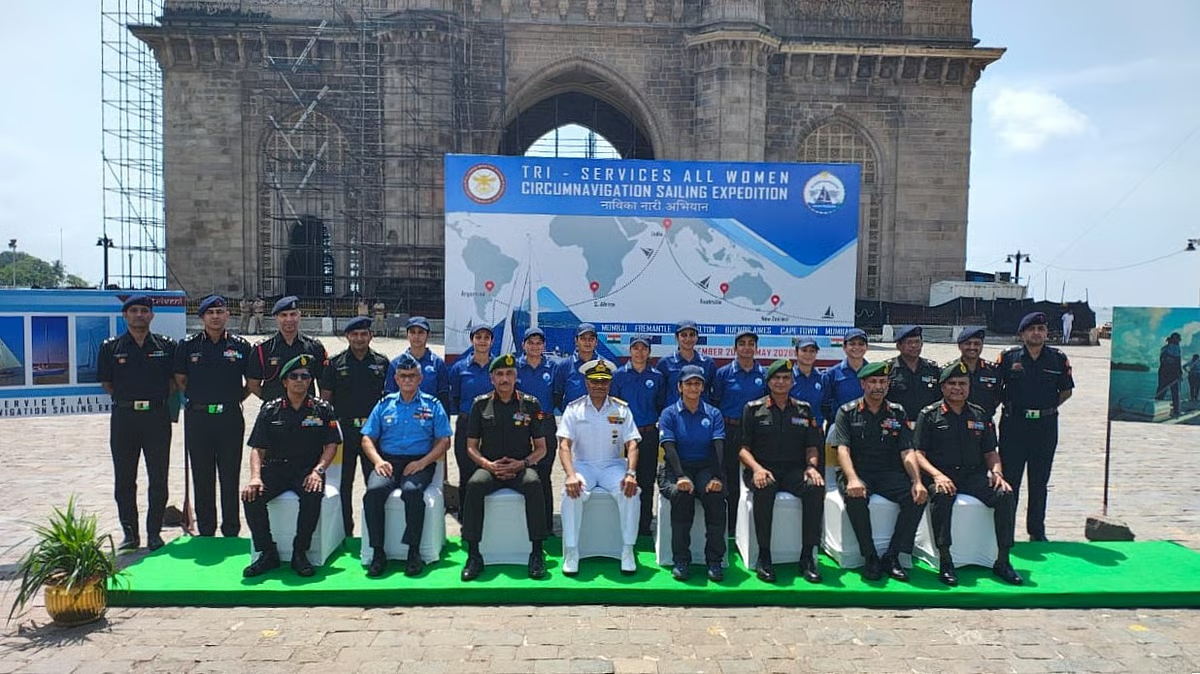
India all women sailing expedition Samudra Pradakshina 2025 flagged off from Mumbai. Learn about the Tri-Service mission, crew, route, objectives, and strategic significance.
India Flags off “Samudra Pradakshina” – First Ever Tri-Service All-Women Circumnavigation Sailing Expedition
Flag-off of a Landmark Expedition
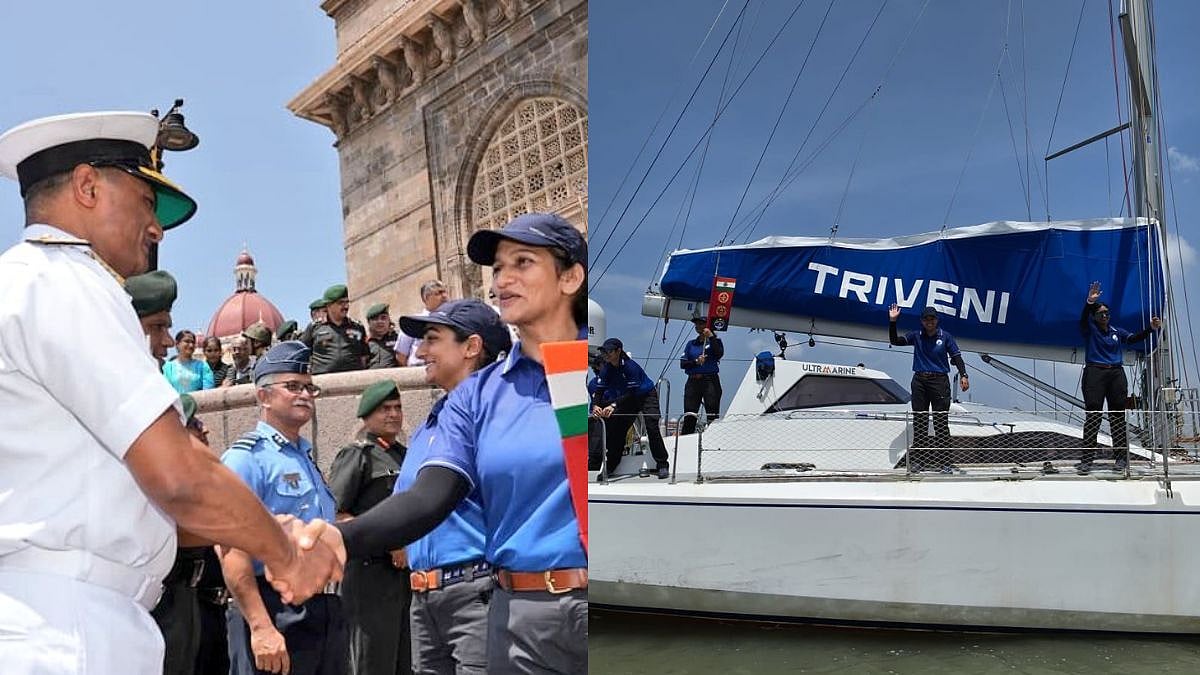
On 11 September 2025, India virtually flagged off Samudra Pradakshina, a historic all-women circumnavigation sailing expedition involving tri-service officers (Army, Navy & Air Force), from the Gateway of India, Mumbai. The expedition was inaugurated by the Defence Minister, Rajnath Singh. It marks the first time in India’s history that a mission of this scale combines women officers from all three armed forces to undertake a global sailing voyage.
The Vessel, Route and Duration
The voyage will be carried out on IASV Triveni, an indigenously built 50-foot Indian Army Sailing Vessel. The journey spans approximately 9 months, covering about 26,000 nautical miles. The route is ambitious: the crew will cross the Equator twice, round the three great Capes (Cape Leeuwin, Cape Horn & Cape of Good Hope), traverse major oceans including the treacherous Southern Ocean and the Drake Passage, and make four international port calls before returning to Mumbai in May 2026.
Crew Composition and Training Regimen
The expedition crew is ten women officers: a mix from Army, Navy and Air Force, led by Lieutenant Colonel Anuja Varudkar with Squadron Leader Shraddha P. Raju as Deputy. Other members include officers like Major Karamjeet Kaur, Captain Prajakta P. Nikam, Wing Commander Vibha Singh, among others.
These officers have undergone three years of rigorous preparation: starting with smaller offshore expeditions on Class B vessels, moving up to more challenging voyages, culminating with training on the IASV Triveni (Class A yacht obtained October 2024). Their training tested seamanship, endurance, navigation, and operating in harsh marine conditions.
Symbolism and Strategic Dimensions
Samudra Pradakshina is not just an expedition; it carries powerful symbolism. It is seen as a glowing emblem of Nari Shakti, the strength of women in India; a display of jointness and unity among the three Services; and of ‘Aatmanirbhar Bharat’ in defence innovation and technology. The voyage will also serve a diplomatic function—through the international port calls, it offers platforms for showcasing India’s culture, maritime credentials and strategic outreach.
Scientific and Operational Challenges
Beyond the voyage itself, the expedition includes collaboration with the National Institute of Oceanography for scientific work—study of microplastics, marine biodiversity, ocean health etc. Operational challenges are significant: crossing Southern Ocean and Drake Passage implies exposure to freezing winds, storms, ice, high swells, sleep deprivation, navigation hazards. Also, the mission adheres to the norms of the World Sailing Speed Record Council: crossing all longitudes, no use of canals/powered transit, etc.
Why this News is Important
Breaking Gender Barriers and Empowerment
This expedition is a major milestone in demonstrating India’s commitment to female inclusion in all spheres, particularly in defence and adventure. It breaks traditional taboos by placing women in a high-risk, high-skill maritime mission involving all three services. For aspirants, this shows the growing role of women in Indian Armed Forces and how policies are increasingly translating into action.
Strategic Diplomacy and Defence Posture
“Samudra Pradakshina” is not just symbolic—it enhances India’s maritime diplomacy. The international port calls will serve as soft power tools, promoting cultural exchange, showcasing military professionalism, and strengthening India’s image as a strategic maritime nation. Also, the use of indigenous vessel aligns with the government’s aim of defence self-reliance (Atmanirbhar Bharat).
Operational Excellence and Skill Development
To successfully sail across major oceans, through extreme weather zones, and meet global norms reflects a strong emphasis on training, technological capabilities, and operational readiness. For students and exam-takers, this exemplar shows the kinds of skills, logistics, and scale required in modern defence missions.
Historical Context
Earlier Women-Led Indian Sailing Expeditions
India has seen precedent in women circumnavigation voyages. Notably, Navika Sagar Parikrama I (2017-18) by six women officers of the Indian Navy on INS Tarini, where they circumnavigated the globe, crossing the Equator twice, and making port calls in Australia, New Zealand, Falklands, South Africa. More recently Navika Sagar Parikrama II (2024-25) by two women officers (Lt Cdr Dilna K & Lt Cdr Roopa A) on INSV Tarini in “double-handed” mode reinforced India’s growing tradition of maritime adventure by women.
Tri-Service and “Jointness” in India’s Armed Forces
Jointness between Army, Navy, and Air Force has been an evolving theme in India, especially since recent reforms (e.g. creation of Chief of Defence Staff, integrated commands, etc.). The Samudra Pradakshina reflects it in action by integrating officers from all three services for a common mission. It also follows India’s emphasis on combined operations in defence planning and diplomacy.
Maritime History and Strategic Importance of Oceans
India’s geography—extensive coastline, strategic position in Indian Ocean Region (IOR)—has always made maritime ability vital. India has been expanding its maritime engagements, e.g. SAGAR, Malabar exercises, enhancement of naval capabilities, indigenous shipbuilding. This expedition adds to that narrative, showing capability in maritime navigation, endurance sailing, scientific research. Also, world circumnavigation missions have been historically significant: Cape Horn rounding, equator crossings, etc. These are benchmarks used globally to assess sea-voyaging competence.
Key Takeaways from “Samudra Pradakshina”
| S. No. | Key Takeaway |
|---|---|
| 1. | Samudra Pradakshina is India’s first Tri-service all-women circumnavigation sailing expedition, flagged off on 11 September 2025 from Mumbai. |
| 2. | The mission involves 10 women officers from the Army, Navy & Air Force sailing on IASV Triveni over ~9 months covering about 26,000 nautical miles including crossing the Equator twice, rounding Cape Leeuwin, Horn, and Good Hope. |
| 3. | The crew has been in training for almost three years, progressing through smaller offshore missions, rigorous seamanship training, and preparing in increasingly tough conditions. |
| 4. | The expedition serves multiple purposes: strengthening Nari Shakti (women empowerment), demonstrating Atmanirbhar Bharat (indigenous capabilities), promoting jointness among services, and enhancing military diplomacy through international port calls. |
| 5. | It incorporates scientific research (studies on micro-plastics, marine biodiversity, ocean health) and demands navigation through some of the world’s toughest maritime zones (Southern Ocean, Cape Horn, Drake Passage) under stringent norms (e.g., no powered transit). |
FAQs: Frequently Asked Questions
1. What is Samudra Pradakshina?
Samudra Pradakshina is India’s first Tri‑service all-women circumnavigation sailing expedition involving women officers from the Army, Navy, and Air Force.
2. When and where was the expedition flagged off?
The expedition was flagged off on 11 September 2025 from the Gateway of India, Mumbai.
3. How long is the journey and what is the route?
The voyage lasts approximately 9 months, covering 26,000 nautical miles, crossing the Equator twice, rounding three great Capes (Cape Leeuwin, Cape Horn, Cape of Good Hope), and making four international port calls.
4. Who is leading the expedition?
Lieutenant Colonel Anuja Varudkar leads the crew, with Squadron Leader Shraddha P. Raju as Deputy. The team consists of 10 women officers from the three services.
5. Which vessel is used for the expedition?
The expedition uses the IASV Triveni, an indigenously built 50-foot Indian Army Sailing Vessel.
6. What training did the crew undergo?
The officers underwent three years of rigorous preparation, starting from smaller offshore expeditions, moving to challenging voyages, and finally training on the IASV Triveni for seamanship, navigation, endurance, and extreme weather conditions.
7. What is the strategic significance of this expedition?
It symbolizes women empowerment, jointness among the services, and India’s maritime diplomacy. It also promotes Atmanirbhar Bharat through indigenous vessel usage.
8. Are there any scientific objectives?
Yes, the mission includes collaboration with the National Institute of Oceanography to study microplastics, marine biodiversity, and ocean health.
9. What challenges will the crew face?
The crew will navigate treacherous zones like the Southern Ocean and Drake Passage, facing high swells, freezing winds, storms, and sleep deprivation.
10. How does this expedition connect to India’s maritime history?
It follows earlier women-led voyages like Navika Sagar Parikrama I & II, and reflects India’s emphasis on maritime security, endurance sailing, and international diplomacy.
Some Important Current Affairs Links