









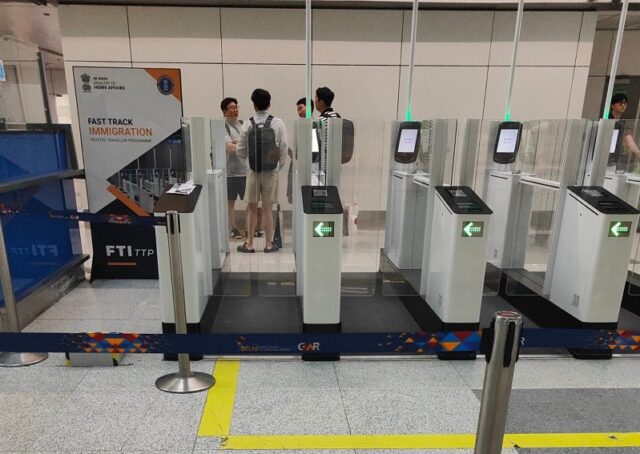
Fast Track Immigration Trusted Traveller Programme 2025 enhances airport clearance, enabling OCI cardholders and frequent travellers to clear immigration in 30 seconds. Check new airport expansions and registration details.
Fast-Track Immigration – Trusted Traveller Programme Expanded to 13 Airports
Introduction: What Is the FTI-TTP
India’s Union Home Minister, Shri Amit Shah, recently inaugurated the Fast Track Immigration – Trusted Traveller Programme (FTI-TTP) at five additional airports—Lucknow, Thiruvananthapuram, Trichy, Kozhikode, and Amritsar—via video conferencing. The programme, intended to speed up immigration clearance, reduces delays by enabling immigration formalities in just 30 seconds for registered travellers.
Expansion to More Airports
Originally launched in 2024 at Delhi airport, the FTI-TTP had already been implemented at several major international airports: Mumbai, Chennai, Kolkata, Bengaluru, Kochi, and Ahmedabad. With the recent addition of the five airports, the total number of airports under the programme has risen to thirteen. Plans are underway to extend it further to the new airports at Navi Mumbai and Jewar.
How the Programme Works: Enrollment and Process
Interested travellers register on the portal ftittp.mha.gov.in, where they fill in their personal details and upload required documents. Biometric data is collected either at a Foreigners Regional Registration Office (FRRO) or during an airport transit. On arrival at an enrolled airport, travellers use e-Gates—scanning passport and boarding pass—and after biometric verification, the e-Gate opens automatically. This removes the need to stand in manual immigration queues.
Traveler Uptake & Performance
As of the latest report, approximately 3 lakh travellers have registered for the programme, of whom 2.65 lakh have used it. Feedback has been largely positive, especially regarding speed and convenience.
Significance and Broader Impacts
- The expansion of FTI-TTP aligns with the Indian government’s push for modernization and digital transformation in its public services.
- It is especially beneficial for OCI cardholders (Overseas Citizens of India), who often face longer processes for immigration formalities; this programme may reduce redundancy (e.g., requiring separate documentation or fingerprinting).
- The sharp growth in international travel demands improved infrastructure and efficient processes; the passenger numbers have gone up significantly over the past decade.

Why This News Is Important
Enhancing Travel Efficiency & Security
For competitive exams, this news showcases India’s efforts to balance traveler convenience with national security. Fast-track immigration reduces waiting times while retaining biometric and document verification—both important from a governance, administrative law and public policy point of view.
Relevance for Multiple Exam Syllabuses
- For Civil Services / UPSC: It’s relevant under topics like internal security, governance reforms, migration law, and India’s border management.
- For Defence / Police / Security Forces: The process involves identity verification, which ties into law enforcement, immigration control and cross-border security.
- For Railways / Banking / Teaching exams**: Improved travel infrastructure and technology adoption (digital services, biometric-based systems) are generic current affairs topics that often come up in “General Knowledge” and “General Studies” sections.
Policy and International Relations Aspect
By improving facilities for OCI cardholders and foreign visitors, India signals its openness and aims to raise its ranking in global travel ease indices. This has tourism, investment, and diplomatic implications. For example, smoother immigration encourages foreign investment, visitors, and diaspora engagement.
Historical Context
Earlier Immigration Processes and Challenges in India
India has long grappled with challenges at airports: long queues, delays in manual document/manual immigration checks, inefficiency due to paperwork and human bottlenecks. Especially during peak hours, immigration could take tens of minutes, even hours.
Use of Technology & E-Gates Globally
Globally, many countries have adopted e-Gate, automated border control, and trusted traveller/registered traveller programmes. For instance, the US has Global Entry; Singapore has automated clearance; the EU operates automated border gates at Schengen entry points. These systems rely on biometric verification and pre-registration.
India’s Earlier Reforms
- The Indian government has introduced Passport Seva Project, e-visas, digital immigration forms, multiple checkpoints at airports with biometric readers.
- First implementation of FTI-TTP in 2024 at Delhi, then rollout to select high-traffic international airports. This expansion to 13 airports is part of that gradual scaling.
Key Takeaways from Expansion of FTI-TTP
| S. No. | Key Takeaway |
|---|---|
| 1 | The Fast Track Immigration – Trusted Traveller Programme (FTI-TTP) has been expanded to 13 airports, with five new additions: Lucknow, Thiruvananthapuram, Trichy, Kozhikode, Amritsar. |
| 2 | Immigration clearance for registered travellers under this programme can be completed in approximately 30 seconds using e-Gates with biometric verification. |
| 3 | ~3 lakh travellers have registered so far; 2.65 lakh have actually used the facility. |
| 4 | The programme is expected to be further extended to the upcoming Navi Mumbai and Jewar airports. |
| 5 | OCI cardholders are among those who will benefit greatly, especially because the programme aims to reduce repeated documentation/fingerprinting for foreign returnees. |
FAQs: Frequently Asked Questions
1. What is the Fast Track Immigration – Trusted Traveller Programme (FTI‑TTP)?
FTI‑TTP is an Indian government initiative to speed up immigration clearance for pre-registered travellers at select international airports using biometric e-Gates.
2. How many airports currently have the FTI‑TTP facility?
As of September 2025, FTI‑TTP has been implemented at 13 airports, including Delhi, Mumbai, Chennai, Bengaluru, Kolkata, Kochi, Ahmedabad, Lucknow, Thiruvananthapuram, Trichy, Kozhikode, and Amritsar.
3. How can a traveller register for FTI‑TTP?
Travellers can register online at ftittp.mha.gov.in by providing personal information and required documents. Biometric data is collected at FRROs or airport enrollment counters.
4. How much time does FTI‑TTP save during immigration?
Registered travellers can clear immigration in approximately 30 seconds, reducing waiting times compared to manual immigration counters.
5. Who can benefit the most from the programme?
OCI cardholders and frequent international travellers benefit most, as the programme reduces redundant documentation and repetitive fingerprinting.
6. Are there plans to expand FTI‑TTP further?
Yes, the programme is expected to extend to upcoming airports at Navi Mumbai and Jewar.
7. What is the purpose of e-Gates in the programme?
e-Gates allow biometric verification and automatic passport scanning, providing a secure, faster alternative to manual immigration.
8. Why is FTI‑TTP significant for exams like UPSC and PSC?
It is relevant for topics on governance, internal security, public policy, and digital infrastructure, often asked in General Studies papers.
Some Important Current Affairs Links