








Removable solar panel system at BLW Varanasi marks Indian Railways’ renewable energy milestone. Learn about the 15 KWp installation, features, benefits, and exam-relevant details for students.
Indian Railways Unveils India’s First Removable Solar Panel System Between Tracks
A Green Milestone in Rail Innovation
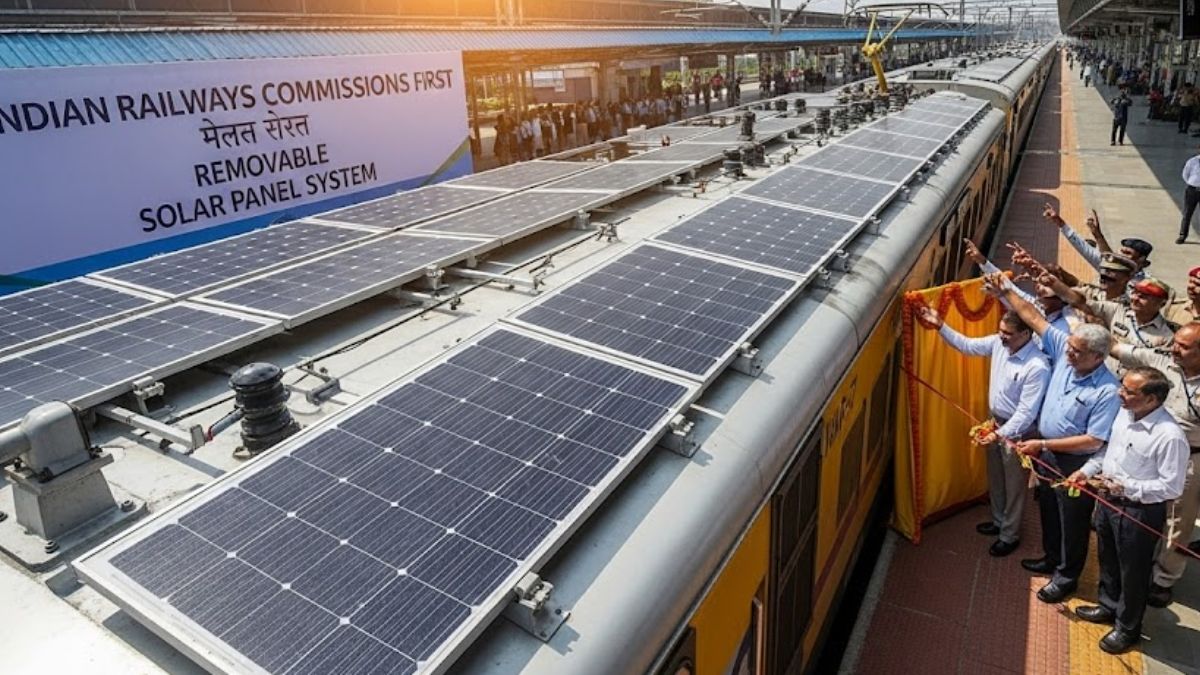
Banaras Locomotive Works (BLW) in Varanasi has pioneered a groundbreaking innovation by commissioning India’s first removable solar panel system installed between active railway tracks. Officially inaugurated on Independence Day (August 15, 2025) by BLW General Manager Naresh Pal Singh, this system was deployed along Line-19 of the BLW workshop
Ingenious Engineering: Installation and Design
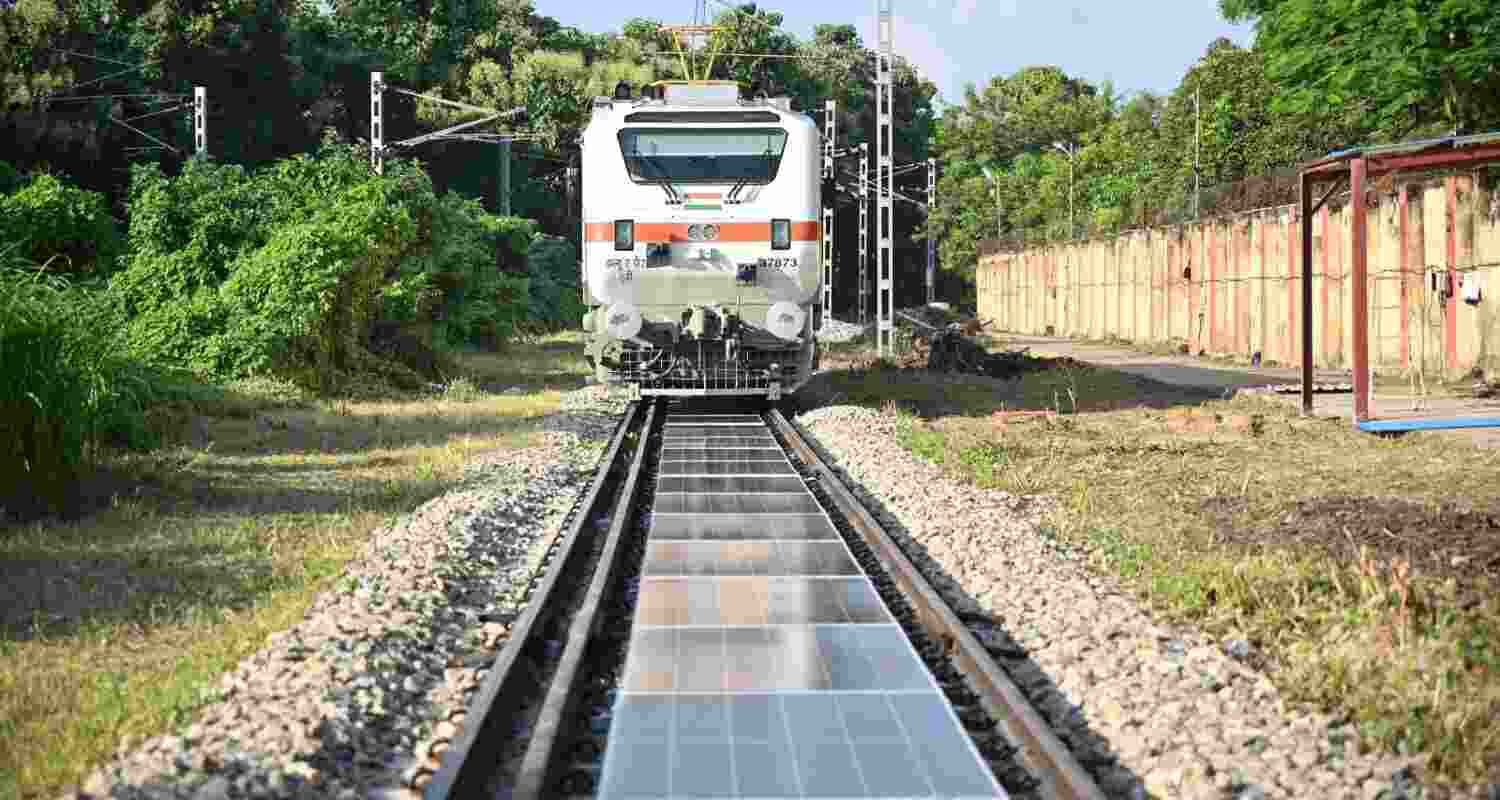
The solar panels are mounted directly atop concrete sleepers using a specially developed indigenous installation technique. To combat the intense vibration caused by passing trains, rubber pads act as cushioning, while epoxy adhesives provide a strong bond to the sleepers. The design allows quick removal—secured by just four stainless steel Allen bolts—for track maintenance without disrupting rail operations
Technical Highlights That Stand Out
- The system spans 70 metres and features 28 bifacial monocrystalline panels, totaling 15 KWp capacity.
- With an estimated power density of 220 KWp per km and energy yield of around 880 kWh per km per day, it’s efficient and effective
- Each panel measures 2278 × 1133 × 30 mm, weighs 31.83 kg, and boasts a module efficiency of 21.31% using 144 half-cut monocrystalline PERC bifacial cells, with IP-rated junction boxes and a maximum voltage of 1500 V
Sustainable Scale and Strategic Advantage
This innovative solution uses otherwise idle track space, bypassing the need for land acquisition. Projections estimate that if deployed across the Indian Railways network, it could generate about 321,000 kWh per kilometre annually, aligning closely with the railway’s net-zero carbon emissions roadmap The initiative complements BLW’s existing rooftop solar installations and marks an important leap towards sustainable, renewable energy in rail transport
Why This News Is Important
Green Energy Meets Infrastructure Innovation
This project exemplifies how Indian Railways is reimagining its physical infrastructure as an asset in the renewable energy ecosystem. By integrating solar panels into track infrastructure, the railways effectively unleash untapped potential in everyday railway architecture.
Operational Efficiency Without Disruption
The detachable, modular design ensures that routine maintenance and service operations remain uninterrupted. Such seamless integration of clean energy solutions speaks to Indian Railways’ pragmatic and forward-thinking approach.
Scaling with Impact
Given India’s expansive rail network—spanning over 1.2 lakh km—this initiative has extraordinary replication potential. It promises not only carbon mitigation but also energy self-sufficiency without additional land investment.
Reinforcing National Sustainability Goals
This innovation aligns with the national agenda for reducing carbon footprints and moving toward energy independence. It underscores Indian Railways’ role as a frontrunner in public sector green innovation.
Historical Context: Sustainable Railways on the Move
Indian Railways has long journeyed toward becoming an eco-friendly behemoth. Past efforts include widespread electrification, installation of over 200 MW rooftop solar capacity at thousands of installations, bio-toilet deployments, and water recycling systems at major stations. BLW itself transitioned from primarily manufacturing diesel locomotives to producing electric engines, which now number in the thousands
The new between-track solar installation perfectly embodies this evolution—from reliance on fossil fuels to robust renewable infrastructure. It reflects not just a technical milestone but also a broader shift toward smart, sustainable public infrastructure solutions in India.
Key Takeaways from “Removable Solar Panel System Between Tracks”
| S. No. | Key Takeaway |
|---|---|
| 1 | Banaras Locomotive Works (BLW), Varanasi, installed India’s first removable solar panel system between operational railway tracks. |
| 2 | The installation spans 70 metres, includes 28 bifacial monocrystalline panels, with a combined capacity of 15 KWp. |
| 3 | Panels are mounted on concrete sleepers using rubber pads and epoxy adhesives, ensuring vibration resistance and easy removal for maintenance. |
| 4 | The system delivers 220 KWp per km power density and 880 kWh per km per day energy output, with an estimated 321,000 kWh/year/km potential network-wide. |
| 5 | This initiative supports renewable energy expansion, avoids land acquisition, and strengthens Indian Railways’ push toward net-zero carbon emissions. |
FAQs – Frequently Asked Questions
Q1. Where was India’s first removable solar panel system between railway tracks installed?
It was installed at Banaras Locomotive Works (BLW), Varanasi.
Q2. What is the total capacity of the removable solar panel system installed at BLW?
The system has a total installed capacity of 15 KWp.
Q3. What unique feature makes this solar system different from traditional solar setups?
It is removable and can be detached using only four Allen bolts, allowing track maintenance without disruption.
Q4. How much power density does the system provide per kilometre?
It delivers around 220 KWp per km.
Q5. How much annual energy yield is expected per kilometre if the system is scaled across Indian Railways?
The estimated yield is 321,000 kWh per kilometre annually.
Q6. Why is this solar project important for Indian Railways?
It utilizes unused track space, reduces dependence on land acquisition, and supports the net-zero carbon emissions goal.
Q7. Which type of solar panels have been used in this system?
Bifacial monocrystalline panels with 144 half-cut PERC cells.
Q8. What materials are used to ensure vibration resistance of the panels?
Rubber pads for cushioning and epoxy adhesives for firm bonding.
Q9. When was this system officially inaugurated?
On 15th August 2025 (Independence Day).
Q10. How does this initiative align with India’s broader energy goals?
It supports renewable energy expansion, contributes to sustainability, and strengthens India’s energy independence roadmap.
Some Important Current Affairs Links